
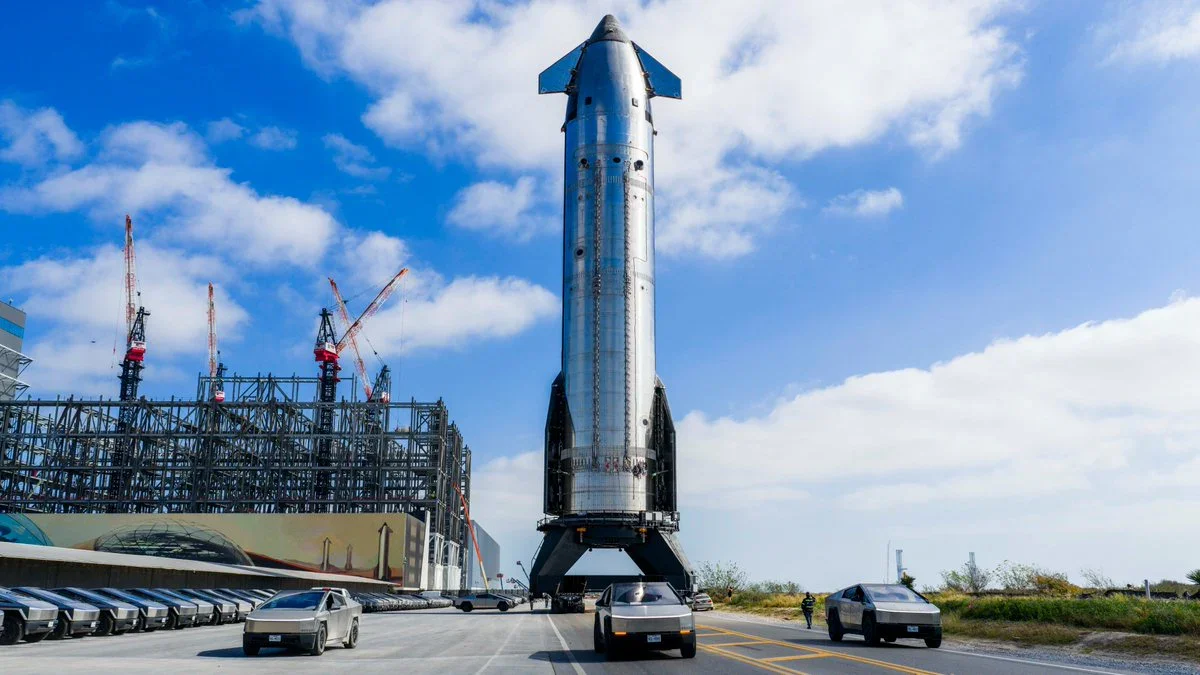
Starship V3: Doubling Saturn V Thrust to Unlock Million-Ton Orbital Capacity and Space AI
How rapid reusability and purpose-built satellites shift compute infrastructure from ground constraints to solar-powered orbital scale
Starship Version 3 produces more than twice the thrust of the Saturn V rocket that powered the Apollo program. Version 4 extends that margin toward three times the historic benchmark. These gains, paired with flight rates exceeding one per hour, move annual mass delivery to orbit from roughly 2,500 tons industry-wide today to the million-ton range within about three years. The same vehicles that enable this throughput also support a new generation of satellites optimized for AI workloads, where solar arrays generate power and radiators reject heat directly into space.
Key Takeaways
Starship V3 thrust exceeds twice the Saturn V level, with Version 4 approaching three times that output, directly multiplying payload mass per flight.
Mature operations target launch cadence above one flight per hour, turning space access into high-volume industrial activity rather than episodic events.
SpaceX currently delivers 85–90 percent of all mass placed into Earth orbit; Starship operations aim to expand total global capacity by orders of magnitude.
Annual mass to orbit could scale from approximately 2,500 tons to over one million tons per year within roughly three years once Starship reaches full cadence.
Recent record payloads represent only a small fraction of what operational V3 vehicles will carry routinely on each flight.
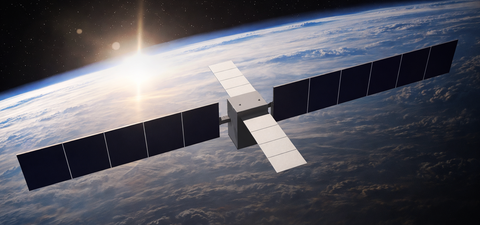
Orbital AI platforms take the form of compact satellites rather than conventional data-center buildings lifted into space, focusing on integrated power generation and thermal rejection.
AI satellites require less hardware complexity than Starlink units, needing primarily solar cells, radiators, and laser links instead of large phased-array antenna systems.
Early AI satellite designs target 150 kilowatts peak power while sustaining about 120 kilowatts of continuous compute, based on actual large-scale AI cluster performance.

AI Infrastructure Takes Flight: Building Compute Capacity in Orbit to Approach Stellar Energy Scales
Reusable heavy-lift systems and purpose-built satellites with integrated solar power and thermal management offer a route to scale AI far beyond what terrestrial grids and land can support, while advancing an objective benchmark for civilizational capability.
Earth’s surface imposes hard limits on power generation and heat dissipation that become increasingly binding as AI workloads grow. Shifting key elements of compute infrastructure into low Earth orbit allows direct collection of solar energy and efficient radiation of waste heat into the vacuum of space. Achieving this at meaningful scale depends on the ability to deliver enormous quantities of hardware to orbit at low cost, which in turn rests on achieving full rapid reusability for the largest launch vehicles ever developed. Over longer horizons, establishing production and launch capabilities on the Moon could multiply the feasible throughput by additional orders of magnitude.
Key Takeaways
Civilizational advancement can be tracked objectively by the share of available energy harnessed, beginning with a planet’s resources and progressing to a star’s output and ultimately a galaxy’s.
Human activity currently captures only a tiny fraction of Earth’s incident solar power and a vanishingly small portion of the Sun’s total energy production.
Orbital placement removes the need for massive ground-based power infrastructure and simplifies cooling, since heat can radiate freely into space without atmospheric interference or large cooling towers.
Full and rapid reusability of launch vehicles transforms the economics of space access, making it possible to move from thousands of tons to millions of tons delivered to orbit each year within a short timeframe.
Satellites dedicated to AI compute can be engineered with fewer complex subsystems than communications satellites, centering on large solar arrays, double-sided radiators, and dense racks of high-power chips linked by laser communications.
Early orbital units are sized around 150 kilowatts of peak power and 120 kilowatts of sustained compute, comparable to a single advanced GPU rack, with laser connections providing low-latency integration into broader networks.
Meeting the chip volumes required for terawatt-scale orbital compute will necessitate fabrication facilities on a scale far exceeding today’s largest plants, targeting output equivalent to a billion kilowatt-class chips annually.
Extending operations to the lunar surface enables local manufacturing of solar arrays and radiators plus electromagnetic acceleration systems that can launch finished satellites into space without traditional rockets, opening pathways to thousandfold further growth.
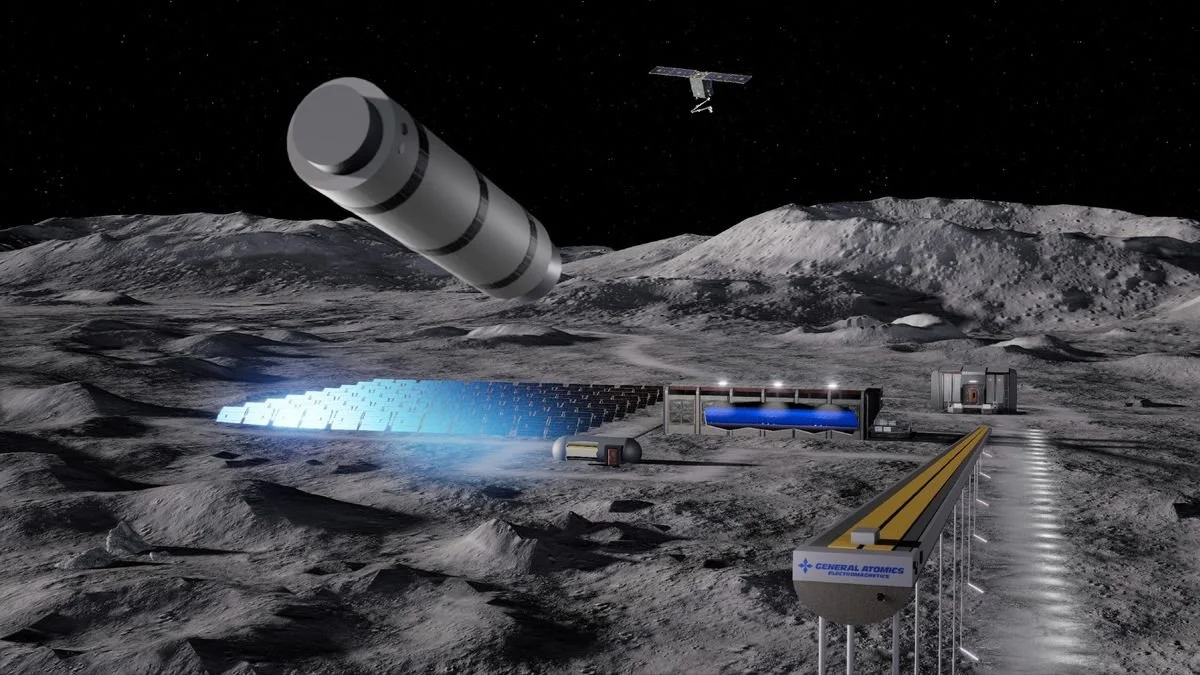
Stop Thinking Small: The Moon as the Gateway to Kardashev-Scale Energy and Compute
Lunar in-situ manufacturing combined with electromagnetic mass drivers creates a practical route to 1,000x energy growth and large-scale deployment of AI satellites in deep space.
Current terrestrial limits on land, materials, and launch costs cap how far energy production and computational infrastructure can scale. Shifting the bulk of manufacturing to the Moon and using its physical properties for efficient electromagnetic launches removes those ceilings. The result is a system capable of producing and deploying the massive solar arrays, radiators, and AI-optimized satellites required to push civilization measurably closer to stellar energy levels.
Key Takeaways
Global energy use sits at roughly 20 terawatts today; even a 1,000x increase remains a small fraction of the output needed for Kardashev Type II status.
The Moon’s one-sixth Earth gravity and total lack of atmosphere allow local production of heavy components like solar panels and thermal radiators with far lower energy input than lifting equivalent mass from Earth.
Electromagnetic mass drivers function as long linear motors that accelerate payloads to lunar escape velocity without onboard propellant, enabling high-volume launches of finished satellites into deep space.
In-situ resource utilization on the Moon means most of the mass for solar power systems and satellite structures comes from lunar regolith rather than Earth shipments.
AI satellites gain continuous solar power and the large radiator surfaces needed for heat rejection in vacuum—both difficult to scale when everything must launch through Earth’s atmosphere and gravity well.
Industrial-scale lunar operations create the logistics backbone that simultaneously makes routine human access to the Moon feasible and affordable.
Reusable heavy-lift rockets handle the initial delivery of specialized equipment and crews, after which lunar production takes over for bulk materials and reduces long-term Earth dependency.
The Orbital AI Revolution: Why a Million Satellites Will Soon Power Every Major AI Model
Earth’s power grids are hitting a hard wall just as AI demand explodes. The solution? Move the data centers to space—where solar energy never stops and cooling is free.
The AI boom is real, but the infrastructure to run it is not. Tech giants have already committed three-quarters of a trillion dollars to data centers for 2026 alone, yet electricity shortages are forcing delays, cancellations, and even regulatory caps in key markets. At the same time, a handful of companies have quietly proven that full AI models can run on actual data-center chips in orbit. The economics, physics, and full-stack control now align to make orbital compute not just possible—but inevitable.
Key Takeaways
Global AI spending hits a record $1 trillion in 2026, but electricity—not money—is the real bottleneck, with major hubs like Northern Virginia maxed out until 2028 and countries like Singapore limiting new builds.
A single NVIDIA H100 chip has already run complete large language models in orbit 325 km above Earth, transmitting results back to the ground in real time.
Orbital solar power delivers roughly five times the efficiency of ground systems thanks to constant sunlight and no atmosphere, while deep-space radiative cooling at near-absolute zero eliminates the billions of gallons of water and massive energy overhead required on Earth.
Launch costs are collapsing: Starship targets under $200 per kilogram (and eventually $20), turning maintenance, redundancy, and refresh cycles from impossible to routine.
One company controls the entire vertical stack—reusable rockets, custom space-optimized chips, ground superclusters, and the world’s largest satellite constellation—positioning it to deploy the first million-satellite orbital data-center network.
Major cloud providers and rocket competitors are accelerating their own orbital plans, creating a high-stakes race that will define the next decade of compute infrastructure.
A pending IPO includes explicit performance milestones tied to 100 terawatts of space-based compute capacity—the power equivalent of 85 billion average U.S. homes.
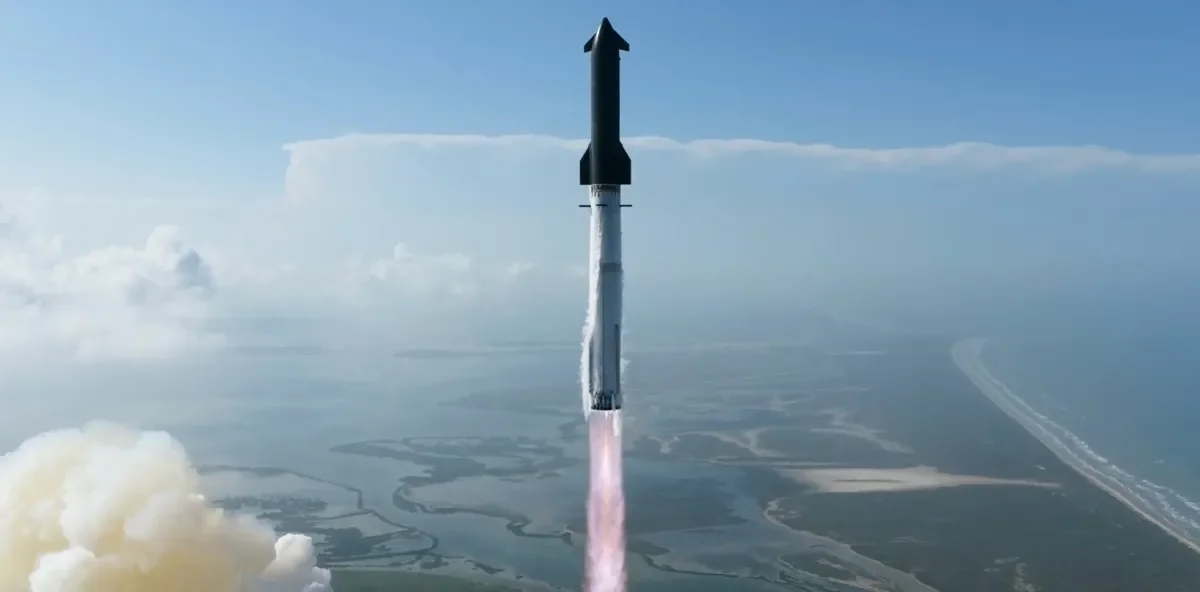
Starship V3 Takes Flight: The Dawn of a New Era in Reusable Spaceflight
Hot staging success, in-space heat shield imaging, and flap stress tests mark major milestones in the push for rapid reusability and massive Starlink deployment.
Starship Version 3 just completed its first flight test, delivering a masterclass in engineering progress. The redesigned vehicle lifted off flawlessly, executed a textbook hot staging separation, deployed a full payload of next-generation satellites while in orbit, and survived an intentionally aggressive reentry that tested its heat shield and structural limits—all while streaming live views back to Earth. These results accelerate the timeline for fully reusable heavy-lift operations and the kind of Starlink constellation scale that changes global connectivity economics.
Key Takeaways
All 33 Raptor 3 engines ignited cleanly on the Super Heavy booster at liftoff, carrying the stack through maximum dynamic pressure without issue.
Hot staging worked on the first attempt for Version 3: the ship’s six engines lit while still attached to the booster, clamps retracted safely, and separation occurred cleanly.
The ship demonstrated strong engine-out capability after losing one Raptor Vacuum engine mid-ascent, gimbaling the remaining engines to maintain trajectory and completing a suborbital mission on five engines.
An upgraded PEZ dispenser deployed 22 satellites—20 Starlink mass simulators plus two specialized “Dodger Dog” units—in record time, previewing the system’s ability to handle up to 60 full V3 Starlink satellites per flight.
Two free-flying satellites equipped with cameras and high-powered flashlights successfully imaged Starship’s heat shield from orbit in real time, a critical data point for future tower catches.
The ship intentionally stressed its aft flaps with a high-Mach “flap slap” maneuver, passed peak heating and peak dynamic pressure, executed a return-to-launch-site-style banking turn, and performed a two-engine landing burn before a soft splashdown in the Indian Ocean.
Experimental heat-shield tiles bonded with new methods on the leeward side held firm through ascent and reentry, delivering actionable data for future flights.