

Key Takeaways from Tesla's Q2 2025 Earnings Call: AI Dominance and the Road Ahead
Tesla's latest earnings reveal a bold pivot to AI-driven growth, with humanoid robots and autonomous tech set to unlock trillion-dollar markets amid short-term financial hurdles.
Tesla's Q2 2025 results underscore a strategic shift toward artificial intelligence and autonomy, positioning the company to lead in transformative sectors like robotics and self-driving vehicles. While near-term earnings face pressure, the focus on scalable AI solutions promises massive long-term value, drawing from expertise in manufacturing, energy, and real-world data.
Key Takeaways
Earnings are expected to stay below prior peaks for at least the next year, potentially leading to flat or declining stock performance unless market multiples rise.
The company is fully committed to AI and autonomy, with all initiatives aligned around advancing robotaxis, humanoid robots, and energy storage.
Leadership expresses strong confidence in dominating future markets through these technologies, backed by plans to use debt if needed to fund capital expenditures.
Market valuation treats Tesla as an AI powerhouse, far exceeding projections from vehicle sales or energy growth alone, with investors eyeing robotaxi rollout speed and profitability.
Humanoid robots could prove viable through cost reductions in factories or sales for urban services, tapping into high-labor-cost industries.
Unsupervised full self-driving capabilities represent the critical threshold for mass adoption, far outpacing current supervised systems in appeal.
Batteries remain essential for balancing energy supply and demand fluctuations, ensuring ongoing demand as global consumption grows.
Progress in AI aspirations can sustain high valuations, enabling self-funding, but any setbacks in robotaxis or bots could trigger sharp declines.
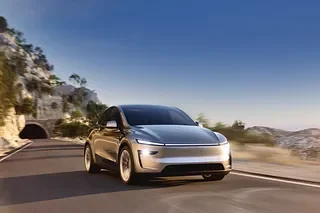
Tesla's Model Y L Ushers in a New Era of Affordable Family EVs and Autonomous Rides
Expanding Tesla's lineup with a stretched, six-seater crossover that bridges gaps in the market while amplifying robo-taxi potential.
Tesla just dropped details on its latest vehicle, the Model Y L, a longer-wheelbase version designed for families needing more space without breaking the bank. This move not only plugs a hole in the affordable three-row EV segment but also ties into broader shifts like robo-taxi fleets and AI integrations that could redefine personal transport. For tech fans eyeing sustainable mobility, this signals Tesla ramping up production efficiency and versatility in a competitive landscape.
Key Takeaways
The Model Y L extends the standard model by 7 inches, adding a usable third row for six passengers, starting around $60,000 in China with potential U.S. pricing between the Model Y and Model X.
It positions Tesla stronger against rivals like the Kia EV9 and Rivian R1S by offering a more affordable three-row EV option.
Robo-taxi services in Austin are expanding, with seamless autonomous rides becoming practical for daily use, costing under $15 round-trip for urban commutes.
This vehicle enhances Tesla's robo-taxi strategy, enabling higher-capacity rides beyond the upcoming two-seater Cybercab, potentially scaling to millions of units annually.
Speculation points to phasing out older models like the S and X to free up factory space for high-volume production or new ventures like drones or AI devices.
Grok AI is rolling out as a car assistant, paving the way for voice-activated features and cross-device integration, potentially challenging smartphone ecosystems.
Overall, these developments aim at sustainable abundance, prioritizing mass-market EVs and AI-driven autonomy over luxury niches.
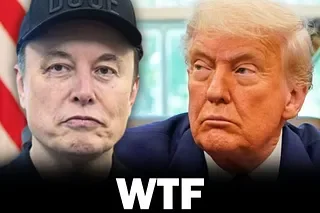
Tesla's Wild Ride
Musk vs. Trump Round Two Rocks Markets
The EV giant's stock tumbles 7% as its CEO launches a new political movement while sparring with the president over subsidies and spending
The tech world woke up to fireworks this Tuesday as two of America's most prominent figures locked horns over government spending, subsidies, and the future of American politics. What started as a disagreement over legislation has spiraled into a full-blown feud with major implications for Tesla investors and the broader tech ecosystem.
Key Takeaways
Tesla stock plunged 7% at market open amid investor concerns over Musk's latest political ventures
Musk announced formation of the "American Party" aimed at primarying Republicans who support the current spending bill
Trump suggested investigating deportation of Musk and redirecting DOGE efforts to examine his government subsidies
The dispute centers on a major spending bill that would extend Trump-era tax cuts while potentially eliminating EV tax credits
Congressional approval ratings sit at 23%, creating an opening for political disruption
Tesla faces headwinds from soft global auto sales, reduced cash flow, and dependency on unproven robotaxi technology
Polls show even Musk supporters prefer him to stay out of direct political leadership roles.

SpaceX's Path to $12.8 Trillion
Why the Space Economy's Future is Bigger Than You Think
What if Mars isn’t just a science project—but an actual line item on a trillion-dollar balance sheet?
A groundbreaking new valuation model from ARK Invest and Mach 33 suggests that SpaceX could become the most valuable company in history, with base-case projections reaching $2.5 trillion by 2030 and $12.8 trillion by 2040. And that’s just the middle scenario.
The model goes beyond speculative hype. Built using Monte Carlo simulations and more than 50 variables, it charts a future where Starlink generates massive global cash flows through 2035—then shifts entirely to funding Mars development. At the heart of the plan? Not astronauts. Not colonies. But a million Optimus robots working on Mars by 2040.
Starlink becomes the cash engine. Starship becomes the logistics network. Optimus becomes the labor force. And Mars becomes the next economic frontier—not through abstract sci-fi dreams, but infrastructure, book value, and scalable industrial development.
Inside this analysis:
Why Starlink’s economics are better than most investors realize
How Wright’s Law is driving down satellite costs faster than Moore’s Law
Why competition like Amazon Kuiper may never catch up
What 100+ Starship launches per year really signals
How SpaceX plans to shift from internet provider to interplanetary builder
Why the first Martians will be robots—and why that changes everything
And what the model doesn’t include that could push valuations even higher
This isn’t just about satellites or space travel. It’s the dawn of a new industrial age—off Earth.