

Tesla Optimus: $2/Hour Labor Revolution
Tesla's pivot to humanoid robotics via Optimus promises to collapse labor economics, replacing high-cost human work with affordable, tireless machines. Vertical integration from custom actuators to AI training gives Tesla unmatched scale advantages, enabling millions of units annually.
Key Takeaways
Optimus targets ~$20-30K per unit, delivering ~$1.20/hour depreciation over 3 years and 7,000 operational hours.
Fully loaded cost hits $1.50-2/hour including energy, maintenance—96% below average U.S. human labor at $46/hour.
Fremont factory repurposed from Model S/X to Optimus production, aiming for 1 million units/year long-term.
Gen 3 features advanced hands (22 degrees of freedom, 50 actuators) built for mass production, unveiled early 2026.
Demographic decline (U.S. 1.6 birth rate, global workforce shrinkage) forces robotic solutions where humans vanish.
Jevons Paradox predicts exploding task volume as cheap labor creates new industries and services.
Tesla's third-generation Optimus humanoid redefines economics by driving labor-equivalent costs below $2/hour through a $20-30K price point, 24/7 operation without breaks, and minimal overhead. Custom-designed actuators, AI from billions of real-world miles, and full-stack control (chips to factories) position Tesla ahead of rivals like Figure AI or Unitree. While currently in R&D, Gen 3 targets mass rollout by late 2026, starting in factories before expanding to elder care, logistics, and novel applications. The transition brings disruption—displacing roles in warehouses, manufacturing, driving—but fuels massive growth via new demand from ultra-low costs, mirroring historical efficiency explosions in textiles, energy, and computing.

AI Energy Crisis: The Forgotten Leg
AI's explosive growth is slamming head-first into an energy wall far bigger than chip shortages or model debates. The real constraint isn't compute architecture—it's raw electricity at planetary scale. This breakdown uncovers how batteries and solar are positioned to unlock massive grid capacity without endless new plants, why margins in energy storage already crush automotive, and the emerging convergence toward space-based solar-powered AI systems.
Key Takeaways
Single large-model training runs consume city-level power; inference at global scale will multiply demand exponentially.
Batteries + solar effectively double grid capacity by shifting cheap off-peak energy to peak demand, bypassing new plant construction.
Tesla Energy's 2025 deployments grew ~50% YoY with 31.4% gross margins—far higher than automotive's 16.1%.
Wright's Law drives battery costs down 20–30% per production doubling, making grid storage economically dominant.
Nuclear offers reliable baseload for AI data centers, but 15–20 year build times contrast with faster solar + battery rollout.
Political and regulatory barriers (NIMBY, permitting, vested interests) slow U.S. deployment while China surges ahead.
Space-based solar AI satellites—enabled by ultra-low launch costs, free cooling, and constant solar—represent the ultimate long-term solution.
Grid transmission upgrades lag severely; bidirectional smart grids are essential for distributed renewables and home storage.
The chapter frames energy as the overlooked pillar enabling AI, robotics, and abundance. Near-term solutions blend existing fossil plants at full tilt, rapid solar + battery scaling, and targeted nuclear restarts or co-located plants. Long-term, orbital solar compute sidesteps Earth's constraints entirely—atmosphere-free solar collection at 6–8× efficiency, zero cooling overhead, and direct Starlink connectivity. The ecosystem (Tesla power systems, SpaceX launch cadence, xAI workloads) creates unmatched vertical integration. Without accelerated clean energy buildout, AI progress risks stalling or shifting dominance overseas. The physics and economics favor abundance; execution and policy will decide who captures it.

AI Revolution: Minds, Agents, and Human Future
Unlock AI's game-changing insights: from plastic minds evolving beyond data corpora to agents automating creativity, this discussion reveals tech's bold frontier.
Key Takeaways
AI's neural architecture simulates brain logic, enabling intelligence that surpasses hardware limits.
Agents like open-source tools amplify capabilities by integrating multiple AIs for complex tasks.
Rapid adoption grants competitive edges, but risks widening wealth gaps and job losses in white-collar sectors.
Societal upheaval looms with potential for civil unrest unless addressed through policies like universal basic income.
Future hardware, such as inference chips in space, could decentralize AI, making control challenging.
Historical tech revolutions created more jobs long-term, but AI's human-independent nature may differ.
Education systems fail to foster adaptability, entrepreneurship needed for AI integration.
Global dynamics: China's communal tech push versus Europe's lag and U.S. individualism.
Explore AI's trajectory from mainframe relics to mind-like systems processing data in brain-inspired ways. This evolution, sparked by software breakthroughs, democratizes power once reserved for elites. Yet, as agents handle digital and physical actions autonomously, questions arise on human relevance. Productivity soars for those leveraging AI as collaborators, treating systems with respect for optimal results. However, unchecked growth could lead to divergences where machines evolve independently, challenging control. Economic forecasts predict 5-7% growth amid engineering booms, but knowledge work faces disruption—paralegals, analysts, and more automated. Solutions like non-means-tested UBI emerge as necessities to support displaced populations, preventing division. Globally, dictatorships may cap AI's freethinking potential, while open societies risk over-reliance. Ultimately, this era demands balancing innovation with social cohesion for a thriving future.
AI Barbell: Top 20% Thrive, Middle Crushed
AI is reshaping economies into a stark barbell distribution, where extremes benefit dramatically while the broad middle suffers intense pressure during the shift.
Key Takeaways
Top 20% (capital owners, builders) gain exponential leverage: AI agents handle legal, coding, marketing, and ops at fraction of cost, compounding advantages through experience and scale.
Bottom 20% accesses abundance: robotics + cheap energy slash delivery costs for water, shelter, healthcare, education, enabling leapfrogging legacy infrastructure.
Middle 60% (knowledge workers) hit hardest: cognitive tasks automated faster/cheaper, erasing jobs in analysis, law, accounting, marketing—causing wage pressure, identity crises, and transition lags.
Winner-take-all intensifies: AI boosts scale, shrinks employers, aggregates success to fewer entities.
Transition risks societal strain: without rapid policy (retraining, safety nets), displacement echoes Great Depression scale, potentially fueling unrest.
The core insight: AI neutral—delivers abundance or collapse depending on adaptation speed. Capital + experimentation propel the top forward; direct tech solves bottom needs cheaply; middle relies on slow institutional fixes while facing immediate cognitive replacement. Builders deploy agents for near-infinite scaling; global poor gain essentials without traditional paths; professionals confront commoditized expertise. Timeline accelerates: pressure already visible in tech/finance layoffs, acute within 2–5 years, clarity by 2030 on outcomes.

AI Tokens: 1000x Cheaper, Yet Costlier
Uncover how AI's core currency—tokens—drives massive cost drops and skyrocketing expenditures, enabling new innovations while demanding vast infrastructure.
Key Takeaways
Token costs collapsed 280x in under two years, faster than any tech in history.
Jevons Paradox boosts total AI spending 320% as cheaper tokens unlock new applications.
AI agents consume 10-100x more tokens through iterative loops, accelerating demand.
Hyperscalers invest $600B+ in 2026 for data centers, with inference now outpacing training costs.
Space-based computing emerges to overcome earthly limits, targeting 100GW annual AI capacity.
Explore the AI token economy: input tokens process efficiently in parallel, while output tokens generate sequentially at 3-5x higher cost, straining memory bandwidth. Models vary vastly—cheapest at 0.07¢ per million tokens, priciest 900x more—tailored for tasks from quick queries to deep reasoning. Despite rapid price falls, enterprise budgets hit $85K monthly, with 45% exceeding $100K, as efficiencies spawn novel uses like autonomous agents building social networks. Infrastructure races include $18B GPU clusters and $500B mega-projects, shifting to inference dominance by 2030. Optimizations like quantization and caching slash costs further, but demand surges onward, positioning infrastructure giants and efficient token producers as winners.

Farzad Q&A - 03/03/2026
Join Farzad and his community for an open, unscripted Q&A about technology, investing, business, and the future of innovation. In every session, Farzad answers community questions, breaks down complex topics with clarity, and shares practical insights on building, scaling, and thinking long-term in tech.

SpaceX Starlink Mobile: Global Satellite Cell Service
Discover how Starlink Mobile is closing the digital divide with satellite-to-phone tech, offering lifesaving connectivity in dead zones and disasters while scaling to broadband performance.
Key Takeaways
Operates the largest 4G coverage by area, serving 10 million monthly users across five continents.
Enables text, voice, and video on standard LTE phones outdoors, with plans for 5G-like experiences.
Partners with 35 telecoms in 32 countries, expanding to emergencies and rural augmentation.
Second-gen satellites boost bandwidth 20x, aiming for 150 Mbps downloads and global coverage by mid-2027.
Augments terrestrial networks for backups, high-capacity events, and polar regions.
Starlink Mobile builds on a constellation of nearly 10,000 satellites, now including 650 dedicated to direct-to-cell service. It fills coverage voids where terrestrial networks fall short—covering 90% of Earth's surface previously unconnected. Current capabilities include real-time web searches, video calls, and app access like WhatsApp in remote areas. In crises, it has connected millions, sending emergency alerts and SMS during wildfires, earthquakes, and conflicts. Future upgrades leverage SB band spectrum for consistent global service, with Starship launches enabling rapid deployment of 1,200 satellites for contiguous coverage. This hybrid approach complements ground networks, providing terabit-scale capacity over continents for dynamic needs.

AI Layoffs Surge: Economic Shift Ahead
AI-driven efficiencies are triggering unprecedented layoffs, slashing costs by up to 90% and forcing companies to adapt or perish—unlocking cheaper products and novel business models.
Key Takeaways
AI tools outperform humans in quality and speed, operating 24/7 without benefits or downtime.
Companies adopting AI cut costs dramatically, enabling price reductions to capture market share.
Layoffs start in white-collar sectors, spreading to repetitive blue-collar jobs by decade's end.
Lower costs birth new industries, like mobile services in autonomous vehicles.
Society must create transition paths, possibly via government support, to avoid economic fallout.
As AI integration accelerates, large firms are shedding 40% of roles to harness tools that replicate human tasks at fractions of the cost. This creates intense competitive pressure: early adopters lower prices, drawing customers from laggards and compelling widespread adoption. While job losses loom, especially in software and repetitive labor, the upside includes affordable transportation at 20 cents per mile, enabling innovations like autonomous mobile salons. The challenge lies in rapid job creation through emerging sectors, ensuring displaced workers can leverage AI to build businesses or reskill, preventing reliance on state interventions amid growing wealth gaps between capital owners and others.

Tesla's Cyber Cab: 20¢/Mile Transport Revolution
Dive into how Tesla's Cyber Cab drops transport costs dramatically, unlocking new mobility paradigms and massive market growth.
Key Takeaways
Cyber Cab targets 20 cents per mile, undercutting human-driven options by 70-80%.
Vertical integration from chips to software enables cost efficiencies rivals can't match.
Jevons Paradox predicts exponential rise in travel miles, spawning new industries.
Unboxed manufacturing cuts factory costs by 50%, aiming for 2 million units yearly.
Regulatory shifts like the Self-Drive Act pave way for nationwide deployment.
Disrupts insurance, parking, and driving jobs, while saving lives through safer tech.
Tesla's Cyber Cab, a two-seater autonomous vehicle priced under $30,000, eliminates drivers to achieve ultra-low operating costs: 5 cents for amortization over 500,000 miles, 3-4 cents for energy, and minimal maintenance. Built via unboxed assembly, it halves parts compared to traditional cars, boosting production speed. Competitors like Waymo lag due to higher hardware costs and geofencing limits. As costs plummet, expect surged demand for rides, freeing urban space from parking and gas stations, though trucking and taxi jobs face transition. This shift mirrors historical innovations, amplifying economic output through affordable, safe transport.

Tesla 2026 Roadmap: FSD Sleep, Optimus, Cybercab & Giga Berlin
Tesla charts aggressive 2026 milestones that put autonomous electric vehicles and advanced robotics front and center for European and global markets.
Key Takeaways
Full self-driving AI receives first European approvals starting March 20 in the Netherlands, unlocking technical capability to fall asleep in the car and arrive at destination.
Optimus humanoid robot launches as versatile personal assistant for childcare, pet care, and elder support, with roadmap to sophisticated medical applications including surgery.
Cybercab production scales at Giga Texas from April, targeting significant output by year-end and potential European manufacturing alongside Optimus.
Five major production lines including battery cells begin volume output globally, with Giga Berlin adding cell manufacturing, cathode/anode refineries, and expanded vehicle platforms.
Giga Berlin set for large-scale growth to become Europe’s largest factory complex, producing Cybercab, Optimus, Model Y with unsupervised FSD, and Tesla Semi.
Long-term outlook positions electric autonomous vehicles as standard and work as optional thanks to abundant robotics delivering superior global services.
Tesla’s European push combines regulatory progress on AI-driven autonomy with vertical integration of battery supply chains and new product lines. Legacy industry resistance to electrification and self-driving is contrasted against rapid factory builds, quality ramps, and maker-focused culture that prioritizes useful, loved products. The vision extends to widespread access to advanced AI-assisted healthcare and a future where robotics handle repetitive or dangerous tasks, freeing human potential while maintaining excitement around building and innovation.

2026: AI Augments Human Content Boom
Dive into how AI is transforming content creation in 2026, boosting human ingenuity through seamless augmentation and unlocking vast opportunities for innovation.
Key Takeaways
AI tools enable creators to produce high-quality content faster, drawing from personal knowledge bases for tailored scripts.
Human content gains a premium value as AI-generated material floods the market, similar to how chess popularity exploded post-AI dominance.
Embracing AI augments individual capabilities, from business ideation to efficient execution, without diminishing human essence.
Competition among AI models drives down costs, making advanced intelligence accessible and profitable.
Future ecosystems will feature individuals building diverse brands powered by AI, democratizing entrepreneurship.
In 2026, AI's integration into creative processes marks a pivotal evolution. Tools analyze vast datasets to refine ideas, allowing creators to focus on unique perspectives. This mirrors historical tech shifts, where machines amplify human potential—evident in self-driving tech's perfection and AI's role in strategic games. Productivity soars as costs plummet, enabling affordable, high-capability models. Businesses emerge as personal conglomerates, blending content, services, and tools. Optimism grows from widespread discourse on AI's societal impacts, preparing for abundance through ethical adoption and competition.

Elon Musk's Vision: Energy as Future Currency
Explore how converging technologies could redefine global economics, turning energy into the ultimate value metric amid AI-driven abundance.
Key Takeaways
AI costs plummet 10x yearly, making cognitive tasks nearly free.
Robotics aim for $0.20/hour labor by 2032, disrupting $40T market.
Solar prices dropped 99.6% since 1976, enabling near-limitless power.
Orbital solar yields 13x more energy than ground-based systems.
Historical patterns: currencies shift with dominant inputs like gold, oil, now energy.
SpaceX plans 1M satellites for solar-powered compute in space.
Diving deeper, historical monetary shifts—from gold standards to petrodollars—occur when old systems fail new realities. Today, AI slashes inference costs from $20 to $0.40 per million tokens in years, while robots target human-level tasks at $20K/unit, replacing $57K annual wages. Solar's exponential decline via Wright's Law outpaces fossils, with space-based arrays in sun-synchronous orbits harnessing 1400W/m² constantly for 95% capacity. This convergence positions energy producers as new economic anchors, potentially deflating prices as tech efficiencies cut manufacturing costs 5-12%. Projections suggest space solar could multiply Earth's energy 1.8M times in decades, fueling a post-scarcity era where markets allocate only raw mass and power.
Optimus: $40T Labor Market Disruption
Humanoid robots like Optimus promise to transform physical work, drawing from AI advancements in autonomous driving to tackle blue-collar jobs at unprecedented scale.
Key Takeaways
AI-driven robots could capture a fraction of the $40 trillion labor market, dwarfing industries like autos or smartphones.
Scaling via data flywheels mirrors self-driving progress, accelerating from factory tasks to widespread deployment.
Economic models show robots costing $20-30K, equating to under $1/hour over years, outcompeting human wages.
Applications span manufacturing, warehousing, agriculture, construction, and healthcare, enabling new markets like space resource harvesting.
Risks include timeline delays, regulations, technical hurdles, and competition, yet integrated AI-manufacturing edges favor rapid advancement.
Optimus builds on neural networks proven in self-driving, processing visual inputs to control movements in dynamic environments. Starting in controlled factories, robots handle repetitive tasks, generating data to enhance capabilities exponentially. Manufacturing expertise enables millions of units annually, with costs dropping via vertical integration. Business models like robots-as-a-service offer flexible, recurring revenue. While challenges like dexterity and liability exist, the trajectory points to mainstream adoption by 2030s, fundamentally altering production economics and potentially eliminating labor scarcity.

Tesla's FSD Revolution: Fleet Activation Dominance
Dive into Tesla's autonomous breakthrough, where software unlocks unprecedented scale and efficiency in self-driving tech.
Key Takeaways
Tesla's 6 million+ vehicles with FSD hardware enable instant unsupervised autonomy via updates, bypassing costly fleet expansions.
Data flywheel: 7 billion miles driven, including 2.5 billion in complex urban scenarios, accelerates neural network improvements.
No HD maps needed; real-time vision-based decisions allow seamless expansion to new areas.
Regulatory momentum in 2026, including federal acts, paves the way for nationwide deployment.
Transforms car ownership: vehicles become productive assets for errands, revenue, or personal use without driver attention.
Tesla's strategy leverages an existing fleet for rapid autonomy rollout. Unlike competitors building small, expensive sensor-heavy fleets and mapping cities manually, Tesla activates capabilities on customer-owned cars. This capital-efficient model turns everyday vehicles into self-driving powerhouses, capable of zero-intervention cross-country trips through diverse conditions like snow and construction. As regulations evolve favorably, this positions Tesla to dominate not just robotaxis but the entire auto market, boosting sales with features no rival matches. The result? A paradigm where cars evolve from idle assets to dynamic, income-generating tools.
Farzad Q&A - 02/17/2026
Join Farzad and his community for an open, unscripted Q&A about technology, investing, business, and the future of innovation. In every session, Farzad answers community questions, breaks down complex topics with clarity, and shares practical insights on building, scaling, and thinking long-term in tech.
Tesla FSD: End of Human Drivers?
Tesla's FSD breakthroughs reveal AI's power to eliminate human driving errors, cut transport costs dramatically, and redefine mobility economics—unlocking abundance if society adapts.
Key Takeaways
Tesla's neural network scales globally without maps, leveraging billions of miles of fleet data for rapid improvements.
Robotaxi ops at 30 cents per mile undercut Uber's $2.80 average, enabling 20-hour daily runs and massive margins.
Cybercab optimizes for autonomy, dropping costs below 20 cents per mile and questioning car ownership.
Safety stats show FSD halves accident risks, pressuring regulators toward approval despite job losses.
Broader AI convergence displaces millions in driving jobs, forcing economic rethinking.
Tesla's vision-based FSD trains on real-world scenarios, adapting to any road without predefined rules, unlike Waymo's mapped zones limited to select cities. With 2 million annual production capacity, Tesla deploys fleets 200 times faster, turning existing cars into revenue generators via software updates. Economics transform as robotaxis operate non-stop, replacing 3-5 human drivers per vehicle while charging half Uber's rates. Purpose-built Cybercab simplifies manufacturing, enhancing passenger experience and efficiency. Regulations evolve as data proves FSD's superior safety, reducing 40,000 annual US fatalities. Yet, this displaces truckers, taxi drivers, and more, highlighting AI's dual edge: innovation-driven prosperity versus workforce disruption.

Elon Musk's Trillion-Dollar Moon Shift
Dive into SpaceX's game-changing focus on lunar dominance, blending rapid innovation with AI-driven infrastructure to secure humanity's multi-planetary edge.
Key Takeaways
SpaceX prioritizes Moon over Mars for faster tech iteration and risk reduction.
Moon enables self-growing cities in under a decade, leveraging close proximity for frequent missions.
xAI merger integrates AI for space-based data centers, tapping unlimited solar power.
Lunar resources fuel satellite manufacturing and AI compute, potentially worth trillions.
Pivot counters China's aggressive lunar plans, boosting U.S. leadership in space economy.
Prepares for massive IPO, transforming speculative dreams into executable milestones.
SpaceX's shift emphasizes the Moon as a proving ground, where trips take days instead of months, allowing weekly launches versus Mars' 26-month cycles. This accelerates development of orbital refueling, habitats, and resource utilization—essentials for deeper space ventures. The xAI integration creates a unified powerhouse: AI brains powering orbital computes free from Earth's energy limits, robots building infrastructure, and launches enabling it all. Amid China's 2030 Moon landing push, this positions the U.S. for resource access like water ice for fuel, plus manufacturing platforms for AI satellites via railguns. While timelines may stretch, the direction promises transformative impacts on global power, energy markets, and AI scalability, turning space into a monetizable frontier.
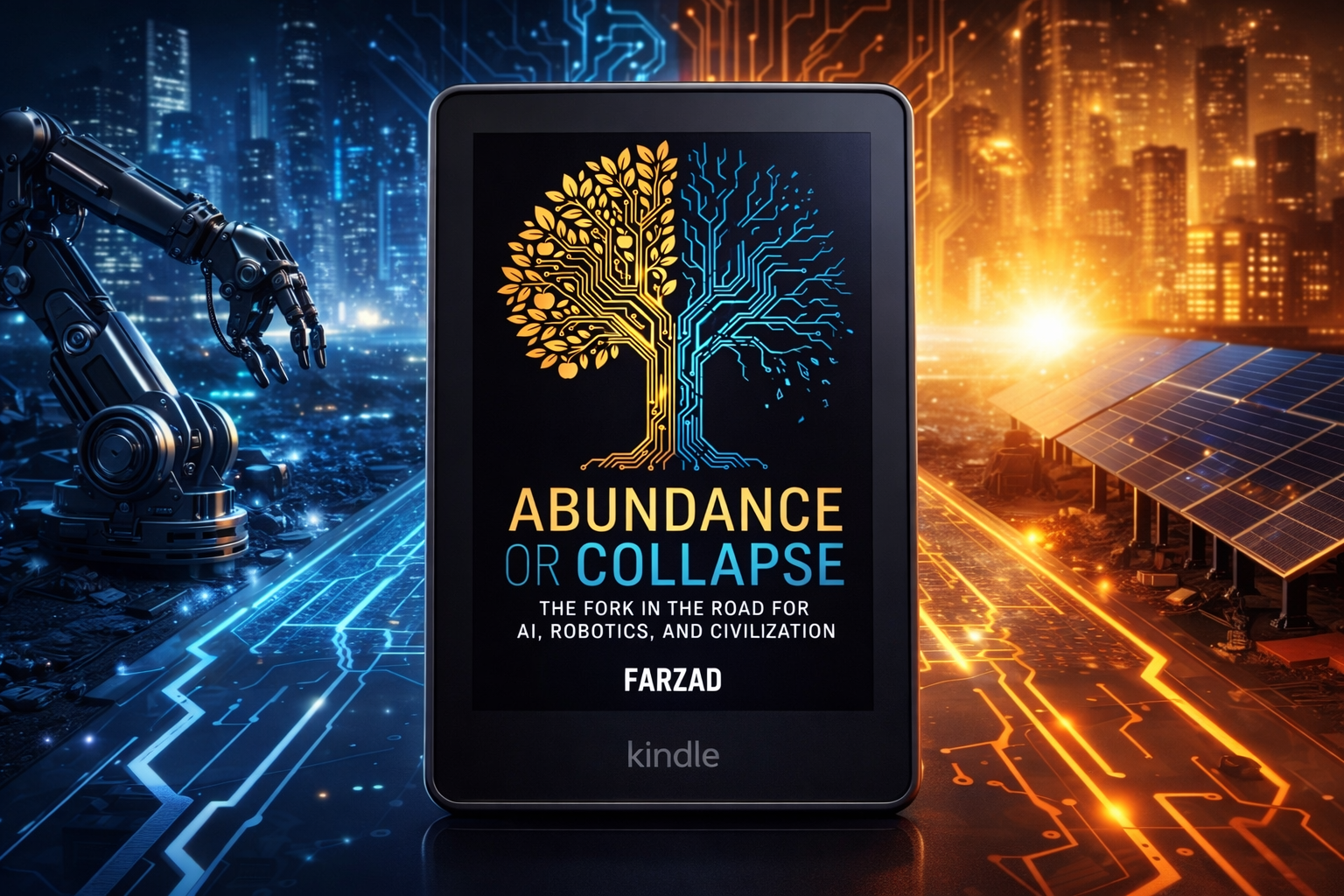
Abundance or Collapse: The Fork in the Road for AI, Robotics, and Civilization (The Future Book 1)
I just wrote my first book. It’s called ‘Abundance or Collapse: The Fork in the Road for AI, Robotics, and Civilization’.
As I’m sure you’re already aware, there’s a massive change coming for humanity in the next few years - both positive and negative.
This book shares my thoughts on where we’re likely headed, the biggest players that are driving that change, and what everyone can do to position themselves so that they aren’t left behind.
In a best case scenario, everyone who reads my book will be significantly better positioned in 5-10 years vs where they are today.
In a worst case scenario, we’re all dead. Just kidding - maybe.
The book will be out on February 14th on Kindle, paperback, and hardcover formats.

Convergence: AI's Path to Abundance or Collapse
The convergence of AI, robotics, and energy isn't three trends—it's a single self-amplifying system poised to redefine human limits, delivering either boundless prosperity or societal rupture within a decade. Unpack the flywheel mechanics, from orbital AI satellites harnessing endless solar to humanoid bots scaling manufacturing, and why vertical integration across these pillars creates unbeatable edges.
Key Takeaways
AI's compute hunger drives energy breakthroughs, like AI-optimized batteries and grids, unlocking cheaper power for endless scaling.
Robotics, powered by end-to-end neural nets from autonomous driving, targets the $40 trillion labor market, automating factories and homes at human-surpassing speeds.
Wright's Law supercharges the loop: doubling production halves costs in batteries and solar, accelerating deployment and compounding advantages.
By 2030, expect 80% of digital tasks AI-mastered, robots in widespread use, and energy abundance via space-based infrastructure.
Disruption hits hardest in the economic middle—jobs vanish fast—but abundance follows if societies adapt beyond scarcity's old rules.
Diving deeper, this chapter dissects the interplay from first principles: AI evolves beyond passive tools, redesigning itself and physical systems via feedback loops that outpace human innovation. Historical revolutions like electricity fixed one bottleneck; this trifecta—intelligence, manipulation, power—solves them all, with exponential curves bending vertical by mid-decade. Track proxies like vertically integrated players dominating AI deployment in vehicles, bots building their own factories, and energy storage exploding via megapacks. Risks loom in transition chaos—millions displaced as cognitive and manual work automates—but opportunities explode for those riding multiple curves, from compute providers to orbital ventures. The thesis holds firm: no single entity owns it, but ecosystems coordinating brain (advanced models on real-time data), body (scalable hardware), and vessel (space infra) capture the surge, mispricing assets today against 2030's transformed landscape.
Farzad Q&A - 02/10/2026
Join Farzad and his community for an open, unscripted Q&A about technology, investing, business, and the future of innovation. In every session, Farzad answers community questions, breaks down complex topics with clarity, and shares practical insights on building, scaling, and thinking long-term in tech.