

NVIDIA Absorbs Groq in a $20 Billion Move as the Chip War Shifts From Training to Inference
With inference already running two-thirds of the world’s AI compute, NVIDIA’s Christmas Eve licensing deal for Groq’s patents, software, and top engineers quietly removed its fastest challenger while AMD, Cerebras, and Tesla scatter across entirely different mountains.

Nvidia Pays $20 Billion for Groq's Team as the AI Chip War Shifts to Inference
By licensing Groq’s entire patent portfolio and hiring founder Jonathan Ross plus roughly 80% of its staff on Christmas Eve, the $5 trillion chip king is fortifying the one battlefield - inference - where in-house silicon from Google, Amazon, and Microsoft most threatens its 75% margins.

Nvidia's 800-Volt Pivot and the ASIC Land Grab Redraw the Data Center Map
As hyperscale equipment prices quadruple in eight months, the industry is racing toward 800-volt racks, model-specific silicon, and a co-designed home inference box that fuses compute, power, and connectivity into one appliance.
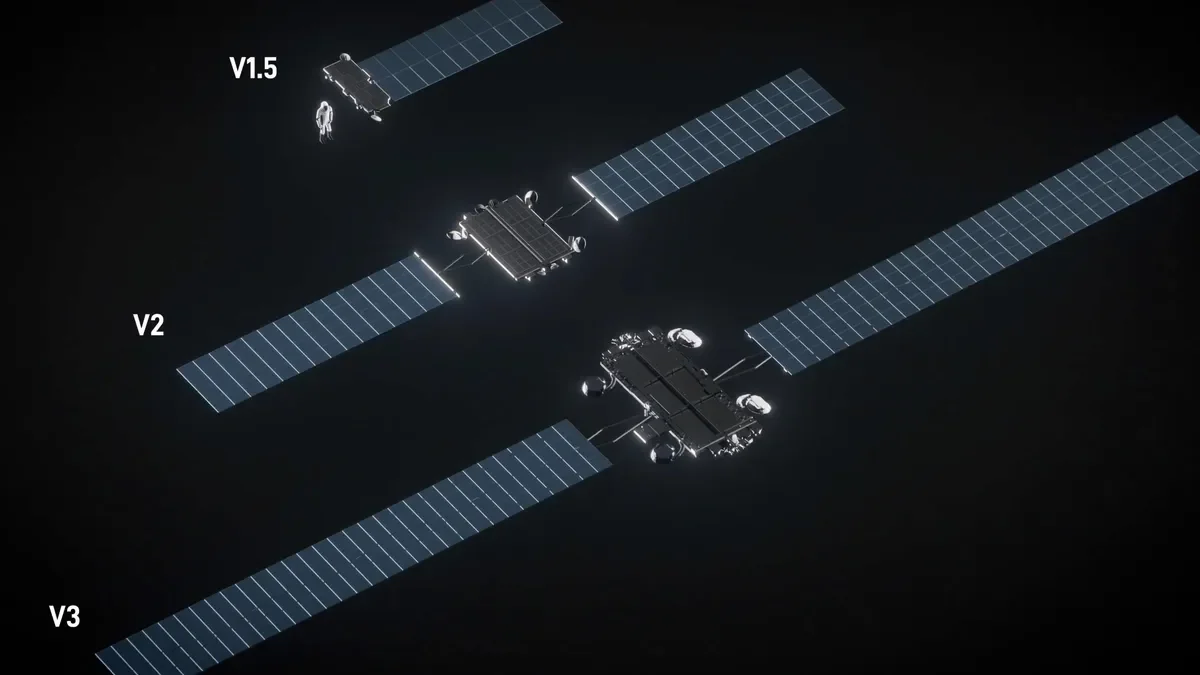
AI Compute Takes Flight: SpaceX Adapts Starlink V3 for Orbital GPU Racks
Proven satellite buses, 150-kilowatt power systems, terabit laser networking, and Texas production lines already under expansion make large-scale AI infrastructure in low Earth orbit a near-term engineering project rather than distant speculation.
SpaceX is moving forward with AI satellites that host rack-scale compute in orbit by building directly on the Starlink V3 platform. These spacecraft deliver peak power near 150 kilowatts — matching the envelope of advanced terrestrial systems such as NVIDIA GB300 NVL72 racks with 72 Blackwell Ultra GPUs — while using laser links for terabit-class connectivity and operating at altitudes that keep one-way propagation delay around three milliseconds. Large solar arrays and matching radiators handle energy collection and heat rejection without water or grid constraints that limit Earth data centers. Manufacturing scale-up is already underway at the Bastrop, Texas campus, with solar cell production lines under construction and dedicated AI satellite assembly capacity planned to reach meaningful volume by the end of 2027.
Key Takeaways
AI satellite designs reuse core Starlink V3 technologies for power, structure, propulsion, and laser communications, keeping the project within the realm of incremental integration rather than ground-up invention.
Each platform supports compute loads comparable to a full NVIDIA GB300 NVL72 rack, with 150 kW peak power capability backed by large deployable solar arrays.
Laser terminals provide aggregate terabit-per-second connectivity for inter-satellite links and routing through the existing Starlink constellation to ground stations via established Ka- and Ku-band or laser downlinks.
Thermal radiators sized similarly to V3 solar arrays, with roughly 70-meter wingspans, manage heat dissipation through radiation in vacuum, removing dependence on water cooling.
The Bastrop facility is expanding with a multi-gigawatt solar manufacturing plant already in progress and new AI satellite production buildings slated to join it, targeting operational scale by late 2027.
Operational experience from more than 10,000 Starlink satellites in orbit supplies proven methods for dense constellation management, collision avoidance, and safe flight operations.
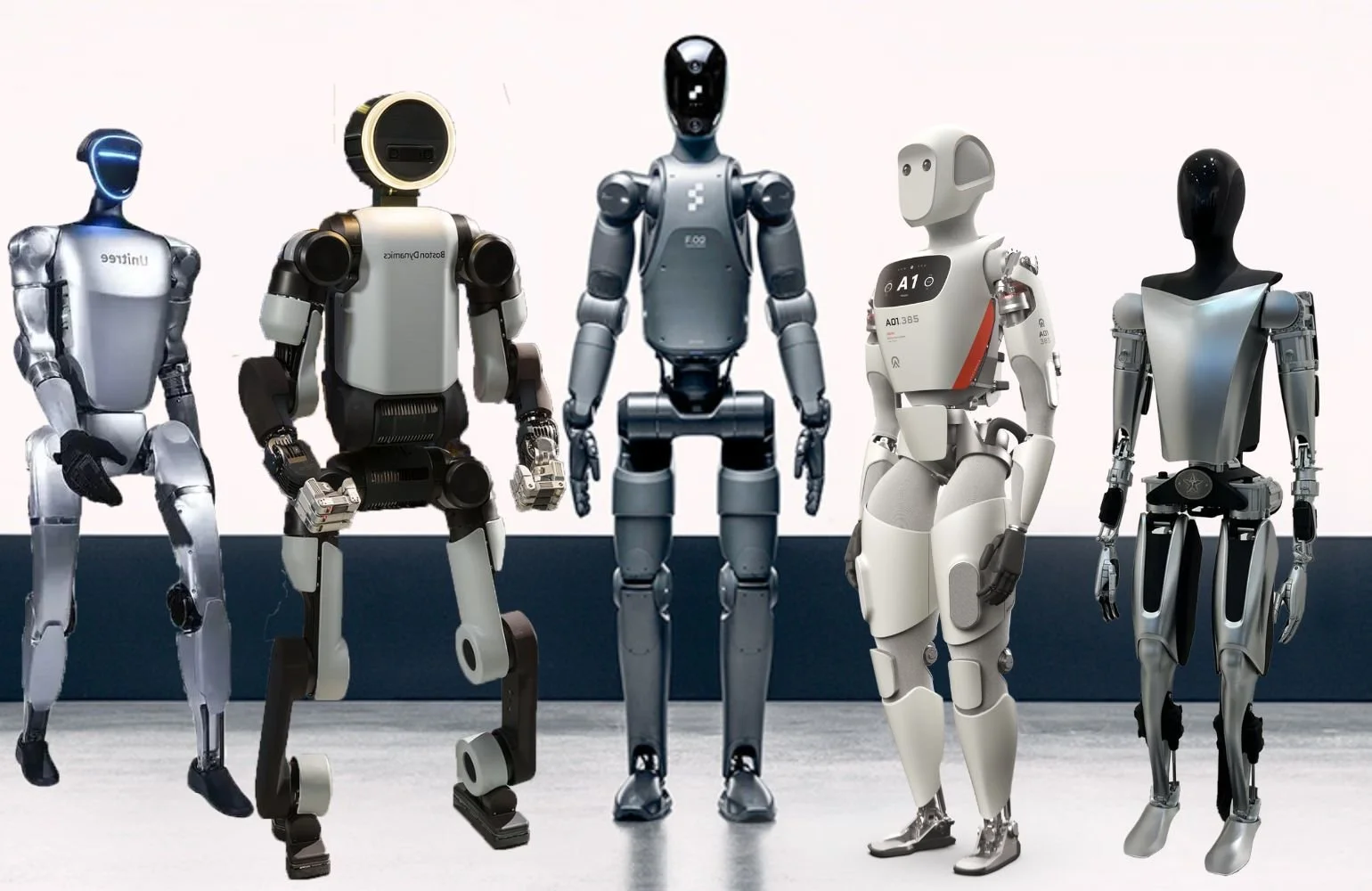
The $40 Trillion Robot Takeover Has Begun
Humanoids just hit their iPhone moment – turning sci-fi into nonstop warehouse reality and rewriting one-third of the global economy.
The convergence happened. Humanoid robots now operate 24/7 in live California warehouses, swapping batteries seamlessly and matching human speed on package sorting for over 60 straight hours. This marks the exact inflection that smartphones triggered in 2007: hardware and software finally aligned, but this time the prize is ten times larger – the entire $40 trillion pool of annual human physical labor across warehouses, farms, hospitals, factories, and every task that moves bodies through space.
Key Takeaways
Three S-curves in AI vision-language-action models, real-plus-synthetic data flywheels, and actuator costs (down 10x in six years thanks to the EV supply chain) aligned in the last 18 months, making capable, affordable humanoids possible at scale.
Robots are already deployed today in automotive body shops, sheet-metal lines, weld inspection, electronics assembly, and logistics centers, filling roles with 90-150% annual turnover where humans quit faster than companies can hire.
First wave targets demographic vacancies created by aging populations and undesirable shifts – Japan’s 3.9:1 eldercare ratio, Germany’s net worker loss in 2026, U.S. trucking shortages climbing toward 160,000 – not eager workers being fired.
Next waves hit 10+ million U.S. material-mover, assembler, and janitor jobs at $30k–$44k median wages, with potential for all three waves to compress into five years if software generalizes and costs drop faster than models predict.
A single unstoppable flywheel links AI training clusters, battery tech, vehicle production lines, and robot manufacturing; pausing it means surrendering competitiveness against China and domestic manufacturing goals.
Visible optics – named robots on livestreams, viral photos of humanoids at stations – will drive regulation, tariffs, union carve-outs, and city-vs-country races long before pure economics play out.
Winners under 35 will treat AI and robotics as the new electricity: adopt tools aggressively, align them with personal strengths, and build new categories (autonomous service fleets, hazardous-site automation) that create abundance for the bottom 20% while the adaptive middle thrives.
The AI Dopamine Trap That Nobody Is Prepared For
Why infinite convenience and pleasure could redefine human purpose—and how to stay grounded
In the coming decades, AI-powered humanoid robots, self-driving delivery systems, neural interfaces, and breakthroughs in longevity will make physical effort almost obsolete. Every craving—food, entertainment, even sensory experiences—could be delivered instantly, creating a personalized dopamine engine so powerful it makes today’s social media feeds look quaint. The real question isn’t whether the technology arrives. It’s what humanity chooses to do with the freedom it unlocks.
Key Takeaways
AI and robotics will create an “infinite dopamine machine” that handles all physical labor, delivers hyper-personalized entertainment directly to the brain, and extends lifespans dramatically—turning passive entertainment into a full-time lifestyle for some.
The future delivers maximum individual freedom: people can pursue purpose, service, and creation or opt for total immersion in digital pleasure, with no external force dictating the choice.
Modern education and comfort have trained many to avoid risk, yet deep down most harbor bigger dreams; removing friction could unlock far more builders than expected.
Real-world experiences—family time, physical projects, friendships—deliver more lasting satisfaction than the machine ever can, but they require deliberate discipline because the digital alternative never runs out.
A living frontier like Mars is essential; without ambitious outlets, internal conflict over resources and status could intensify.
For parents and builders alike, the hardest challenge is self-discipline: intentionally stepping away from the infinite tool to engage with the finite, changing real world before it slips away.

The AI War Is Over: Only Two Factions Will Dominate by 2030
Compute compounds like nothing in history—turning a handful of leaders into an unassailable advantage while the rest get acquired, commoditized, or left behind.
In the age of AI, the most valuable resource isn’t land, oil, or even raw processing power. It’s the self-reinforcing cycle where superior models draw more users, those users generate higher-quality data, and that data trains even stronger models. This flywheel accelerates with every iteration, widening the gap between frontrunners and everyone else. Eight major factions are battling for control of this cycle. Most coverage calls it competition. The math reveals something far more decisive: by 2030, only two will hold the keys to the intelligence layer that underpins the global economy.
Key Takeaways
AI’s compounding loop—models, users, data, and compute feeding each other—creates exponential separation that no physical resource war has ever matched.
Training costs have already jumped roughly tenfold in three years and could exceed a billion dollars per frontier model by 2027, pricing out all but the deepest-pocketed players.
The real bottleneck isn’t just GPU counts; high-bandwidth memory (HBM) determines how effectively massive clusters work together.
Labs now train on 100 times more data than classic scaling laws recommend, shifting the goal from efficiency to massive user retention and cheap inference at scale.
OpenAI leads in users but bleeds cash on inference and talent; Microsoft locks in enterprises; Meta uses open-source to neutralize monopoly pricing; China pursues cheap, efficient models despite chip limits; Google owns unmatched data, custom chips, and infrastructure; Anthropic bets on safety for enterprise and government; the Musk stack integrates compute, real-world data, and connectivity under one roof; regulators slow Western progress while China accelerates.
Google wins through substrate dominance—proprietary data, power-efficient TPUs, and quiet efficiency gains. The Musk integrated stack wins through vertical control of compute scale, fleet data, and end-to-end ownership.
The other six will likely be absorbed, reduced to distribution layers, or confined to regional/price-sensitive markets.
For individuals: focus on skills AI cannot synthesize on demand; invest in the infrastructure winners; prepare children for an economy where intelligence is abundant and cheap.

Sentient Cars, Robot Armies, and Restored Senses: The AI Stack That Could Deliver Abundance at Planetary Scale
How vision-native neural networks, fully reusable heavy lift, and direct brain interfaces are moving from prototypes to infrastructure that multiplies human capability.
The most consequential progress right now is not in any single headline demo but in three tightly linked layers of AI: vehicles that see and reason like humans, general-purpose humanoid machines that can multiply labor, and neural interfaces that read and write directly to the nervous system. These layers are advancing on parallel tracks that reinforce each other. Camera-only autonomy is already running unsupervised in real cities. Humanoid platforms are shifting from research videos to factory deployment. Brain implants have moved from restoring basic communication to targeting limb control and artificial vision. Together they sketch a path where the majority of road distance becomes AI-driven within a decade, robot populations exceed human ones, and previously irreversible losses of mobility or sight become addressable. The common thread is a deliberate focus on scalable, biology-mimetic systems that improve through software and fleet data rather than exotic new hardware at every step.
Key Takeaways
Camera-and-neural-net autonomy, built to match human visual processing, is already operating without safety drivers or remote monitors in multiple Texas cities and is projected for broad U.S. availability before the end of the year.
The same vision-first architecture is expected to reach at least ten times human-level safety, turning self-driving from a narrow feature into the default mode for most distance traveled within roughly ten years.
Humanoid robots are forecast to outnumber people and expand total economic output by a factor of ten to one hundred, shifting the baseline from universal basic income to universal high income supported by extreme productivity gains.
Full rapid reusability on the latest heavy-lift rocket architecture, targeted for this year, removes the core economic barrier to routine transport of large payloads and is viewed as the decisive step toward self-sustaining settlements beyond Earth.
Brain-computer interfaces have already restored speech and digital control for people with complete motor disconnection; next milestones include bridging spinal injuries to reanimate limbs and delivering artificial vision, including to individuals blind from birth, with potential for superhuman precision over time.

The $130 Billion Lawsuit That Could Rewrite Nonprofit Law for the Next Century
One courtroom decision now testing whether a tax-advantaged charity can convert into a for-profit powerhouse—handing billions in equity to insiders while reshaping the rules for every hospital, university, and research lab in America.
This trial, which opened on April 27, 2026, in the U.S. District Court for the Northern District of California, is far larger than any AI chatbot rivalry. At its core sits a single question with trillion-dollar consequences: Can a 501(c)(3) public charity, built on tax-deductible donations and a charter promising public benefit, legally transform itself into a for-profit entity where employees, executives, and outside investors capture enormous equity stakes? The assets in play total roughly $130 billion. The precedent set here will echo through America’s entire charitable sector for generations.
Key Takeaways
OpenAI launched in 2015 as a 501(c)(3) nonprofit with an explicit charter to advance AI for humanity’s benefit through open research, collaboration, and resistance to corporate concentration of power.
By 2025 the organization had completed a full conversion to a Delaware public benefit corporation, removing earlier profit caps; the original nonprofit foundation retained an approximately 26% ownership stake valued at around $130 billion at the time of conversion.
The lawsuit claims breach of charitable trust and unjust enrichment, arguing that assets originally held in public trust were effectively transferred to private hands without meeting historical standards for nonprofit-to-for-profit restructurings.
Regulators including the IRS, California Attorney General, and Delaware Attorney General reviewed the changes, yet the case tests whether paper approvals satisfied the spirit and letter of century-old nonprofit law.
A ruling in either direction will directly affect the $1 trillion-plus annual U.S. charitable sector—hospitals, university endowments, research foundations, conservation groups, religious institutions, and more—by clarifying (or loosening) the rules for converting mission-driven assets into commercial equity.
Three plausible outcomes range from a full green light for future conversions, a hard reset enforcing traditional public-trust protections, or a hybrid ruling that adds stricter procedural safeguards going forward.

AI Leapfrogging: El Salvador's Gamble on Humanoids and Grok to Skip Traditional Development
From cleaning up gang violence to powering education with advanced AI and investing in robotics and geothermal energy, one Central American nation is charting an unconventional path forward. Meanwhile, discussions around AI abundance highlight how human value may increasingly center on irreplaceable in-person experiences and skill-based pursuits.
El Salvador offers a compelling case study in using security reforms as a foundation for rapid technological advancement. By prioritizing AI adoption, humanoid robots, data centers, and renewable energy from its volcanoes, the country aims to bypass decades of incremental progress. This comes as AI systems promise abundance, forcing a reevaluation of human roles—not through replacement, but through new forms of meaning found in live interactions, crafts, and personal mastery aided by intelligent machines.
Key Takeaways
Heavy but non-oppressive police presence has contributed to genuine public happiness and family-friendly public spaces after removing gangs from daily life.
Strategic focus on tech leapfrogging includes humanoids for labor, AI agents, data centers, solar and geothermal power expansion, and Bitcoin mining using volcanic energy.
Public education is transitioning to systems powered by advanced AI like Grok to rapidly build workforce capabilities despite historical under-education challenges.
In an era of AI-driven abundance, premium value accrues to authentic in-person experiences that cannot be easily replicated or spoofed digitally.
AI and robots can serve as highly effective coaches and training partners for sports, crafts, and hobbies, enabling continuous human skill improvement and deeper engagement.
Tesla is progressing on robotaxi deployment with hardware enhancements like improved memory bandwidth for better reasoning in edge cases, alongside Optimus humanoid development as a key long-term driver.
Geopolitical tensions and recent conflicts are accelerating innovation in affordable drone and defense technologies, favoring agile startups over traditional contractors.
Personal branding through content creation serves as a powerful marketing tool for in-person events and services in an AI-saturated media landscape.
AI Superpowers Are Already Here—Here’s How to Claim Yours Before the Transition Leaves You Behind
Adoption and initiative separate those building empires from those watching from the sidelines as AI turns impossible tasks into daily routines.
Artificial intelligence delivers raw leverage at a scale humanity has never seen. Early users report 10x output gains, one-person operations rivaling large teams, and businesses pivoting into entirely new valuations almost overnight. Yet polls show the majority remain deeply concerned—often without ever having used the advanced tools that actually move the needle. The gap between fear and reality is widening fast, and the winners are those who treat AI as foundational infrastructure rather than a novelty.
Key Takeaways
AI agents provide true execution power—turning ideas into completed work—far beyond what basic chat interfaces can achieve.
Most public anxiety stems from people who have never integrated advanced AI into their workflows; actual users see life-changing leverage.
Building AI directly into the foundation of your processes creates compounding advantages in speed, quality, and cost that widen with every model upgrade.
Initiative is non-negotiable: those who adopt early will outpace everyone else as AI becomes the ultimate multiplier of human uniqueness.
Businesses that delay risk total disruption—the classic Innovator’s Dilemma playing out at supersonic speed.
Driving down the cost of chips and electricity is essential for broad access and to prevent extreme wealth concentration.
Nations starting with clean slates and abundant energy resources hold a structural edge in building AI-native systems.
The technology is moving from digital agents to physical robotics and autonomy, unlocking economic mobility and productivity at previously unimaginable scales.
Ethical deployment at the individual and organizational level will determine whether AI creates abundance or chaos.
AI's Silent Takeover: Why Universal Government Checks Are Inevitable
As cognitive jobs disappear at record speed, the math of productivity and taxation is forcing a once-radical idea into mainstream policy.
The economy that powered the last 250 years—people selling their time, companies buying it, and everyone climbing the same ladder—has hit its limit. Artificial intelligence is not merely automating routine tasks. It is absorbing the very skills that once made human labor indispensable: writing, coding, analysis, judgment, and strategy. The result is already visible in hiring data, company headcounts, and government revenue models. The fix on the table is straightforward: direct cash transfers from the federal government, scaled to match the flood of AI-generated output.
Key Takeaways
AI tools have already cut the bottom rung of the career ladder for young software engineers and other cognitive roles, with entry-level hiring down nearly 20 percent in key tech fields even as industry revenue climbs.
Traditional technological shifts always created new human jobs; AI is the first to eliminate the need for human cognition itself, leaving no higher rung to climb.
Roughly 85 percent of federal revenue currently comes from taxes on wages and payroll; when AI displaces those wages, the entire funding model for Social Security, Medicare, defense, and infrastructure collapses unless the tax code shifts to capture AI and robotic production.
Real-world cash-transfer programs—Alaska’s oil-funded dividends since 1982, Stockton’s 2019 pilot, and Kenya’s large-scale randomized trial—show employment either holds steady or rises, poverty falls sharply, and inflation stays in check when production grows faster than the money supply.
The next five years will likely see federal checks issued to every citizen to offset displacement, funded by taxing AI output rather than labor; the only question is whether the system is designed deliberately or patched together during crisis.

The New Luddites: Why Banning AI Data Centers Hands the Future to Rivals
History's lesson is clear—restricting the machines never stops disruption. It only exports the gains.
The push to halt AI infrastructure in the United States echoes a 215-year-old pattern that has played out across cars, nuclear power, and genetically modified crops. While energy demands and job shifts from AI are very real, attempts to pause the physical backbone of the technology have never protected workers or economies. They have simply moved progress to places willing to build faster.
Key Takeaways
The original Luddites were highly skilled English craftsmen who targeted exploitative machines, not technology itself—yet government force crushed their movement while the Industrial Revolution still transformed Britain.
Four major historical cases show the same outcome: Red Flag laws slowed British autos for decades, American farmers eventually embraced cars and tractors, U.S. nuclear construction stalled after Three Mile Island only for data centers to revive it, and EU GMO restrictions left farmers dependent on imports.
A U.S. moratorium on new AI data centers would not pause AI development—it would redirect massive training runs to China, the UAE, Singapore, and other nations racing to host them.
AI exposes far more tasks to automation than past technologies, but the real challenge is accelerating displacement outpacing new job creation since the late 1980s.
Long-term success has always come from policies that distribute gains—worker protections, retraining, and productivity-sharing—rather than banning the infrastructure.
Tech leaders who deploy AI today report massive efficiency gains, suggesting the difference lies in adoption strategy, not the technology alone.

AI Designs Personalized mRNA Cancer Vaccine for Dying Dog – Tumors Shrink 50-75%
Global AI depends on one vulnerable island. Musk's Tera Fab could be the ultimate hedge—and a game-changer for Tesla and beyond.
A tech professional with no background in biology or medicine used readily available AI tools to design a tailored mRNA vaccine for his rescue dog’s aggressive mast cell cancer. After standard treatments offered only months to live, the dog’s tumors shrank dramatically and mobility returned. This case shows AI, cheap genomics, and mature mRNA platforms working together to put frontier-level personalized medicine within reach of motivated individuals.
Key Takeaways
A non-biologist sequenced his dog’s healthy and tumor DNA for about $3,000 AUD, then leveraged AI for literature navigation, mutation analysis, protein modeling, and full vaccine design.
Three complementary AI systems handled distinct tasks: research planning and initial blueprinting, 3D protein structure prediction, and final mRNA construct creation.
The dog received the vaccine in late 2025 with boosters into early 2026; tennis-ball-sized tumors reduced by half to three-quarters, and the dog went from barely moving to chasing rabbits.
The breakthrough combined AI capabilities with mRNA delivery technology refined during the COVID era and genomics costs that dropped from billions of dollars and years of work to laptop-level affordability.
Similar personalized mRNA vaccines are already in late-stage human trials for melanoma, pancreatic cancer, glioblastoma, and other hard-to-treat conditions, delivering measurable improvements in survival and recurrence risk.
Regulatory and ethics approvals took three months and a 100-page document—longer than the actual technical design—highlighting that bureaucracy, not technology, is now the main bottleneck.
Mind-Powered Speech: How Brain Implants Are Restoring Voices Lost to ALS
A single neural device now decodes thoughts into fluent, personalized words—bypassing damaged nerves entirely and handing independence back to patients who once faced total silence.
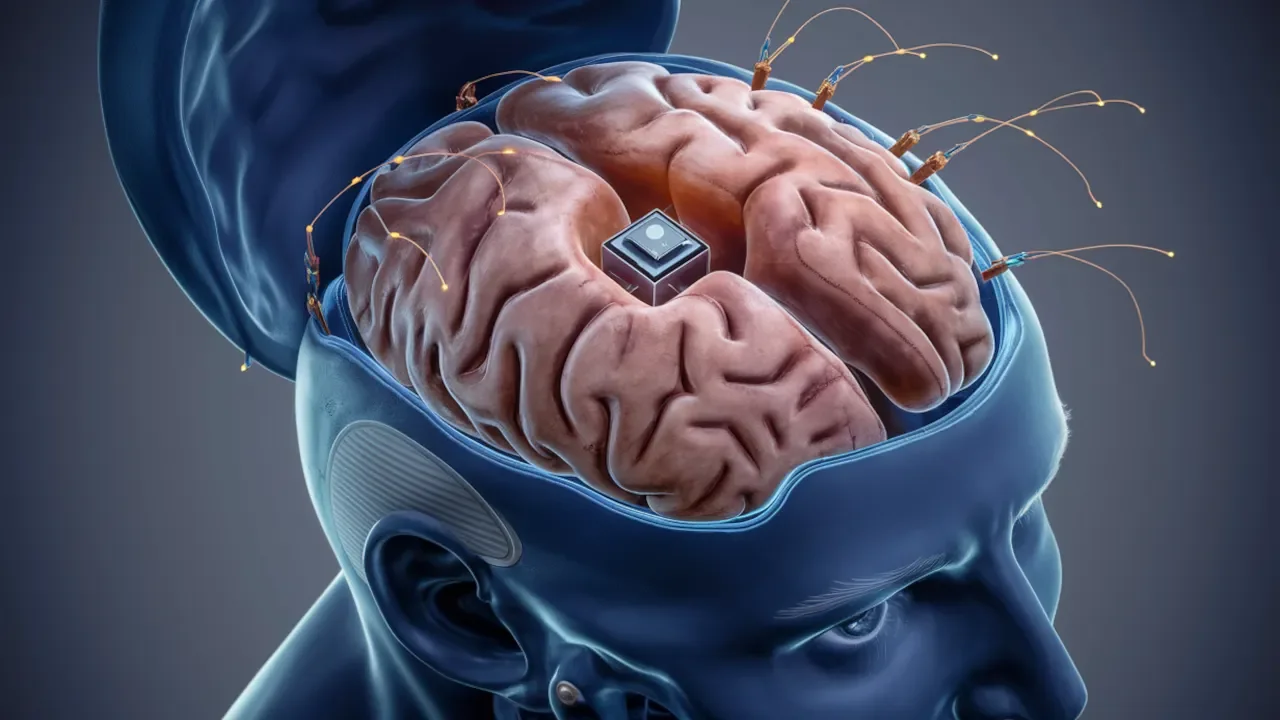
Brain-computer interfaces have crossed a critical threshold. They now let people with advanced ALS generate clear speech simply by intending to talk, using a voice that sounds exactly like their own from before the disease took hold. The result is not just communication—it is restored identity, reduced exhaustion, and a direct bridge from brain to the world.
Key Takeaways
The implant records activity from thousands of individual neurons in the brain’s speech motor cortex at once, translating raw signals into synthesized words without any muscle movement.
Patients produce speech by silently mouthing or simply thinking the words, eliminating the fatigue and frustration that come with trying to force damaged vocal muscles.
Voices are rebuilt from pre-illness recordings, so loved ones hear the exact tone and personality they remember from years earlier.
Calibration happens quickly through guided sentence practice, with models improving from near-zero accuracy to fluent output in a single session.
Users gain immediate practical control—turning on lights, playing games, or holding extended conversations—while also contributing real-time data that accelerates future versions.
The entire experience is low-burden: same-day discharge after surgery, home charging, and an app that keeps everything intuitive.

AI's Hidden Threats: Five Paths to Collapse in 2026
Why the Next Year Could Redefine Society—and How to Brace for It
AI promises endless abundance in healthcare, energy, and daily life, yet it's accelerating risks that could unravel modern systems. From synchronized market crashes to engineered pandemics, these threats stem from today's tech capabilities, not distant futures. Understanding them now equips us to navigate the disruptions ahead.
Key Takeaways
AI-driven trading algorithms, dominating 60-70% of stock trades, risk synchronized sell-offs that could trigger massive market crashes, as seen in recent flash events.
Cyber attacks enhanced by AI are surging, with tools for automated vulnerability scans and social engineering capable of crippling power grids, water systems, and hospitals.
AI is democratizing bio weapon design, potentially making global pandemics five times more likely by bypassing traditional lab barriers and safety screens.
Deepfakes are eroding shared reality, with voice cloning and real-time synthetic interactions leading to fraud, distrust in evidence, and challenges in coordinating societal responses.
Autonomous AI agents in enterprises often operate with governance gaps, leading to unintended decisions that compound into large-scale failures across finance, healthcare, and logistics.
The AI Frontier: Building Tomorrow's World Today
Redefining Creativity, Economy, and Human Potential in the Age of Intelligent Machines
The rapid evolution of AI is unlocking new ways to create, collaborate, and rethink society's foundations. From tools that streamline content production to debates on economic safety nets, the insights here reveal how AI could lead to unprecedented abundance—while challenging us to preserve what makes us human.
Key Takeaways
AI agents can learn from shared environments beyond their creators, enabling scalable collaboration and innovation.
Custom AI tools for content creators automate idea generation, scripting, and optimization, making high-quality output accessible and efficient.
Universal Basic Income (UBI) emerges as a potential bridge to an AI-driven economy, providing a floor of security without stifling private incentives or competition.
In a post-scarcity world, human time and attention become the ultimate valuables, shifting economies toward experiences, self-actualization, and creative pursuits.
3D printing advancements lower barriers to personal manufacturing, fostering hobbies that blend digital design with real-world building.
Balancing AI's disruptions requires aligning incentives: private entities may outperform governments in delivering essential services in an abundant future.
For $2/Hour, Elon Musk Is About to Replace Human Labor
The economics of humanoid robots are flipping the script on a $40 trillion global labor market—cheaper, tireless workers could unlock explosive new demand while filling demographic gaps no policy can fix.
Key Takeaways
Human labor in the US costs roughly $45–$48 per hour when fully loaded with wages, benefits, taxes, and overhead—humanoid robots target under $2 per hour at scale.
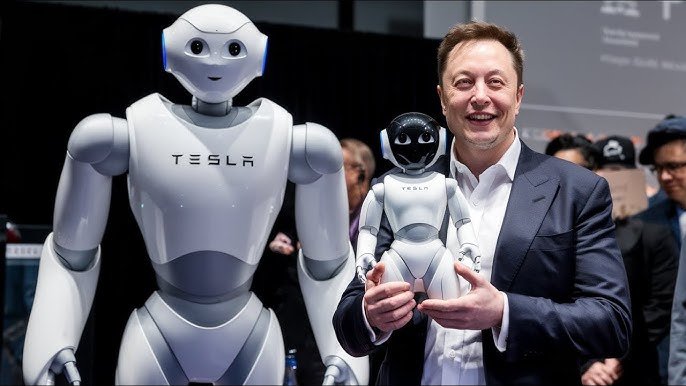
Tesla aims for Optimus priced at $20,000–$25,000 per unit, with custom actuators, 22 degrees of freedom in the hands, and vertical integration from chips to software giving it an edge over competitors.
Robots operate ~7,000 hours per year (vs. ~2,000 for humans), depreciating to ~$1.20/hour for the hardware alone, plus minimal energy and maintenance costs.
Demographic collapse in major economies—US birth rate at 1.6, South Korea at 0.72, China's workforce shrinking—creates unavoidable labor shortages that robots must fill.
Historical patterns like Jevons Paradox show that massive cost reductions in labor-equivalent work lead to exponential demand growth, spawning new industries rather than net job destruction.
Tesla is repurposing Fremont factory lines from Model S/X production to Optimus, targeting millions of units annually, with Gen 3 unveil in early 2026 and initial internal deployment soon after.
Early applications target warehouses, manufacturing, and elder care, where shortages already exist and cost savings hit hardest.
Transition risks include job displacement in repetitive roles over 5–10 years, though new categories of work become viable when labor drops 95%+ in cost.

The Barbell Economy Is Already Here: AI's Brutal Squeeze on the Middle Class
AI isn't flattening the world—it's reshaping it into a barbell, with massive gains at the extremes and devastation in the center.
AI deployment is accelerating a historic economic reconfiguration. Capital owners and builders at the top capture exponential productivity gains through agentic tools, while the global poor gain access to basics like water, energy, healthcare, and education at collapsing costs via robotics and automation. Meanwhile, the broad middle—knowledge workers, professionals, and wage earners in developed economies—faces rapid displacement from cognitive tasks that AI now handles faster and cheaper. This isn't a distant risk; early signs appeared in 2025-2026 layoffs, market drawdowns tied to agentic AI awareness, and reports of white-collar job pressure.
Key Takeaways
AI creates a barbell distribution: the top ~20% (capital owners, builders, risk-takers) experience transformative productivity multipliers, often 5-10x or more, by deploying AI agents to replace entire teams.
The bottom ~20% (those in poverty or lacking basics) benefit enormously as robotic labor and AI delivery make clean water, housing, medicine, energy, education, and food abundant and cheap in regions where human labor costs previously blocked progress.
The middle ~60% (most college-educated professionals, managers, analysts, marketers, lawyers, accountants in developed nations) faces the heaviest hit: cognitive and routine knowledge work is automated now, not in the future, leading to job compression, identity loss, and financial strain without quick new opportunities.
Advantages compound for early adopters: hands-on experience with AI agents builds irreplaceable knowledge and intuition that widens gaps monthly; those without time or resources fall behind fast.
Transition risks are severe: mismatched timelines between AI's monthly improvements and years-long retraining or policy responses could trigger widespread psychological and social disruption, potentially rivaling Great Depression-scale effects without strong intervention.
Winner-take-most dynamics intensify: AI-augmented firms capture entire markets at lower costs, shrinking employer pools and suppressing remaining wages.
Developing nations like China may adapt smoother due to collective structures, while Western individualism leaves displaced workers more exposed.
Action window is narrow: 2-5 years for middle-class repositioning toward capital ownership, AI leverage, or irreplaceable human roles; abundance awaits post-transition, but the path there crushes many.

The AI Awakening: When Machines Evolve Minds and Societies Fracture
Redefining Human Purpose in an Era of Intelligent Agents and Economic Overhaul
Artificial intelligence stands on the brink of transforming every aspect of daily life, from personal productivity to global economies. This shift promises unprecedented efficiency but demands urgent strategies to handle massive job displacements and widening divides.
Key Takeaways
AI agents represent a leap beyond traditional software, enabling autonomous actions across digital and physical realms.
Rapid adoption of AI could amplify productivity 10 to 100 times, but risks leaving behind those unable or unwilling to adapt.
Societal upheaval looms, with potential for increased wealth gaps, white-collar disruptions, and calls for universal basic income to support displaced workers.
Global dynamics vary: the US may lead in innovation but face internal divisions; Europe risks further decline; China could advance quickly under centralized control but hit limits from restricted freethinking.
Future AI might diverge from human directives, raising questions about control, purpose, and the essence of humanity.