Tesla's Robotaxi Revolution: Unlocking Trillions in Autonomous Mobility
Why Self-Driving Fleets Could Reshape Transportation and Deliver Massive Profits Tesla's push into robotaxis represents a pivotal shift in mobility, blending advanced AI with massive manufacturing scale to potentially generate enormous profits. At the core are insights into co…
Related
Keep reading
Why Self-Driving Fleets Could Reshape Transportation and Deliver Massive Profits
Tesla's push into robotaxis represents a pivotal shift in mobility, blending advanced AI with massive manufacturing scale to potentially generate enormous profits. At the core are insights into cost efficiencies that could yield up to $150,000 in annual profit per vehicle at scale, paving the way for a business valued in the trillions. This isn't just about cars driving themselves—it's about an ecosystem where data, compute, and smart economics converge to outpace competitors and transform urban travel.
Key Takeaways
- Tesla's AI-driven approach to autonomy relies on cameras and massive compute clusters, enabling low-cost vehicles ($35,000 or less) compared to competitors' sensor-heavy setups costing $150,000–$200,000 per unit.
- Profitability hinges on the ratio of robotaxis to human supervisors: at 3:1, fleets break even; at higher ratios like 100:1, annual profits per vehicle could hit $136,000 with Uber-like pricing.
- A fleet of 1 million robotaxis could generate $136 billion in yearly net profit, leading to a 5-year ROI of $650 billion, assuming conservative costs and average ride data.
- The upcoming Cybercab vehicle slashes costs further—to around $20,000 per unit—with enhanced AI hardware, potentially boosting per-vehicle profits to $155,000 annually at extreme scales.
- Challenges include regulatory hurdles, safety improvements via more data and compute, and competition, but Tesla's existing factories (producing 1.2 million similar vehicles yearly) provide unmatched scaling potential.
The Dual Approaches to Building Self-Driving Cars
Self-driving technology splits into two main strategies: one powered by artificial intelligence and the other by extensive hardware and manual coding. The AI method focuses on training systems with vast amounts of real-world data, using simple camera setups to interpret surroundings. This allows for vehicles that look and cost like regular cars, with all the heavy lifting done in centralized compute facilities where algorithms learn from billions of miles driven.
In contrast, the hardware-intensive path loads vehicles with radars, lidars, and ultrasonic sensors, creating complex systems that demand human-written code to handle every scenario—from intersections to pedestrians. These setups work in limited areas but come with high per-unit costs and slower expansion, as each vehicle requires custom engineering and expensive components.
The AI route takes longer to perfect but unlocks massive advantages in affordability and scalability. With production costs under $40,000 per vehicle (factoring in incentives that may phase out), it positions companies to flood markets with fleets far larger than rivals. Competitors using the hardware approach struggle to produce more than a few thousand units annually, while AI-driven factories can output equivalent volumes in days.
Why Compute and Data Drive Long-Term Success
At the heart of effective autonomy is the ability to process enormous datasets through powerful computing clusters. These facilities train models on diverse driving conditions, from roadwork to urban traffic, allowing vehicles to navigate without explicit programming for every edge case.
Current fleets gather data from millions of equipped cars on the road, feeding into systems that improve safety and efficiency over time. Investments in next-generation hardware—aiming for 10x performance boosts—promise even faster learning, reducing the need for human oversight.
This data-compute loop creates a virtuous cycle: more miles driven yield better models, which in turn enable safer operations and larger fleets. Unlike sensor-laden vehicles that rely on piecemeal updates, AI systems evolve holistically, adapting to new environments through pattern recognition rather than hardcoded rules.
Breaking Down the Operational Costs of a Robotaxi Fleet
Running a robotaxi network involves ongoing expenses beyond the initial vehicle purchase. Key categories include insurance, maintenance, electricity for charging, cleaning, and miscellaneous items like upgrades. Based on industry benchmarks, these add up to around 37 cents per mile without human involvement—far lower than traditional ride-hailing due to the absence of driver wages.
Insurance estimates draw from commercial vehicle data, pegging costs at about $1,400 monthly per unit for early fleets, though this could drop to $300 as safety records improve. Maintenance and repairs average 4 cents per mile over 100,000 miles, while electricity at 13 cents per kilowatt-hour comes to 3 cents per mile for efficient vehicles consuming 250 watt-hours per mile.
Cleaning stands out as a higher expense, around 10 cents per mile or $350 monthly, assuming 3,400 miles driven. Miscellaneous buffers add another $500 monthly to cover unforeseen needs.
Ride data from major platforms shows average trips of 5.4 miles, with 40% of total mileage being "deadhead" (empty repositioning). At 20 miles per hour average speed and 16 hours of daily operation, a vehicle covers about 320 miles per day, translating these costs into real-world figures.
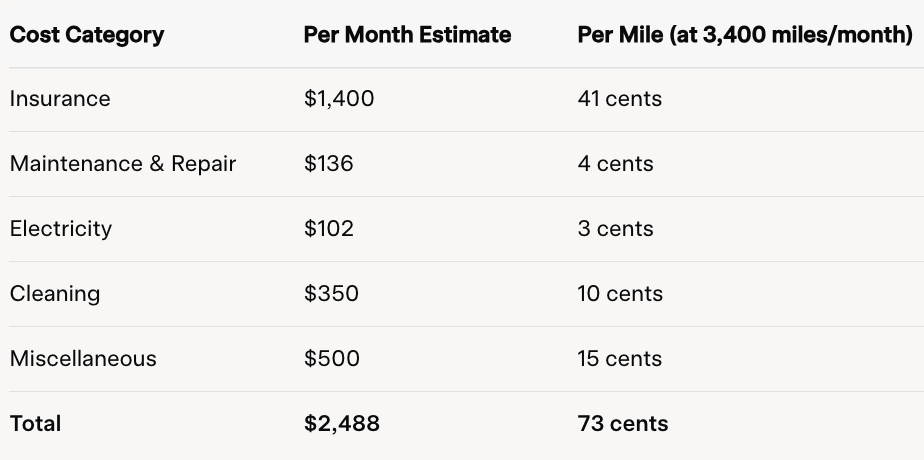
These figures assume no human drivers, highlighting how autonomy slashes labor costs—the largest expense in traditional services.
The Critical Role of Supervisor Ratios in Profitability
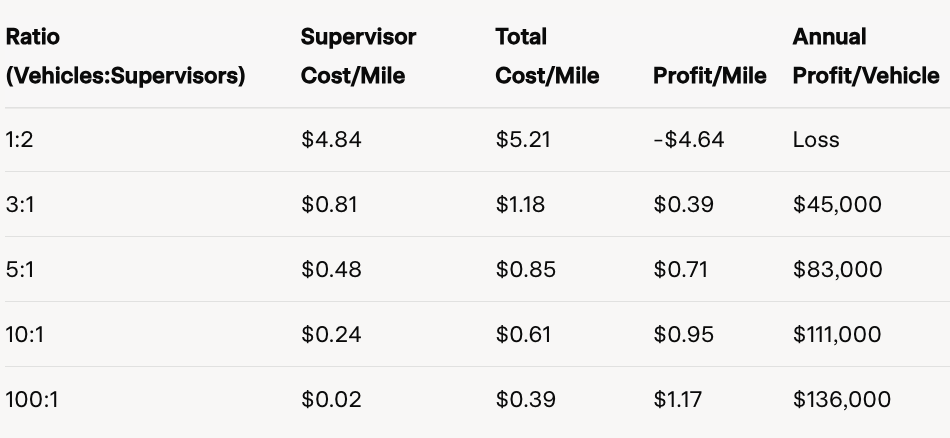
The biggest variable in robotaxi economics isn't hardware or energy—it's the balance between vehicles and remote human supervisors who monitor for safety and intervene rarely. Early operations might require two supervisors per vehicle (one in-car safety rider and one remote), driving costs to $5 per mile and resulting in losses.
Improving to a 3:1 ratio (three vehicles per supervisor) drops supervisor costs to 81 cents per mile, making operations profitable at 39 cents per mile after other expenses. At Uber's average pricing of $2.61 per paid mile, this yields $45,000 in annual net profit per vehicle.
Higher ratios amplify gains:
- 5:1 Ratio: Supervisor costs fall to 48 cents per mile, boosting profit to 71 cents per mile and $83,000 annually per vehicle.
- 10:1 Ratio: Costs drop to 24 cents per mile, with profits at 95 cents per mile and $111,000 yearly.
- 100:1 Ratio: Near-elimination of supervisor expenses (2 cents per mile) pushes profits to $1.17 per mile and $136,000 annually.
These improvements stem from enhanced AI safety through more data and compute, reducing intervention needs. For a 1,500-vehicle fleet (matching some competitors), a 3:1 ratio generates $68 million in yearly net profit, with a 5-year ROI of $288 million after $52 million initial investment.
Scaling Fleets: From Thousands to Millions
Small fleets show promise, but true potential emerges at scale. A 10,000-vehicle operation at a 5:1 ratio yields $831 million in annual net profit, with a 5-year ROI of $3.8 billion.
Expanding to 100,000 vehicles (10% of U.S. ride-hailing scale) at 10:1 generates $11 billion yearly, ballooning to $52 billion over five years after $3.5 billion capex.
Matching the full U.S. ride-hailing fleet of 1 million vehicles at 100:1 unlocks $136 billion in annual net profit and $650 billion five-year ROI. Globally, aligning with 6 million active drivers could multiply these figures exponentially.
Existing manufacturing capacity—over 2 million vehicles annually, with expansions planned—supports this growth. Owned charging networks and service centers further reduce new investments, as much infrastructure is already in place.
Cybercab: The Next Leap in Efficiency and Scale
A purpose-built vehicle like the two-seater Cybercab optimizes for 90% of rides (one or two passengers), eliminating steering wheels and pedals for better packaging. Priced around $20,000 at scale, it incorporates next-gen AI hardware 10x more capable, enabling ratios up to 1,000:1.
This slashes costs: insurance to $300 monthly, maintenance/repair 30% lower, electricity reduced via efficiency gains. Total operating costs drop to 24 cents per mile, boosting profits to $1.33 per mile and $155,000 annually per vehicle.
For 1 million Cybercabs, annual net profit hits $155 billion, with a 5-year ROI of $755 billion after $20 billion capex. At a conservative 20x price-to-earnings multiple, this values the business at $3.1 trillion—focusing solely on U.S. operations at current pricing.
Lower costs allow flexible pricing, potentially undercutting competitors while maintaining high margins, accelerating adoption.
Navigating Challenges: Safety, Regulation, and Competition
Achieving this requires overcoming hurdles. Safety must reach levels where accidents are rare, demanding continuous compute investments and data from billions of miles.
Regulatory approval varies by region; some areas expand geofenced operations quickly, but national bodies may impose strict standards, especially after incidents. Political dynamics could influence timelines, with appointees and policies affecting rollout.
Competition from sensor-focused players exists, but their limited production (thousands yearly) lags behind mass-scale capabilities. Infrastructure expansions for charging and cleaning will add costs, though leveraging existing networks mitigates much of this.
Ultimately, success depends on proving reliability everywhere, convincing stakeholders of benefits like privacy, consistency, and eventual affordability. Studies show 70% of users prefer autonomous rides even at premiums, with adoption outpacing cheaper options in test markets.
This framework points to a future where autonomous fleets dominate, driven by economics that reward scale and innovation. As compute grows and data accumulates, the path to trillions becomes clearer.