
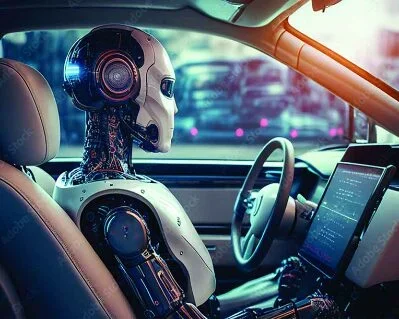
Sentient Cars, Robot Armies, and Restored Senses: The AI Stack That Could Deliver Abundance at Planetary Scale
How vision-native neural networks, fully reusable heavy lift, and direct brain interfaces are moving from prototypes to infrastructure that multiplies human capability.
The most consequential progress right now is not in any single headline demo but in three tightly linked layers of AI: vehicles that see and reason like humans, general-purpose humanoid machines that can multiply labor, and neural interfaces that read and write directly to the nervous system. These layers are advancing on parallel tracks that reinforce each other. Camera-only autonomy is already running unsupervised in real cities. Humanoid platforms are shifting from research videos to factory deployment. Brain implants have moved from restoring basic communication to targeting limb control and artificial vision. Together they sketch a path where the majority of road distance becomes AI-driven within a decade, robot populations exceed human ones, and previously irreversible losses of mobility or sight become addressable. The common thread is a deliberate focus on scalable, biology-mimetic systems that improve through software and fleet data rather than exotic new hardware at every step.
Key Takeaways
Camera-and-neural-net autonomy, built to match human visual processing, is already operating without safety drivers or remote monitors in multiple Texas cities and is projected for broad U.S. availability before the end of the year.
The same vision-first architecture is expected to reach at least ten times human-level safety, turning self-driving from a narrow feature into the default mode for most distance traveled within roughly ten years.
Humanoid robots are forecast to outnumber people and expand total economic output by a factor of ten to one hundred, shifting the baseline from universal basic income to universal high income supported by extreme productivity gains.
Full rapid reusability on the latest heavy-lift rocket architecture, targeted for this year, removes the core economic barrier to routine transport of large payloads and is viewed as the decisive step toward self-sustaining settlements beyond Earth.
Brain-computer interfaces have already restored speech and digital control for people with complete motor disconnection; next milestones include bridging spinal injuries to reanimate limbs and delivering artificial vision, including to individuals blind from birth, with potential for superhuman precision over time.

The AI Tsunami: Redefining Work, Wealth, and Human Purpose
Why the Next Decade Could Make Jobs Obsolete—and Unlock Unimaginable Prosperity
The rapid rise of AI and robotics is set to transform society in ways that demand immediate attention. At its core, this shift promises a world of abundance where goods and services become incredibly affordable, but the path there involves navigating massive job disruptions and economic upheaval. Drawing from emerging trends in technology and economics, this newsletter explores how AI is already reshaping industries and what it means for the future.
Key Takeaways
AI excels at digital tasks, making it ideal for replacing white-collar roles like coding, data analysis, and education far sooner than physical labor.
Tools powered by AI allow non-experts to build complex software and apps, slashing development costs and reducing the need for human developers.
Established companies face resistance to change due to bureaucracy, giving startups built on AI a competitive edge.
Historical shifts, like the replacement of human calculators with machines, show how entire job categories can vanish overnight.
The transition to an AI-driven economy will be chaotic, with potential social unrest, but it could prevent national financial collapse by boosting productivity.
Universal high income emerges not through taxes, but via deflation as production efficiency skyrockets, making everything cheaper.
By 2026, AI could reach general intelligence levels, surpassing humans in all digital domains, with superintelligence following by 2030.
Algorithmic advances could multiply AI's efficiency by orders of magnitude, even without more hardware.
Embracing AI tools today is essential for individuals and businesses to thrive in this new era.