

Blue Origin’s Money Cannot Buy SpaceX’s Flight Cadence
A billion dollars a year funded New Glenn’s first orbit, but Falcon’s reuse loop, Starlink demand, and spare capacity still define who treats low Earth orbit as routine work.
SpaceX Bets Its IPO Future on AI-1, a 70-Meter Orbital Supercomputer
A 747-wide, chip-agnostic compute satellite targeting 150 kilowatts in orbit sits at the center of the roughly $85 billion float, and the economics only close if Starship drives launch costs toward $200 per kilogram.
Musk Lifts Tesla Stake to 20% After SpaceX Listing, Clearing Path for Historic Merger
A June 2026 options exercise, a public SpaceX, and an xAI combination already done leave Tesla as the last piece of a roughly $4 trillion ecosystem deal.
Why a Billion Dollars a Year Still Cannot Buy Blue Origin a SpaceX Flight Cadence
After New Glenn’s first orbit in 2025 and a pad-wrecking test failure in 2026, launch practice and captive Starlink demand - not founder wealth - still separate Falcon 9’s factory rhythm from Blue Origin’s early orbital path.

Boring Company’s Vegas Loop Is Quietly Building America’s Biggest Transit System
With tunneling under $10 million a mile, point-to-point Teslas, and airport lines nearly live, the network already moves stadium-scale crowds and is racing toward top-tier U.S. ridership.
Five Ideas That Misread the Entire Musk Empire
FSD subscriptions, Optimus, drones, one intelligence stack, and a Moon-and-Mars endgame reframe how Tesla, SpaceX, and the rest of the complex actually fit together.
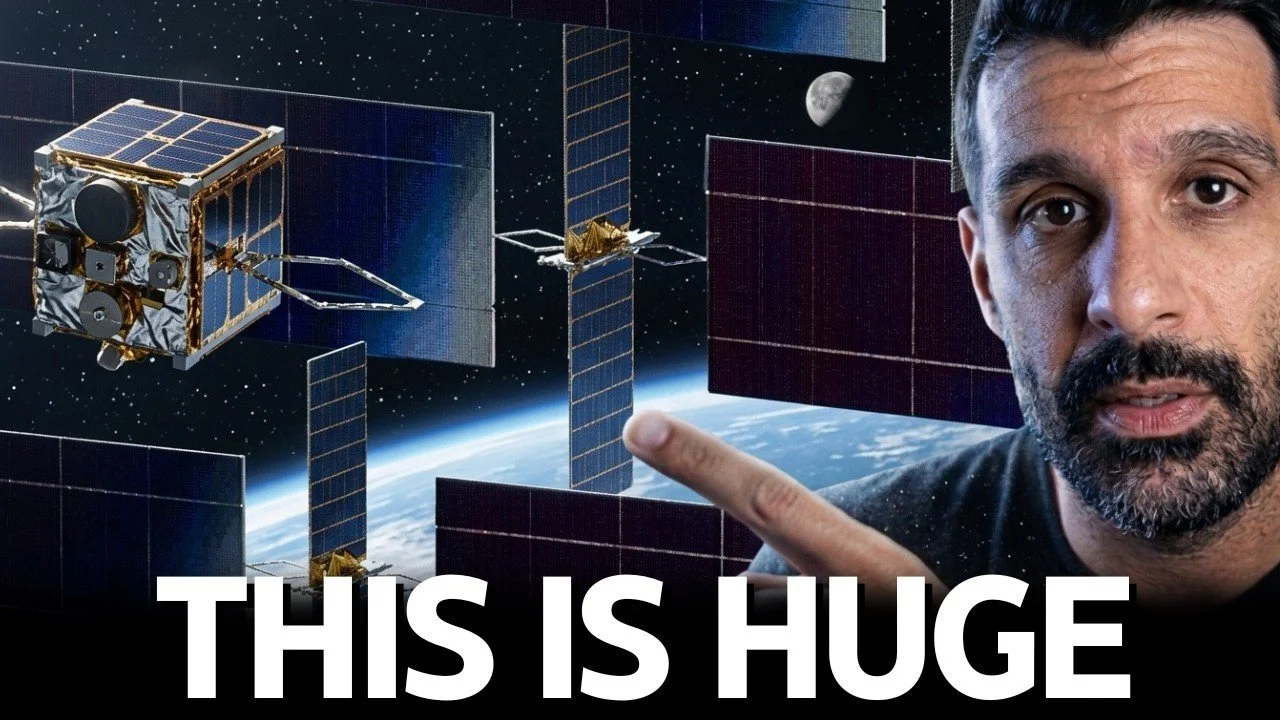
SpaceX Bets Public Markets on AI-1 Orbital Compute
A 70-meter AI satellite, an $85 billion IPO, and a thermal math problem that decides whether space compute ever undercuts Earth.
SpaceX Asks the FCC to Clear a 100,000-Satellite Starlink Network Built on Starship
The third-generation, non-geostationary system would spread up to 100,000 satellites across two very-low-orbit shells packed with beamforming and optical inter-satellite links to multiply capacity, but the entire plan hinges on regulators clearing spectrum and Starship becoming routine enough to fly

Musk Lifts Tesla Voting Power to 20% Days After the $1.7 Trillion SpaceX-xAI IPO
By exercising 304 million options from his 2018 award five days after the newly merged SpaceX-xAI began trading, Musk is quietly assembling the control stack needed to bolt Tesla onto a nascent $4 trillion machine.
SpaceX Puts a Fuel-Free Lunar Railgun on Its Roadmap, Reviving a 1977 MIT Machine
A magnetic mass driver that flings cargo off the Moon on electricity alone landed in SpaceX’s S-1 filing, and the physics behind it - 22 times cheaper than escaping Earth - has had working prototypes sitting on a shelf for nearly 50 years.
Musk Warns Optimus Production Will Start Extremely Slow at Fremont
Tesla is building a modular Optimus line in Fremont designed for iteration before scale, and the deliberately slow start is the strongest signal yet that the humanoid robot is a twenty-year manufacturing story rather than a near-term revenue event.

SpaceX Bets Its IPO on Turning Space-Based Sunlight Into Intelligence With AI-1 Orbital Data Centers
Alongside its historic public offering, SpaceX unveiled AI-1, a solar-powered satellite carrying a 150-kilowatt computing payload, revealing a vertically integrated plan to manufacture cognition from the cheapest energy in the solar system.

SpaceX Absorbs xAI and Bets Its $1 Trillion Revenue Target on Compute, Not Rockets
Fresh off the largest IPO in history, Elon Musk is claiming SpaceX can multiply revenue 54x by 2030 — a promise that only makes sense because the company quietly became an AI infrastructure play whose addressable market it pegs at $28.5 trillion.
SpaceX's IPO Bets Everything On One Number: The 95% Collapse In Cost-To-Orbit
A $1.77 trillion valuation that careful models can’t justify makes perfect sense once you see the cost of putting internet bandwidth into orbit fall from $6.55 to 30 cents per megabit per second, and why the same curve unlocks data centers in space.
SpaceX Debuts Public With 4% Float as Retail Gets Slivers and Starlink Storms Mainstream Ads
A thin tradable float, staggered lockup releases starting in August, and a sudden Starlink advertising blitz across the NBA Finals, UFC, and T-Mobile push notifications reframe SpaceX as a multi-revenue ecosystem the moment it hits the open market.

The Trillion-Dollar Threshold That Changes Little—and Everything
Why Elon Musk’s valuation milestone aligns with Gilded Age peaks in real terms while concentrating unmatched leverage over space, connectivity, and physical AI.
Elon Musk’s net worth crossing into trillion-dollar territory stems from equity stakes in companies that survived near-collapse and scaled into dominant positions across electric vehicles, reusable rocketry, satellite broadband, and AI-driven automation. The number itself functions mostly as a market-assigned price tag on shares rather than accessible cash, and when measured against the full size of the U.S. economy it sits at roughly the same slice once commanded by the most powerful industrialists of the early twentieth century. At the same time, operational control over launch capacity, global internet infrastructure, frontier AI models, and large-scale robotics data gives one individual influence over foundational technologies that no private citizen has previously held at this breadth.
Key Takeaways
Net worth in this range equals shares outstanding multiplied by current market price, with less than one-tenth of one percent typically held as liquid cash.
The fairest historical comparison uses wealth as a percentage of total economic output; Musk’s position lands near three percent of today’s U.S. economy, comparable to John D. Rockefeller’s roughly two-to-three percent share in 1913.
Tesla and SpaceX both approached bankruptcy in late 2008; concentrated founder ownership and willingness to risk remaining capital allowed both to reach leadership in autonomy, energy storage, reusable orbital launch, and satellite internet.
An IPO converts private valuation guesses into continuous public market pricing for shares already owned, without creating new assets for the holder.
Ultra-high-net-worth individuals commonly borrow against pledged stock at low interest rather than sell, since loans do not count as taxable income; proceeds have largely flowed back into the same companies.
Federal Reserve data show the top one percent of households now hold 32 percent of U.S. wealth and the top 0.1 percent hold around 14 percent—levels higher than at any point since tracking began in 1989.
Proposals for annual wealth taxes face practical hurdles demonstrated by multiple European countries that later repealed similar levies after they delivered minimal revenue, proved difficult to administer on private assets, and prompted capital relocation.
SpaceX currently accounts for the majority of mass placed into orbit by humanity in a given year, while Starlink serves ten million subscribers across more than one hundred countries and has proven decisive for connectivity in active conflicts.
Tesla’s real-world driving data and AI training pipeline support both autonomous vehicles without steering wheels or pedals and the development of humanoid robots intended for general physical tasks.
Continued execution on satellite mega-constellations, lunar and Mars infrastructure, high-volume robotaxis, and tens of millions of humanoid robots could scale Musk’s equity value well beyond current levels if those ventures succeed at planned magnitude.

The Master Plan You Can't Unsee: Wiring Civilization's Next Foundation
How energy systems, self-driving fleets, humanoid robots, satellite networks, and orbital infrastructure are stacking into one coherent architecture for abundance—and why Mars ambitions are already reshaping what is possible on Earth.
A single Tesla completing a 13,000-mile coast-to-coast journey on full self-driving in January 2026 without any human intervention on the controls was more than an autonomy milestone. It marked the visible activation of something larger: a stacked foundation of technologies now advancing in parallel across energy, transport, labor, intelligence, connectivity, and space. The most valuable pattern is not any single product but the way these layers reinforce one another, with physics-first requirements for multi-planetary settlement acting as the forcing function that accelerates practical progress everywhere else. Cost curves in AI, robotics, and solar are collapsing at the same moment, pointing toward a period where intelligence, physical work, and energy become abundant enough to reorder how economies measure value.
Key Takeaways
Eight interlocking layers—energy generation and storage, physical transport, humanoid robotics for labor, AI agents for knowledge work, frontier model intelligence, global satellite networks, off-world transport, and direct brain-computer interfaces—are being built together rather than as isolated bets.
Reusable orbital-class rockets and mass-market electric vehicles both moved from expert consensus of impossibility to routine operation, showing that compressed timelines often precede large-scale delivery once the underlying engineering locks in.
Hardware and data integrations across projects, such as satellite antennas embedded in vehicle roofs, energy storage powering training clusters, and vehicle fleets supplying training data for robots, create closed loops that multiply progress beyond what any single company could achieve alone.
The requirement to settle Mars drives demand for electric propulsion, robotic construction crews, subsurface habitats, and reliable interplanetary links—technologies that simultaneously relieve energy, labor, infrastructure, and connectivity constraints on Earth.
Observed cost trajectories show AI inference dropping by roughly 36 times in two years, robotic labor approaching a couple of dollars per hour at scale, and solar generation costs having already fallen 99 percent over recent decades, with further declines continuing.
Physical infrastructure at new orders of magnitude, including chip fabrication targeting 100–200 billion specialized AI units per year and launch costs falling toward $10–100 per kilogram to orbit, is enabling both terrestrial AI expansion and space industrialization at the same time.

SpaceX’s $2 Trillion IPO: The AI Infrastructure Empire Hiding in Plain Sight
A single $15 billion annual compute contract is about to flip the entire narrative on the company’s reported losses—and reveal why this might be the most important public offering of the decade.
SpaceX has filed its S-1 for what is set to become the largest IPO in history, targeting a valuation near $2 trillion. While headlines fixate on last year’s nearly $5 billion loss, the filing exposes a far more strategic picture: a company that has evolved into three distinct businesses, with Starlink generating massive cash flow to bankroll an aggressive push into AI compute infrastructure—including orbital data centers that could solve Earth’s crippling power and cooling constraints.
Key Takeaways
SpaceX is on track for the biggest IPO ever, raising potentially three times more capital than Saudi Aramco’s 2019 record at a $2 trillion-plus valuation.
Anthropic has committed to paying SpaceX $1.25 billion every month—$15 billion per year—through May 2029 for exclusive access to its AI compute capacity.
The company now reports in three segments: Space (rockets), Connectivity (Starlink), and AI (data centers and related operations acquired via xAI).
Starlink delivered $11 billion in 2025 revenue—61 percent of total company sales—with $4 billion in operating income and roughly 63 percent adjusted EBITDA margins on a hardware business.
Starlink grew nearly 50 percent year-over-year, now serves 10 million subscribers in 164 countries, and powers direct-to-cell service for millions of devices monthly.
The AI segment, currently showing operating losses, is positioned to swing sharply profitable once the Anthropic revenue begins flowing, potentially making the entire company profitable as early as 2026.
SpaceX plans to launch orbital AI compute satellites as early as 2028, leveraging constant solar power and infinite heat dissipation in space.
Elon Musk will retain overwhelming voting control post-IPO through a dual-class share structure, ensuring long-term focus on Mars colonization.

The AI War Is Over: Only Two Factions Will Dominate by 2030
Compute compounds like nothing in history—turning a handful of leaders into an unassailable advantage while the rest get acquired, commoditized, or left behind.
In the age of AI, the most valuable resource isn’t land, oil, or even raw processing power. It’s the self-reinforcing cycle where superior models draw more users, those users generate higher-quality data, and that data trains even stronger models. This flywheel accelerates with every iteration, widening the gap between frontrunners and everyone else. Eight major factions are battling for control of this cycle. Most coverage calls it competition. The math reveals something far more decisive: by 2030, only two will hold the keys to the intelligence layer that underpins the global economy.
Key Takeaways
AI’s compounding loop—models, users, data, and compute feeding each other—creates exponential separation that no physical resource war has ever matched.
Training costs have already jumped roughly tenfold in three years and could exceed a billion dollars per frontier model by 2027, pricing out all but the deepest-pocketed players.
The real bottleneck isn’t just GPU counts; high-bandwidth memory (HBM) determines how effectively massive clusters work together.
Labs now train on 100 times more data than classic scaling laws recommend, shifting the goal from efficiency to massive user retention and cheap inference at scale.
OpenAI leads in users but bleeds cash on inference and talent; Microsoft locks in enterprises; Meta uses open-source to neutralize monopoly pricing; China pursues cheap, efficient models despite chip limits; Google owns unmatched data, custom chips, and infrastructure; Anthropic bets on safety for enterprise and government; the Musk stack integrates compute, real-world data, and connectivity under one roof; regulators slow Western progress while China accelerates.
Google wins through substrate dominance—proprietary data, power-efficient TPUs, and quiet efficiency gains. The Musk integrated stack wins through vertical control of compute scale, fleet data, and end-to-end ownership.
The other six will likely be absorbed, reduced to distribution layers, or confined to regional/price-sensitive markets.
For individuals: focus on skills AI cannot synthesize on demand; invest in the infrastructure winners; prepare children for an economy where intelligence is abundant and cheap.

The Infrastructure Play That Could Decide AI's Next Decade
How record deployment speeds, orbital power constraints, and runaway token demand are forcing a complete rethink of who can actually deliver abundant intelligence at scale.
The real bottlenecks in advanced AI have shifted from model architecture to physical execution. Legal maneuvers around major labs have exposed governance friction without resolving underlying questions about long-term stewardship. At the same time, the ability to stand up massive compute clusters in months rather than years, combined with the hard physics of powering AI workloads off-planet, is creating asymmetric advantages for players who control both the chips and the energy layer. Most overlooked: even steep gains in efficiency will not flatten demand. New applications in video synthesis, persistent agents, and physical robotics multiply token consumption faster than optimization curves can contain it. The organizations that solve the manufacturing, power, and orbital constraints first will set the cost floor for intelligence for years to come.
Key Takeaways
Legal resolutions on procedural grounds in AI governance cases can inflict lasting reputational damage while leaving core structural issues unaddressed, increasing the likelihood of internal leadership changes at scaled labs rather than wholesale unwinds of their corporate form.
Model performance has split along task lines, with some systems delivering superior cost-performance on coding workloads and others advancing faster on general capabilities, accelerated by targeted talent inflows and selective early access programs.
First-principles manufacturing discipline and direct production-line leverage have compressed large-scale GPU cluster deployment to roughly four months, enabling potential cost leadership when paired with integrated renewable generation.
AI satellites operating in higher orbits face rapid solar panel degradation from elevated radiation, requiring specialized space-grade photovoltaics whose global production remains limited to a few megawatts per year and concentrated supply chains.
Token demand follows Jevons paradox dynamics: efficiency improvements from distillation and specialized models unlock entirely new use cases in generative media, autonomous agents, and robotics that drive net consumption sharply higher.
Electricity prices in key technology corridors have risen 200 percent or more in recent years, underscoring the need for co-located generation, deregulation of new capacity, and expanded domestic solar manufacturing to prevent cost curves from throttling AI deployment.
National leadership selection patterns that favor engineering execution correlate with faster delivery of complex infrastructure projects, creating competitive edges in the physical layer of intelligence.