

Boring Company’s Vegas Loop Is Quietly Building America’s Biggest Transit System
With tunneling under $10 million a mile, point-to-point Teslas, and airport lines nearly live, the network already moves stadium-scale crowds and is racing toward top-tier U.S. ridership.

The Infrastructure Play That Could Decide AI's Next Decade
How record deployment speeds, orbital power constraints, and runaway token demand are forcing a complete rethink of who can actually deliver abundant intelligence at scale.
The real bottlenecks in advanced AI have shifted from model architecture to physical execution. Legal maneuvers around major labs have exposed governance friction without resolving underlying questions about long-term stewardship. At the same time, the ability to stand up massive compute clusters in months rather than years, combined with the hard physics of powering AI workloads off-planet, is creating asymmetric advantages for players who control both the chips and the energy layer. Most overlooked: even steep gains in efficiency will not flatten demand. New applications in video synthesis, persistent agents, and physical robotics multiply token consumption faster than optimization curves can contain it. The organizations that solve the manufacturing, power, and orbital constraints first will set the cost floor for intelligence for years to come.
Key Takeaways
Legal resolutions on procedural grounds in AI governance cases can inflict lasting reputational damage while leaving core structural issues unaddressed, increasing the likelihood of internal leadership changes at scaled labs rather than wholesale unwinds of their corporate form.
Model performance has split along task lines, with some systems delivering superior cost-performance on coding workloads and others advancing faster on general capabilities, accelerated by targeted talent inflows and selective early access programs.
First-principles manufacturing discipline and direct production-line leverage have compressed large-scale GPU cluster deployment to roughly four months, enabling potential cost leadership when paired with integrated renewable generation.
AI satellites operating in higher orbits face rapid solar panel degradation from elevated radiation, requiring specialized space-grade photovoltaics whose global production remains limited to a few megawatts per year and concentrated supply chains.
Token demand follows Jevons paradox dynamics: efficiency improvements from distillation and specialized models unlock entirely new use cases in generative media, autonomous agents, and robotics that drive net consumption sharply higher.
Electricity prices in key technology corridors have risen 200 percent or more in recent years, underscoring the need for co-located generation, deregulation of new capacity, and expanded domestic solar manufacturing to prevent cost curves from throttling AI deployment.
National leadership selection patterns that favor engineering execution correlate with faster delivery of complex infrastructure projects, creating competitive edges in the physical layer of intelligence.
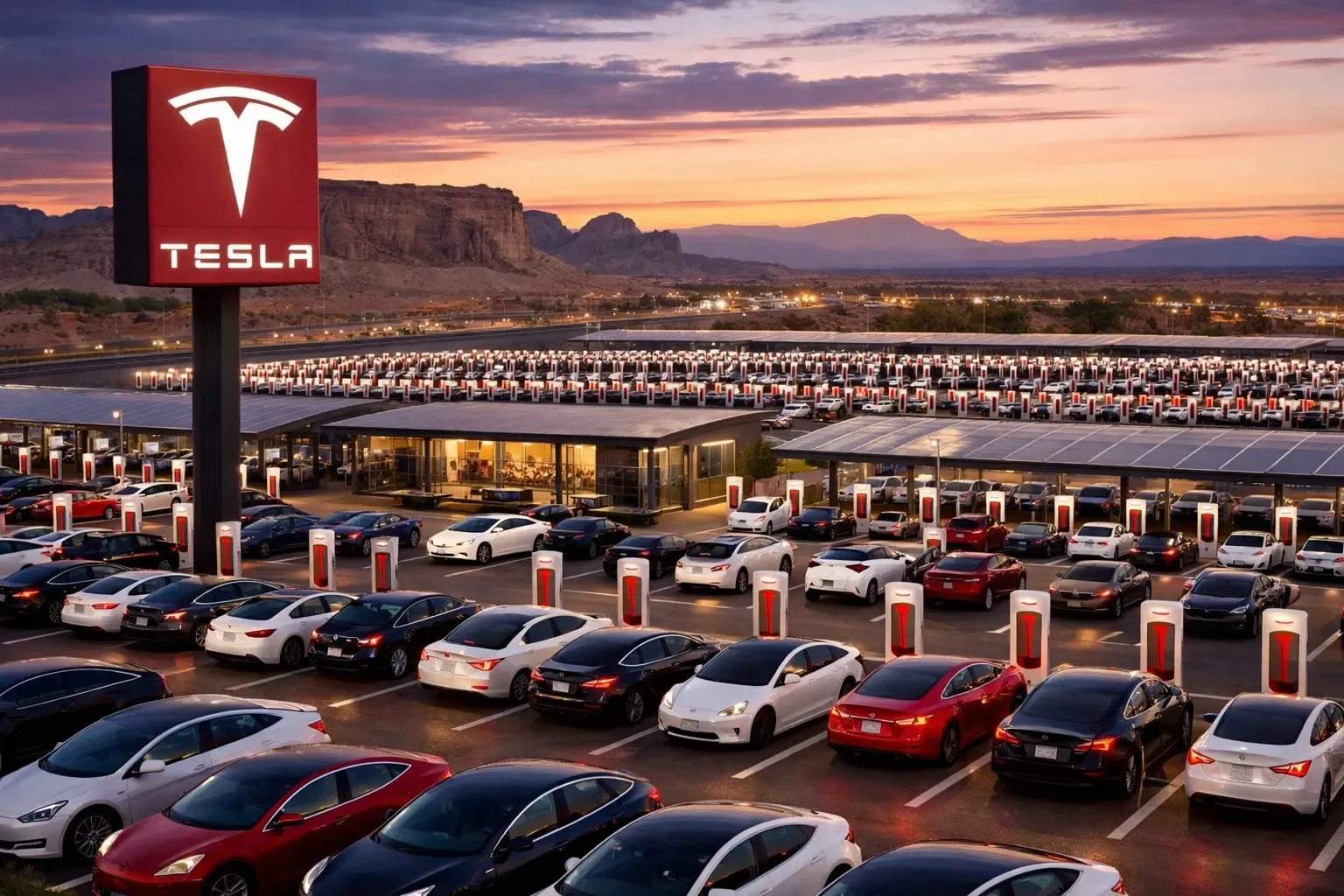
Tesla's Quiet Infrastructure Revolution: Off-Grid Chargers, Business Charging, and the AI Chip Moonshot
How Tesla is quietly building the backbone for massive energy + compute scale while the world debates geopolitics and AI backlash.
The most valuable signals right now aren't in the headlines. They're in the unglamorous but hyper-scalable infrastructure moves: massive off-grid Supercharger sites that double as potential compute nodes, a new program letting businesses host and price their own chargers, and the imminent kickoff of a gigantic in-house AI chip fabrication project. These pieces form the foundation for Tesla's energy storage dominance, fleet-wide inference, and independence from fragile global supply chains.
Key Takeaways
Tesla launched Supercharger for Business in mid-March 2026, allowing property owners to install and set pricing on Superchargers while Tesla handles hardware, software, maintenance, and network integration.
The massive Lost Hills "Project Oasis" station in California—164 stalls, 11 MW solar farm, 39 MWh battery storage—operates primarily off-grid and demonstrates a replicable model for high-utilization solar + battery sites that could host AI inference during low-EV demand periods.
Tesla's Terafab project launches March 21, 2026: a multi-billion-dollar effort to build a 2nm-class semiconductor fab targeting 100–200 billion custom AI chips annually for Dojo, vehicles, and distributed compute.
Geopolitical risks around Taiwan and advanced chip supply remain acute, but Tesla's vertical integration push reduces long-term exposure.
AI graphics breakthroughs like NVIDIA's DLSS 5 show photoreal neural rendering becoming mainstream, yet face cultural resistance that may be amplified by competing interests slowing U.S. AI progress.
Agentic AI tools (Claude Code, OpenRouter, local models) are already automating paperwork, development, and operations—shifting from scarcity to abundance mindsets in creative and professional fields.

The Robot Revolution: Reshaping Global Power Through AI and Space
Exploring how massive infrastructure builds, demographic crises, and robotic economies could redefine nations and unlock abundance.
The world stands at a pivotal moment where technology intersects with geopolitics in unprecedented ways. Rapid advancements in AI, robotics, and space infrastructure promise to upend traditional power structures, while countries grapple with internal challenges like economic instability and aging populations. This newsletter dives into these dynamics, revealing opportunities for tech-driven growth amid global uncertainties.
Key Takeaways
Economic pressures and youth demographics are fueling unrest in oppressive regimes, creating openings for pro-Western shifts that could weaken adversaries like Russia and China.
China's aggressive infrastructure investments in remote areas aim to secure unpopulated regions, but demographic collapse from past policies threatens long-term viability.
Surveillance-heavy governance stifles innovation and free speech, limiting a nation's potential compared to open systems that attract global talent.
Robotics will eliminate labor cost advantages for low-wage economies, positioning countries with strong AI ecosystems—like the US—for dominance.
Space-based AI and manufacturing could detach economies from Earth-bound constraints, making national borders less relevant as corporations lead exploration.
Allocating a portion of robot labor to public good—around 15%—could achieve sustainable abundance without relying on inefficient government taxation.