

Starlink Surpasses 10 Million Users as SpaceX Scales Gigawatt AI and Readies Orbital Compute
The satellite network's dominance, direct-to-phone expansion, and space-based AI infrastructure plans point to a tightly integrated system built for both global connectivity and frontier intelligence workloads.
Starlink's active user base crossed 10.3 million by the end of Q1 2026 after more than doubling in the prior year. Its constellation now accounts for roughly three-quarters of every active maneuverable satellite in orbit, while coverage spans more than 164 countries and territories serving over three billion people. At the same time, the company has stood up gigawatt-scale AI training infrastructure on the ground and is advancing plans to place portions of that compute in orbit, powered by sunlight and cooled by radiation.
Key Takeaways
Starlink reached approximately 10.3 million users by the end of Q1 2026, reflecting more than 100 percent year-over-year growth from roughly 4.4 million users at the end of 2024.
The network now represents about 75 percent of all active maneuverable satellites currently in orbit.
Service is live across more than 164 countries and territories, providing coverage to populations exceeding three billion people.
Adoption is accelerating in aviation with frequent new airline integrations, while enterprises increasingly use Starlink as primary or backup connectivity for operational resilience.
Starshield operates as a dedicated constellation delivering secure capabilities tailored to U.S. government needs.
The first-generation direct-to-device service, activated with 650 satellites and partnerships involving 30 mobile network operators, has already demonstrated coverage for 1.9 billion people and confirmed real demand.
A second-generation direct-to-device system is designed to deliver full 5G performance directly to standard phones, targeting connectivity for the remaining three billion people currently outside reliable networks.
Colossus Two has been deployed as the world's largest coherent supercomputer, incorporating NVIDIA GB300 processors as the first gigawatt-scale training cluster along with the first gigawatt-scale Megapack battery installation and early large-scale use of both GB200 and GB300 hardware.
Orbital AI compute capacity is under active development for deployment within the next couple of years, leveraging solar power generation and radiative cooling in the space environment.
Proven satellite subsystems already in production—including ion propulsion thrusters, inter-satellite laser links, flight computers, and reaction wheels—remove key technical barriers to placing AI workloads in orbit.
Vertical integration across launch, satellites, connectivity, and AI creates a self-reinforcing loop: better infrastructure improves model quality and lowers token costs, which in turn funds further capacity expansion.

AI: The New Nuclear Arms Race Redefining Global Power
Why the race for artificial superintelligence mirrors the atomic age—and what it means for the next century of dominance
The parallels between today's AI competition and the nuclear era of 1945 are striking and unavoidable. Just as the atomic bomb reshaped alliances, economies, and military strategies overnight, AI infrastructure is forcing nations to realign around control of compute, energy, data pathways, and deployable systems. The United States holds a commanding lead in frontier models and advanced semiconductors, but China advances rapidly in scaled deployment, energy buildout, and open-source disruption. Every tariff, reactor restart, satellite constellation, and robot factory forms part of a deliberate strategy to secure civilizational advantage.
Key Takeaways
The U.S. treats advanced AI chips as strategic weapons, imposing export controls and tariffs equivalent to munitions regulations to maintain its monopoly on the "uranium" of the AI age.
Global data center power demand surges toward levels rivaling entire nations' electricity use, pulling nuclear restarts, natural gas, and renewables into service—China deploys solar and small modular reactors at unmatched speed.
Orbital infrastructure emerges as a game-changer, with plans for massive solar-powered satellite networks to host AI compute beyond earthly grid constraints.
Humanoid robots and autonomous vehicles represent the "warheads"—physical AI embodiments poised to transform a $45+ trillion global labor and transportation market.
The U.S. benefits from uncapped private innovation and capital accumulation, while China's centralized system caps individual power but excels in coordinated infrastructure scaling.
Economic disruption hits hardest in the middle class unless offset by policies like universal basic income or widespread entrepreneurship; the top and bottom socioeconomic tiers stand to gain most from abundance.
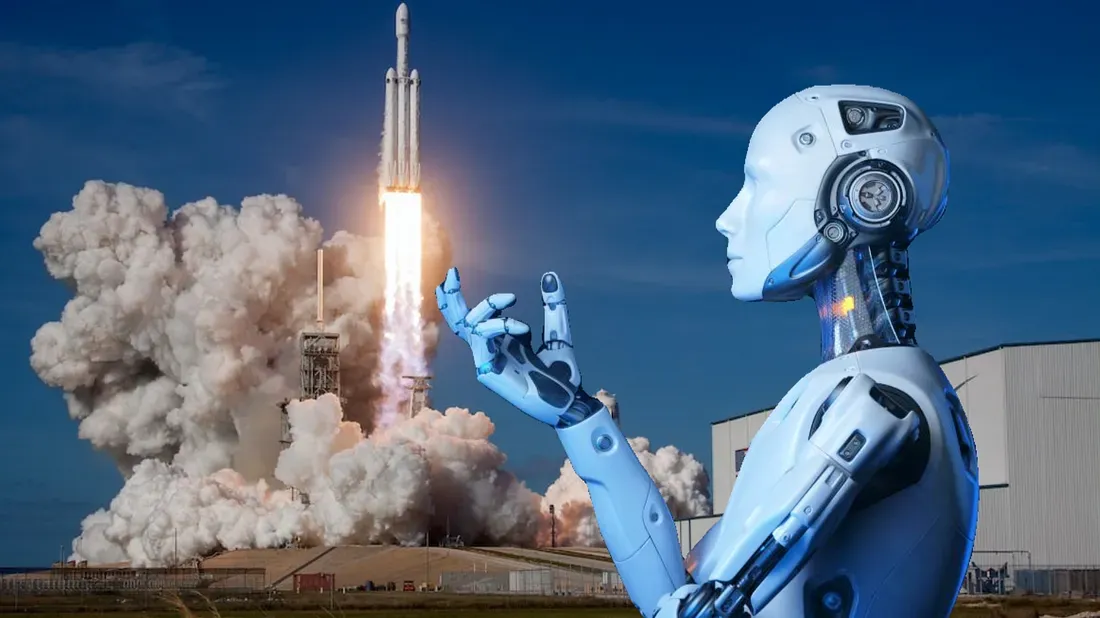
Elon's Cosmic Leap: AI Heads to Space with Satellites and Lunar Rail Guns
Revolutionizing Compute Power by Tapping Infinite Solar Energy—And It's Happening Sooner Than You Think
Space offers a breakthrough for AI's biggest bottleneck: power. By shifting compute to orbit and beyond, we could add massive capacity without Earth's constraints, accelerating advancements in every sector. This shift promises to scale AI far beyond current limits, opening doors to a true space economy.
Key Takeaways
AI development on Earth is stalled by electricity shortages, with data centers demanding power equivalent to small cities.
Orbital satellites in constant sunlight solve power and cooling issues, enabling 100 gigawatts of annual AI compute addition without competing for terrestrial resources.
In under three years, space-based AI could become the cheapest compute option, disrupting traditional data center economics.
Lunar factories using local materials and electromagnetic rail guns could launch satellites at scale, achieving over 100 terawatts per year—hundreds of times U.S. total power generation.
This accelerates AI capabilities, reshapes industries, and positions humanity toward multiplanetary expansion with self-sustaining space infrastructure.

The Drone Revolution: AI's Grip on Tomorrow's Battlefields
Why Autonomous Tech Isn't Sci-Fi Anymore—And How It Shapes Global Power
The landscape of warfare is shifting faster than ever, driven by advances in drones and artificial intelligence. At the core are breakthroughs that make machines not just tools, but decisive forces on the battlefield. Key insights reveal how production scales, human limits, and space-based systems could determine winners in future conflicts, urging a rethink of defense strategies now.
Key Takeaways
Drones and AI dominate modern warfare, as seen in ongoing conflicts where volume and autonomy outpace human involvement.
Localized AI in drones enables independent decision-making, raising risks of unchecked escalation if not managed carefully.
Human soldiers face increasing dangers at the front lines due to precision tech like computer-guided snipers, pushing toward drone-only engagements.
Scaling drone production is critical; superior kill ratios mean little without overwhelming numbers to counter adversaries.
Space communications and positioning systems provide unbreakable advantages, essential for coordinating drones and maintaining operations.
Neural interfaces could bridge human cognition with AI, boosting bandwidth for control and mitigating risks of AI surpassing human oversight.
Innovation stems from first-principles thinking: question requirements, delete unnecessary elements, optimize wisely, and accelerate processes.
Leadership in tech demands hands-on expertise; leaders must understand the engineering to evaluate teams and drive progress effectively.
Curiosity drives success—broad learning across fields fosters cross-pollination of ideas for breakthrough solutions.