

New Luddites of AI: Why Bans Fail
The AI Data Center Moratorium Act revives a 200-year-old pattern of trying to kill disruptive technology by attacking its infrastructure. This video traces the Luddite uprising through failed automobile, nuclear, and GMO restrictions to reveal why such bans backfire—and what actually worked for workers.
Key Takeaways
Original Luddites were England’s most elite craftsmen protesting exploitation, not fearing machines.
Every major tech restriction (Red Flag Act, Three Mile Island fallout, EU GMO rules) shifted innovation abroad while the banning country fell behind.
AI data centers consume city-scale power and accelerate automation, but a U.S. moratorium only moves training to China, UAE, or Singapore.
Displacement is real; the solution is sharing gains through retraining, energy offsets, and policy—not halting hardware.
Luddite unrest directly paved the way for legal unions and the first Factory Acts protecting workers.
From Nottinghamshire looms in 1811 to Virginia server farms in 2026, the pattern repeats: legitimate fears about jobs, energy, and inequality meet the wrong fix. Banning physical buildings never stops the underlying capability—it just exports leadership. The Luddites’ real legacy wasn’t machine-breaking; it was the political pressure that forced labor reforms. Today’s debate should focus on the same: how to distribute AI’s massive productivity windfall so the transition lifts everyone instead of leaving millions behind.

Farzad Q&A - 04/07/2026
Join Farzad and his community for an open, unscripted Q&A about technology, investing, business, and the future of innovation. In every session, Farzad answers community questions, breaks down complex topics with clarity, and shares practical insights on building, scaling, and thinking long-term in tech.

Starship Catch: Unlocking Trillion-Dollar Space Economy
Starship's successful booster catch signals the dawn of a new space economy poised to reshape global industries through unprecedented cost reductions and novel in-space production capabilities.
Key Takeaways
Launch costs drop from $54,000/kg (Shuttle era) to $10-20/kg target, enabling profitable space businesses.
In-orbit manufacturing creates unique materials and pharmaceuticals impossible under Earth's gravity.
Orbital solar mirrors and AI compute platforms leverage vacuum advantages for energy and processing.
Robotic swarms will build and maintain orbital infrastructure at $2/hour effective labor cost.
Second-order effects will spawn trillion-dollar industries we can't yet imagine.
The dramatic reduction in space access costs mirrors historical breakthroughs like container shipping and internet bandwidth. Companies are already developing mirror satellites for continuous solar power, microgravity crystal production for superior semiconductors and drugs, and orbital data centers powered by unlimited solar energy and natural heat dissipation. Combined with advanced humanoid robots, this creates a scalable industrial civilization in orbit, transforming space from a domain of exploration to one of high-margin commerce and innovation.

Elon Musk's TeraFab: $25B AI Chip Bet
Musk's TeraFab represents a bold leap in semiconductor strategy, bypassing traditional supply constraints through smart engineering. It promises faster innovation cycles and optimized hardware for AI inference, delivering efficiency gains critical for next-gen autonomy and robotics.
Key Takeaways
$25B factory targeting 1M wafer starts/month for custom inference chips and D3 orbital processors
Overcomes EUV scarcity (only ~50 machines/year globally) via chiplet architecture and focused use of advanced nodes
In-house mask shop enables 5-10x faster design iterations (weeks vs. months)
Advanced packaging integrates compute (2nm), memory (5nm), and I/O (7nm) for higher yields and flexibility
Custom silicon optimizes for specific AI workloads, boosting power efficiency, reducing latency, and increasing throughput
Positions Tesla with a compounding moat in robots, FSD, and space-based AI compute
TeraFab isn't about matching TSMC's volume production immediately. Instead, it's a design-to-packaging powerhouse under one roof, enabling weekly chip optimizations tailored to Tesla's specific AI models. By using chiplets, only critical compute cores require scarce EUV lithography at 2nm, while other components use older nodes. This sidesteps supply constraints while optimizing silicon specifically for inference in Optimus robots, autonomous driving, and orbital satellites. The integrated approach addresses geopolitical risks around Taiwan and the Netherlands' EUV monopoly, setting up a structural edge that compounds over time.
Terafab: Tesla's Insane Chip Factory Gamble
The most valuable insight: the semiconductor industry’s real limiting factor has quietly shifted from energy to extreme-ultraviolet lithography machines—and Tesla’s TeraFab plan is betting it can solve that at planetary scale.
Key Takeaways
ASML ships only 50–60 EUV machines per year; hitting terawatt compute requires thousands of them.
Every gigawatt of advanced chips demands roughly 3.5 EUV tools—OpenAI’s stated pace alone would consume an entire year’s global output in months.
Older DUV (7 nm+) nodes scale faster and have multiple suppliers, but trade off efficiency and cost-per-token.
Next-gen approaches like Lace’s helium-beam lithography promise finer features and faster digital iteration—no physical masks required.
Rapid masking and packaging breakthroughs could compress design cycles from months to days, accelerating Tesla’s inference chips for vehicles, Optimus, and Starlink.
Long-term flywheel: Grok-level AI + robotics could compress 15-year lithography roadmaps into 3–5 years.
Space-based fabs and Starship launch-cost collapse unlock supply-chain independence beyond Earth-bound constraints.
Tesla’s TeraFab announcement reveals a calculated first-principles attack on the chip supply chain. The goal is terawatts of custom silicon for cars, humanoid robots, AI training clusters, and orbital data centers. Yet the physics are unforgiving: EUV machines rely on supernova-like tin plasma, atomically perfect Zeiss mirrors, and layers upon layers of masks—each new node exponentially harder.
Rather than wait for the industry, Tesla plans to learn inside Samsung’s lines, build an R&D “everything-under-one-roof” prototype in Texas, then iterate at unheard-of speeds on packaging and masking. Older nodes buy breathing room while next-generation helium-beam or high-NA EUV paths are explored. The deeper bet is that AI itself—once powerful enough—becomes the ultimate lithography accelerator, turning engineering bottlenecks into solvable software problems.
Pair that with Starship’s collapsing launch costs and the vision of orbital fabs, and TeraFab stops looking like a single factory. It starts looking like the foundation for compute abundance on a solar-system scale. The road is lumpy, capital-intensive, and politically fraught—but the physics say it’s possible, and Tesla’s track record says they’ll chunk the impossible into daily deliverables until it isn’t.
Farzad Q&A - 03/31/2026
Join Farzad and his community for an open, unscripted Q&A about technology, investing, business, and the future of innovation. In every session, Farzad answers community questions, breaks down complex topics with clarity, and shares practical insights on building, scaling, and thinking long-term in tech.
Tesla's Physical AI Stack Explained
The physical AI revolution requires more than great software—it demands mastery over the entire infrastructure of atoms. Tesla has built precisely that: a fully integrated stack that mirrors how tech giants dominated previous eras.
Key Takeaways
Custom chip fabrication at massive scale powers efficient AI training and inference
Billions of real-world miles generate unmatched data for autonomous driving and humanoid robots
In-house battery chemistry and production lower costs across energy and mobility
Gigafactory manufacturing expertise scales from vehicles to millions of Optimus robots
Strategic land holdings and global supply chains enable true end-to-end control
Each layer feeds the others in a powerful self-reinforcing flywheel
Tesla combines semiconductor fabs, neural network training on fleet data, advanced materials science, precision manufacturing, physical storage assets, and optimized logistics into one cohesive system. This isn't separate businesses—it's layers of a single platform that could reshape industrial economics. While individual competitors may lead in narrow areas, the integrated stack creates platform-level power with significant scale and cost advantages. Long-term, this raises questions around regulatory scrutiny common to dominant tech platforms.
AI Designs mRNA Cancer Vaccine for Dog
This breakthrough reveals how accessible AI tools are now enabling non-experts to navigate complex biology and deliver targeted therapies at unprecedented speed.
Key Takeaways
AI tools analyzed tumor mutations, modeled proteins in 3D, and generated a complete mRNA vaccine construct in hours.
Cheap genome sequencing ($3K AUD) pinpointed unique cancer markers for precise targeting.
mRNA platform—proven in COVID vaccines—enabled rapid customization and delivery via lipid nanoparticles.
Dog experienced 50-75% tumor reduction and regained full mobility despite ongoing conventional treatment.
Regulatory paperwork took longer than the AI-assisted design phase, highlighting the shifting bottleneck in biotech.
Similar personalized mRNA vaccines are already in phase 3 human trials for melanoma, pancreatic cancer, and glioblastoma.
Three competing AI systems from separate labs collaborated seamlessly on one project, previewing practical multi-AI workflows.
The story centers on converging exponential technologies: AI that instantly processes biomedical literature and designs molecules, plummeting genomics costs that make individual tumor profiling routine, and mature mRNA manufacturing that turns digital blueprints into injectable therapies within weeks. A Sydney-based AI consultant sequenced his rescue dog’s healthy and cancerous DNA, used the models to identify neoantigens on the mutated C-KIT protein, and produced a custom vaccine construct. After ethics approval and expert collaboration at top Australian research institutes, the first doses led to dramatic tumor shrinkage. While this single case lacks a control group and combined therapies were involved, the timing and results align with ongoing human trials showing up to 49% reduced recurrence risk in melanoma. The real signal is clear: the expertise wall in medicine is crumbling, shifting the primary challenge from technological limits to regulatory frameworks built for an earlier era of one-size-fits-all drugs.
Elon Musk's $20B Taiwan Chip Crisis Insurance
The AI revolution rests on one fragile island. Advanced semiconductors power everything from autonomous vehicles to trillion-parameter models, yet 90% of the world’s cutting-edge supply comes from a single geopolitical flashpoint. A potential China-Taiwan conflict could trigger the largest economic shock since World War II—$10 trillion in global GDP losses in year one—while advanced-chip shortages linger for years.
Key Takeaways
TSMC dominates 64–70% of global foundry revenue and 90% of sub-7nm production powering AI, EVs, and defense systems
China’s 2027 invasion window is real; prediction markets price a military clash at 11–18% by end of 2027
A blockade or invasion would halt AI training, smartphone production, and autonomous fleets for 3–5 years
Terra Fab targets 2nm process at massive scale—custom silicon optimized for Tesla FSD, Optimus, Dojo, and xAI workloads
Full vertical integration: chips made with Tesla energy, potentially by Tesla robots, eliminating Taiwan dependency
Sovereign AI wave accelerates—US, Europe, and Saudi Arabia are all racing to onshore compute infrastructure
Elon Musk is executing the same playbook that turned Tesla into the battery king: build it yourself at unprecedented scale. Terra Fab isn’t competing with Nvidia across every workload—it’s laser-focused on Tesla and xAI’s unique data flywheel of real-world driving, robotics, and training. While every other AI giant still relies on TSMC fabs in Taiwan, Musk secures an independent US supply chain that keeps Tesla advancing even if the island goes dark. The move also signals the new reality: AI infrastructure is now treated as critical national infrastructure, not just a supply-chain line item. Whether Taiwan stays stable or not, custom silicon at this scale creates a compounding moat that deepens with every generation—exactly the kind of asymmetric bet that turns billion-dollar risks into trillion-dollar opportunities.
Elon Musk Neuralink Helps ALS Patient Speak Again
Neuralink’s Telepathy implant is turning science fiction into reality for ALS patients. In this powerful demonstration, Ken becomes one of the first to speak again using only his mind, with the device recreating his pre-ALS voice from 2020. The technology offers new hope by directly reading motor cortex signals to restore communication without physical effort.
Key Takeaways
Neuralink’s first product, Telepathy, enables conceptual thought-to-speech for those who lost motor control due to ALS.
Ken received his implant in January 2026 as the second voice participant; surgery was outpatient with discharge the next day.
The system records thousands of channels from a small brain area, decoding intended speech even when silent mouthing is used.
Early sessions show rapid progress: from zero accuracy to fluent sentences like “The rain in Spain stays mainly on the plain” after simple adjustments.
Restores independence, reduces fatigue, and revives personal connections—Ken’s wife hears his original voice saying “I love you” for the first time in years.
Ongoing work focuses on real-time decoding, higher sensor density, and smoother brain-to-voice translation for instantaneous control.
Participants like Ken gain purpose by contributing data and feedback to accelerate BCI development.
Neuralink bypasses the degenerated neural pathways in ALS—like a severed cable—by reading directly from the brain’s speech-related motor cortex. Users intend mouth movements comfortably, and the implant translates those signals into spoken words that sound like the person’s original voice. Initial training involves guided sentence attempts, model training on neural data, and iterative refinement. Ken and his wife, who met on eHarmony and built a life together before ALS struck during COVID, now see renewed hope. The implant not only returns voice but empowers patients to participate in research, maintain relationships, and reclaim agency. Future goals include seamless real-time performance and broader applications to reduce human suffering through advanced brain-computer interfaces.
The Book of Elon: Musk's Success Blueprint
Explore the essential principles that enable outlier results in technology and manufacturing. Discover how purpose fuels resilience, high standards drive breakthroughs, and strategic thinking scales hardware empires.
Key Takeaways
Unique combination of intense drive, technical mastery, and Napoleonic-scale strategy
Purpose as the core fuel for grit and sustained risk-taking on existential missions
Setting standards that push teams past perceived limits to deliver the impossible
Vertical integration and U.S. manufacturing revival as competitive superpowers
Zooming out to planetary problems while scaling solutions for maximum impact
AI and robotics convergence multiplying bold execution for an era of abundance
This exploration examines the system behind groundbreaking outcomes at companies reshaping energy, transport, and space. It covers the psychological and philosophical drivers prioritizing meaningful missions over short-term gains, the leadership tactics for high-performing hardware teams, and the broader playbook for founders navigating complex production, culture, and innovation. The result is a clear framework for building resilient organizations that deliver outsized progress amid rapid technological change—no fluff, just distilled insights ready to apply.
Farzad Q&A - 03/24/2026
Join Farzad and his community for an open, unscripted Q&A about technology, investing, business, and the future of innovation. In every session, Farzad answers community questions, breaks down complex topics with clarity, and shares practical insights on building, scaling, and thinking long-term in tech.
Elon's Digital Optimist: AI Replacing Companies
Elon Musk is building an integrated AI system that turns everyday hardware into powerful digital workers capable of handling complex office tasks without cloud dependency.
Key Takeaways
Combines Grok's high-level reasoning with Digital Optimist's fast local screen processing for seamless automation
Operates on affordable Tesla AI4 chips for near-zero marginal cost versus per-token cloud services
Unified architecture powers Full Self-Driving, Optimus robots, and digital agents, sharing learning across domains
Deploys across parked vehicles, Supercharger network, and idle robots for distributed, always-available compute
Enables massive scale through vertical integration including future solar-powered AI satellites
This architecture flips AI economics by shifting most processing to edge devices. Digital Optimist observes the last few seconds of screen activity in real time, performing clicks, typing, and navigation instantly. It escalates complex decisions to Grok while executing routine workflows locally. The same foundational model trained on driving data, robot manipulation, and now screen interactions improves all applications together. With millions of devices potentially contributing, Tesla creates a unique edge computing network that outperforms centralized cloud agents in speed, reliability, and cost—fundamentally reshaping digital labor and AI infrastructure.
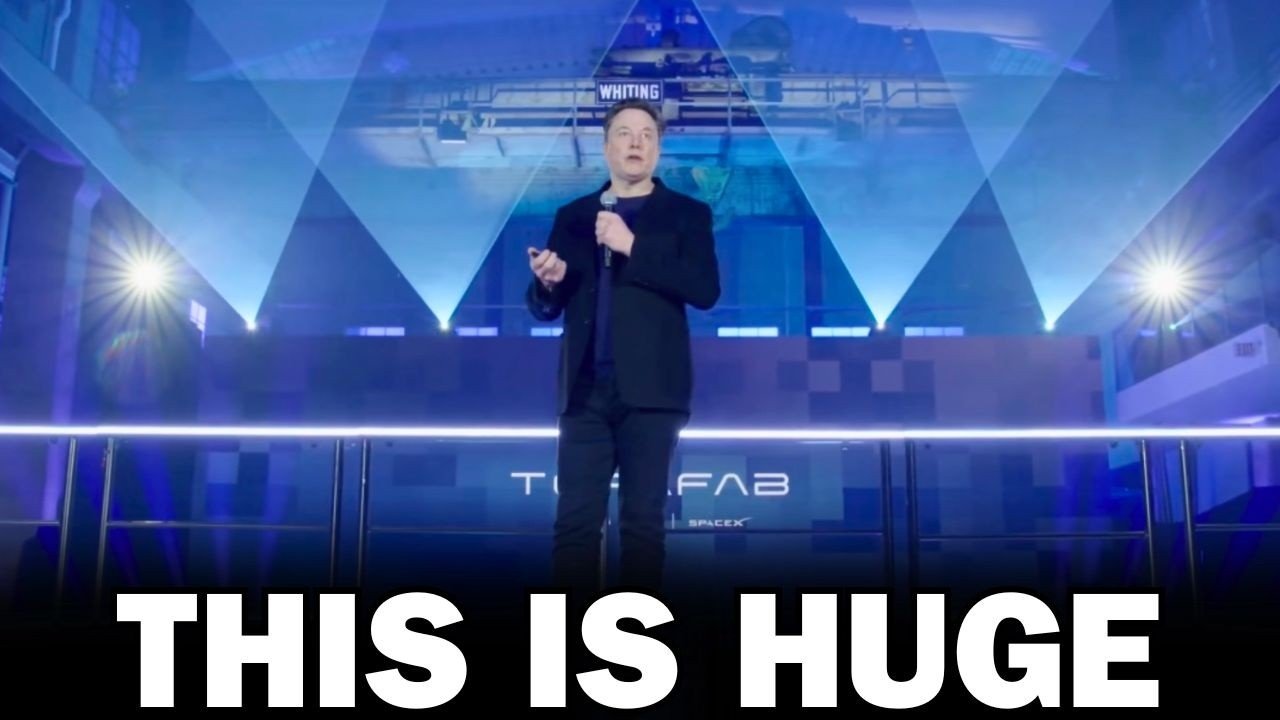
Elon Musk Unveils Tera Fab: Terawatt AI Chip Revolution
In a visionary announcement, Elon Musk reveals the Tera Fab — a groundbreaking semiconductor facility designed to produce terawatts of AI compute annually. This isn’t incremental progress; it’s the missing piece that will power the solar-system-scale intelligence needed for humanity to become a spacefaring civilization.
Key Takeaways
Tera Fab in Austin will integrate logic, memory, packaging, testing, and mask-making in one building for ultra-fast chip iteration — an order of magnitude faster than anywhere else.
Two chip types in development: high-volume edge/inference chips for Optimus robots and vehicles, plus radiation-hardened, high-temperature space-optimized chips.
Starship V3/V4 will deliver the massive payload capacity required to launch 10 million tons to orbit per year, enabling terawatt-scale solar + compute in space.
Space-based AI will soon become cheaper than terrestrial AI due to constant sunlight, 5x+ higher solar efficiency, and no day/night or weather constraints.
Next step after Tera Fab: electromagnetic mass driver on the Moon using Optimus robots to reach petawatt-scale compute and capture a millionth of the Sun’s energy.
Long-term vision: multi-planetary abundance where AI and robotics deliver near-limitless resources, turning science fiction into everyday reality.
The Tera Fab addresses the critical bottleneck: today’s global AI chip output is only about 2% of what’s needed for terawatt-scale compute. While grateful to existing suppliers like TSMC and Samsung, Musk emphasizes the need for dramatically faster scaling, which only an in-house, vertically integrated fab can deliver. By pushing new physics and wild designs in a rapid recursive loop, the project will produce chips tailored for Earth’s edge devices and the harsh realities of space — where power is abundant and radiators can be minimized.
This joint effort across SpaceX (Starship for launch cadence), xAI (gigawatt-scale clusters already built), and Tesla (Optimus and vehicle AI) creates synergies no single company can match. The end goal isn’t just more chips — it’s building the energy and intelligence foundation for cities on Mars, interstellar probes, and ultimately a Type II civilization that taps the Sun’s full potential.
Farzad Q&A - 03/17/2026
Join Farzad and his community for an open, unscripted Q&A about technology, investing, business, and the future of innovation. In every session, Farzad answers community questions, breaks down complex topics with clarity, and shares practical insights on building, scaling, and thinking long-term in tech.
AI Arms Race: Nuclear Parallel in 2026
The AI revolution mirrors the 1945 nuclear breakthrough: a single tech leap that redraws alliances, economies, and power balances. Today, governments and corporations scramble to control the full AI stack—compute, energy, infrastructure, and deployable systems—because dominance here means civilizational edge.
Key Takeaways
Chips function as the "uranium" of AI; US export controls treat advanced semiconductors like munitions to maintain lead over China's rapid domestic alternatives.
Energy demand explodes—data centers could rival entire nations' consumption—prompting nuclear revivals, solar scale-ups, and grid strains, with China advancing faster on renewables.
Infrastructure races ahead: hyperscale data centers, undersea cables, and orbital platforms like evolving Starlink aim to deliver unlimited, grid-independent compute.
Physical AI outputs—humanoid robots, autonomous vehicles, drones—target the $45T+ labor and transport markets, enabling infinite scalable workforces.
Geopolitical realignment echoes the Cold War: nations pick sides in an arms race where first-mover advantages in infinite intelligence could outpace nuclear deterrence.
The full stack builds toward deployable physical AI that operates autonomously in the real world, from factories to space exploration. US strengths in innovation and capital contrast China's manufacturing edge and energy deployment. This isn't abstract tech—it's reshaping jobs (disrupting middle-skill work while boosting extremes), wealth concentration, and global security. The race intensifies daily, with tariffs, reactor deals, satellite launches, and robot factories as coordinated pieces of one strategy.

5 Real AI Threats to Civilization in 2026
Uncover the hidden dangers of AI that could reshape our world, focusing on practical threats backed by current data and trends for a grounded perspective on emerging tech.
Key Takeaways
AI trading algorithms risk synchronized crashes in concentrated markets like the S&P 500.
Cyber attacks amplified by AI target critical infrastructure, exploiting vulnerabilities at unprecedented speeds.
AI lowers barriers to designing bio-weapons, increasing pandemic risks through accessible genetic tools.
Deepfakes erode shared reality, making evidence unreliable and complicating societal responses.
Autonomous AI agents may compound small errors into large-scale failures across industries.
Delve into AI's dual nature: while promising abundance in healthcare and efficiency, it poses immediate risks through interconnected systems. Financial markets, now dominated by algorithms handling 60-70% of trades, face flash crashes from AI monoculture where systems react identically to signals. Cyber threats surge with AI automating scans and social engineering, potentially crippling power grids or hospitals. Bio-AI models enable anyone to create toxins bypassing safety screens, multiplying pandemic odds. Deepfakes, surging to millions online, create a "liar's dividend" where truth fragments, hindering collective action. Finally, AI agents in enterprises show governance gaps, leading to unintended decisions that scale into crises. Preparation involves diversification, AI defenses, screening, cryptographic proofs, and auditing to harness benefits while mitigating downsides.

Iran's Post-Regime Boom: AI & Energy Surge
Iran's regime collapse opens doors to unprecedented technological and economic transformation, blending ancient heritage with modern AI acceleration and abundant energy resources.
Key Takeaways
Iran's 98% youth literacy and 70% female engineering graduates signal a talent pool ready for global impact.
Second-largest natural gas reserves and top-tier solar potential make Iran a prime AI data center hub.
Diaspora networks from Silicon Valley could drive massive knowledge and capital inflows.
Historical parallels like South Korea and Singapore suggest rapid leapfrogging via AI tools.
Potential for top-20 economy status in 15 years through sanctions relief and innovation.
Post-regime Iran stands poised for explosive growth, rooted in 7,000 years of civilizational achievements—from pioneering empires to algebraic breakthroughs. With 90 million people, including a youthful, highly literate population, the nation boasts world-class AI research output despite sanctions. Removing constraints could spark a diaspora return, injecting expertise from tech giants into local startups. Energy wealth, including vast gas fields and superior solar irradiance, positions Iran to power global AI compute at costs far below Western averages. Drawing from successes in Rwanda and UAE, Iran might bypass traditional development, adopting AI-driven healthcare, finance, and education for swift modernization. Risks like infrastructure gaps exist, but education, organization, and AI era timing differentiate this transition, forecasting double-digit GDP surges and a redefined global role.
Farzad Q&A - 03/10/2026
Join Farzad and his community for an open, unscripted Q&A about technology, investing, business, and the future of innovation. In every session, Farzad answers community questions, breaks down complex topics with clarity, and shares practical insights on building, scaling, and thinking long-term in tech.
Innovator's Dilemma Hits Auto Giants
Dive into the forces reshaping industries as proven giants face extinction from their own successes, with automotive leading the charge.
Key Takeaways
Successful companies often fail due to structures optimized for outdated paradigms, not lack of vision.
Legacy automakers' reliance on suppliers for chips, batteries, and software leaves them vulnerable to integrated disruptors like Tesla.
Industries like finance, healthcare, education, and law are next for AI-driven overhauls, eroding traditional advantages.
China's EV prowess accelerates global competition, but lags in autonomy and innovation limits.
AI's rapid evolution shortens adaptation windows, making timing critical for survival.
Legacy giants across sectors build empires on refined processes, but emerging tech flips the script. In automotive, traditional players excel in combustion engines and supplier networks, yet EVs and autonomy demand full-stack control. Tesla dominates by owning every layer—from custom chips to software updates—enabling quick pivots and revenue from self-driving fleets. This mirrors past falls: photography pioneers ignored digital threats to protect film sales; video rental empires dismissed streaming as niche. Now, AI amplifies the pace, compressing decades-long shifts into years. In finance, AI underwriting bypasses human judgment; healthcare diagnostics turn to pattern-matching algorithms; education shifts to personalized AI tutors. China's manufacturers scale EVs efficiently without legacy baggage, but face barriers in Western markets and true disruption. The core lesson: advantages in the old world become anchors, and missing the integration wave means irrelevance.