

Vertical Integration at Scale: Unlocking Leadership Across Space, Connectivity, and AI
How control over the full stack—from rocket design to satellite operations and real-time data—creates durable advantages in markets projected to reach trillions.
The core advantage lies in end-to-end control over satellite systems and connectivity infrastructure. This approach compresses development cycles, slashes costs through in-house production, and generates recurring revenue at low marginal expense once the network is deployed. Layered onto that foundation is the ability to feed live global data into advanced AI systems, creating models that stay current rather than relying on frozen datasets. Together these elements form a platform positioned to expand aggressively into the multi-trillion-dollar intersections of orbital infrastructure, worldwide broadband, and intelligent computing.
Key Takeaways
Vertical integration spanning satellite design, manufacturing, launch, and constellation operations delivers superior cost efficiency and deployment speed that competitors struggle to match.
Ownership of the full orbital launch stack creates structural barriers, as replicating global leadership in reliable, high-cadence access to space requires years of accumulated hardware and operational experience.
Real-time data streams from large-scale platforms enhance AI model accuracy and timeliness, supporting truth-seeking systems that reflect current events and user-generated information.
Once core infrastructure exists, adding subscribers or new services incurs near-zero marginal cost, enabling rapid scaling and high operating margins in connectivity.
Integrated control across hardware, networks, data, and AI layers opens participation in multiple expanding markets, including satellite broadband, direct-to-device services, and space-enabled intelligent systems.
A mission-oriented culture combined with deep technical talent sustains the iteration velocity required to maintain leads in capital-intensive, fast-evolving fields.

AI Infrastructure Takes Flight: Building Compute Capacity in Orbit to Approach Stellar Energy Scales
Reusable heavy-lift systems and purpose-built satellites with integrated solar power and thermal management offer a route to scale AI far beyond what terrestrial grids and land can support, while advancing an objective benchmark for civilizational capability.
Earth’s surface imposes hard limits on power generation and heat dissipation that become increasingly binding as AI workloads grow. Shifting key elements of compute infrastructure into low Earth orbit allows direct collection of solar energy and efficient radiation of waste heat into the vacuum of space. Achieving this at meaningful scale depends on the ability to deliver enormous quantities of hardware to orbit at low cost, which in turn rests on achieving full rapid reusability for the largest launch vehicles ever developed. Over longer horizons, establishing production and launch capabilities on the Moon could multiply the feasible throughput by additional orders of magnitude.
Key Takeaways
Civilizational advancement can be tracked objectively by the share of available energy harnessed, beginning with a planet’s resources and progressing to a star’s output and ultimately a galaxy’s.
Human activity currently captures only a tiny fraction of Earth’s incident solar power and a vanishingly small portion of the Sun’s total energy production.
Orbital placement removes the need for massive ground-based power infrastructure and simplifies cooling, since heat can radiate freely into space without atmospheric interference or large cooling towers.
Full and rapid reusability of launch vehicles transforms the economics of space access, making it possible to move from thousands of tons to millions of tons delivered to orbit each year within a short timeframe.
Satellites dedicated to AI compute can be engineered with fewer complex subsystems than communications satellites, centering on large solar arrays, double-sided radiators, and dense racks of high-power chips linked by laser communications.
Early orbital units are sized around 150 kilowatts of peak power and 120 kilowatts of sustained compute, comparable to a single advanced GPU rack, with laser connections providing low-latency integration into broader networks.
Meeting the chip volumes required for terawatt-scale orbital compute will necessitate fabrication facilities on a scale far exceeding today’s largest plants, targeting output equivalent to a billion kilowatt-class chips annually.
Extending operations to the lunar surface enables local manufacturing of solar arrays and radiators plus electromagnetic acceleration systems that can launch finished satellites into space without traditional rockets, opening pathways to thousandfold further growth.
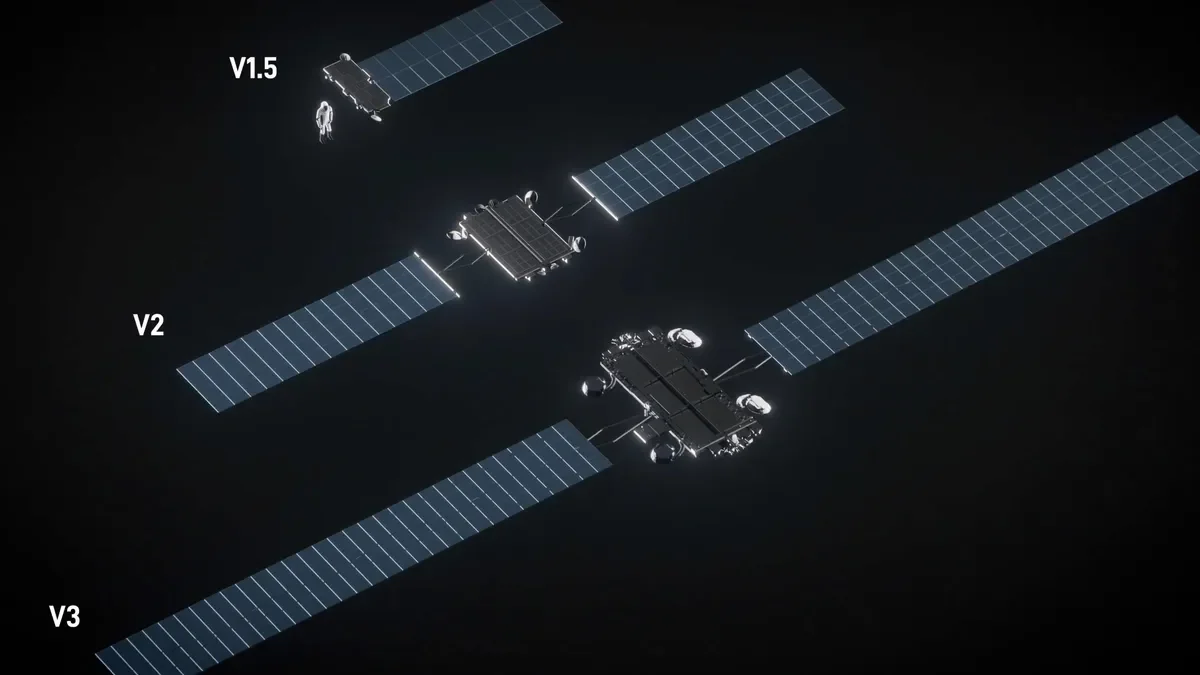
AI Compute Takes Flight: SpaceX Adapts Starlink V3 for Orbital GPU Racks
Proven satellite buses, 150-kilowatt power systems, terabit laser networking, and Texas production lines already under expansion make large-scale AI infrastructure in low Earth orbit a near-term engineering project rather than distant speculation.
SpaceX is moving forward with AI satellites that host rack-scale compute in orbit by building directly on the Starlink V3 platform. These spacecraft deliver peak power near 150 kilowatts — matching the envelope of advanced terrestrial systems such as NVIDIA GB300 NVL72 racks with 72 Blackwell Ultra GPUs — while using laser links for terabit-class connectivity and operating at altitudes that keep one-way propagation delay around three milliseconds. Large solar arrays and matching radiators handle energy collection and heat rejection without water or grid constraints that limit Earth data centers. Manufacturing scale-up is already underway at the Bastrop, Texas campus, with solar cell production lines under construction and dedicated AI satellite assembly capacity planned to reach meaningful volume by the end of 2027.
Key Takeaways
AI satellite designs reuse core Starlink V3 technologies for power, structure, propulsion, and laser communications, keeping the project within the realm of incremental integration rather than ground-up invention.
Each platform supports compute loads comparable to a full NVIDIA GB300 NVL72 rack, with 150 kW peak power capability backed by large deployable solar arrays.
Laser terminals provide aggregate terabit-per-second connectivity for inter-satellite links and routing through the existing Starlink constellation to ground stations via established Ka- and Ku-band or laser downlinks.
Thermal radiators sized similarly to V3 solar arrays, with roughly 70-meter wingspans, manage heat dissipation through radiation in vacuum, removing dependence on water cooling.
The Bastrop facility is expanding with a multi-gigawatt solar manufacturing plant already in progress and new AI satellite production buildings slated to join it, targeting operational scale by late 2027.
Operational experience from more than 10,000 Starlink satellites in orbit supplies proven methods for dense constellation management, collision avoidance, and safe flight operations.
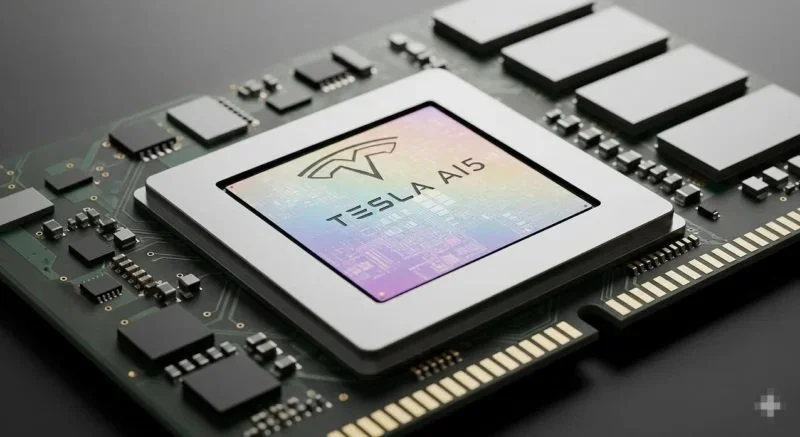
Tesla’s Custom AI Chip Quietly Builds the Foundation for Independence From Nvidia
How a radically simplified inference engine, a $119 billion domestic fab, and orbital data centers powered by constant sunlight could reshape who controls the future of AI infrastructure.
Tesla’s AI5 chip, taped out in April 2026, delivers inference performance in the same range as Nvidia’s H100 for the specific workloads that matter most to large-scale robotics and autonomy systems. Two of the chips together reach territory previously occupied by Nvidia’s Blackwell B200. The difference lies in what the design deliberately left out and where it will actually run first.
Key Takeaways
The AI5 chip matches high-end Nvidia inference throughput for Tesla’s targeted tasks while consuming dramatically less power and costing a fraction as much, because it is built as a narrow-purpose ASIC rather than a general-purpose GPU.
Radical simplification — removing the image processor and other unused blocks — allows the chip to focus exclusively on the low-precision math that runs real-time perception and control in vehicles and humanoid robots.
First deployments target Optimus humanoid robots and internal AI supercomputers rather than next-generation vehicles, since existing hardware already exceeds typical human driving performance in most scenarios.
Tesla continues purchasing hundreds of thousands of Nvidia GPUs for training its largest models, treating custom inference silicon and general-purpose training hardware as complementary tools rather than substitutes.
A rapid internal roadmap calls for AI6 production in 2027 on Samsung’s process with roughly double the performance, followed by AI6.5 on TSMC’s Arizona fab, targeting a new generation every nine to twelve months.
The dedicated Terafab facility carries phase-one costs of $55 billion and total project costs approaching $119 billion — larger than the entire US CHIPS Act — and will be split across Tesla and SpaceX balance sheets ahead of SpaceX’s planned public listing.
SpaceX regulatory filings seek approval for up to one million satellites configured as orbital data centers that run on uninterrupted solar power, with internal projections placing the total addressable market for space-based AI infrastructure at $26 trillion.
The long-term objective is vertical ownership of every critical layer — chip design, domestic fabrication, low-cost launch, and space-based power — so that AI deployment at planetary scale does not depend on any single external supplier for the foundational compute element.

The Master Plan You Can't Unsee: Wiring Civilization's Next Foundation
How energy systems, self-driving fleets, humanoid robots, satellite networks, and orbital infrastructure are stacking into one coherent architecture for abundance—and why Mars ambitions are already reshaping what is possible on Earth.
A single Tesla completing a 13,000-mile coast-to-coast journey on full self-driving in January 2026 without any human intervention on the controls was more than an autonomy milestone. It marked the visible activation of something larger: a stacked foundation of technologies now advancing in parallel across energy, transport, labor, intelligence, connectivity, and space. The most valuable pattern is not any single product but the way these layers reinforce one another, with physics-first requirements for multi-planetary settlement acting as the forcing function that accelerates practical progress everywhere else. Cost curves in AI, robotics, and solar are collapsing at the same moment, pointing toward a period where intelligence, physical work, and energy become abundant enough to reorder how economies measure value.
Key Takeaways
Eight interlocking layers—energy generation and storage, physical transport, humanoid robotics for labor, AI agents for knowledge work, frontier model intelligence, global satellite networks, off-world transport, and direct brain-computer interfaces—are being built together rather than as isolated bets.
Reusable orbital-class rockets and mass-market electric vehicles both moved from expert consensus of impossibility to routine operation, showing that compressed timelines often precede large-scale delivery once the underlying engineering locks in.
Hardware and data integrations across projects, such as satellite antennas embedded in vehicle roofs, energy storage powering training clusters, and vehicle fleets supplying training data for robots, create closed loops that multiply progress beyond what any single company could achieve alone.
The requirement to settle Mars drives demand for electric propulsion, robotic construction crews, subsurface habitats, and reliable interplanetary links—technologies that simultaneously relieve energy, labor, infrastructure, and connectivity constraints on Earth.
Observed cost trajectories show AI inference dropping by roughly 36 times in two years, robotic labor approaching a couple of dollars per hour at scale, and solar generation costs having already fallen 99 percent over recent decades, with further declines continuing.
Physical infrastructure at new orders of magnitude, including chip fabrication targeting 100–200 billion specialized AI units per year and launch costs falling toward $10–100 per kilogram to orbit, is enabling both terrestrial AI expansion and space industrialization at the same time.

The AI Dopamine Trap That Nobody Is Prepared For
Why infinite convenience and pleasure could redefine human purpose—and how to stay grounded
In the coming decades, AI-powered humanoid robots, self-driving delivery systems, neural interfaces, and breakthroughs in longevity will make physical effort almost obsolete. Every craving—food, entertainment, even sensory experiences—could be delivered instantly, creating a personalized dopamine engine so powerful it makes today’s social media feeds look quaint. The real question isn’t whether the technology arrives. It’s what humanity chooses to do with the freedom it unlocks.
Key Takeaways
AI and robotics will create an “infinite dopamine machine” that handles all physical labor, delivers hyper-personalized entertainment directly to the brain, and extends lifespans dramatically—turning passive entertainment into a full-time lifestyle for some.
The future delivers maximum individual freedom: people can pursue purpose, service, and creation or opt for total immersion in digital pleasure, with no external force dictating the choice.
Modern education and comfort have trained many to avoid risk, yet deep down most harbor bigger dreams; removing friction could unlock far more builders than expected.
Real-world experiences—family time, physical projects, friendships—deliver more lasting satisfaction than the machine ever can, but they require deliberate discipline because the digital alternative never runs out.
A living frontier like Mars is essential; without ambitious outlets, internal conflict over resources and status could intensify.
For parents and builders alike, the hardest challenge is self-discipline: intentionally stepping away from the infinite tool to engage with the finite, changing real world before it slips away.

Cybertruck's Near-Miss Off-Road Run Shows Why Tesla's Platform Strategy Matters More Than Looks
Real-world durability tests, modular interiors, DC energy rethinking, and agent orchestration are quietly defining the next wave of useful hardware.
A recent off-road outing in rugged Hill Country terrain put the Cybertruck through conditions most owners will never encounter. The truck handled narrow, rocky ATV trails and sudden drops when its systems were engaged properly, but the episode also showed how quickly capability turns risky without clear route judgment. That same platform thinking now points toward a three-row SUV variant that could solve family hauling needs while keeping the core advantages of shared production and component architecture. At the same time, the push to cut power conversion losses in homes and data centers is gaining practical momentum through integrated solar, storage, and local compute. AI tooling is shifting from single clever models to orchestrated systems with real safeguards. And autonomous van platforms are opening the door to living arrangements that treat mobility as a core feature rather than an afterthought. These threads matter because they focus on integration, efficiency, and adaptability rather than isolated specs.
Key Takeaways
The Cybertruck proved its hardware margin in demanding terrain when using maximum suspension and recovery modes, but the incident reinforced that operator decisions remain the primary variable in extreme use.
Tesla is positioned to launch a three-row SUV on the existing Cybertruck line, likely with configurable seating on tracks, higher interior volume, and shared 48-volt and networking architecture for fast reconfiguration between passenger and cargo layouts.
Native DC power chains in homes and data centers with on-site generation can recover substantial energy currently lost to repeated AC conversions, enabling tighter integration of batteries, HVAC, and local AI hardware.
Effective AI agent systems now emphasize hierarchical permissions, auditability, and task reliability over raw model power, with local frameworks showing clear differences in sustained execution performance.
Autonomous high-roof platforms that double as living spaces reduce the friction of relocation and create climate-resilient, scalable housing options that align with human patterns of mobility seen throughout history.
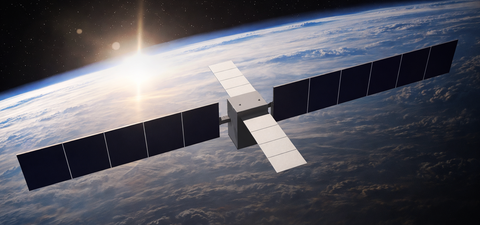
The Orbital AI Revolution: Why a Million Satellites Will Soon Power Every Major AI Model
Earth’s power grids are hitting a hard wall just as AI demand explodes. The solution? Move the data centers to space—where solar energy never stops and cooling is free.
The AI boom is real, but the infrastructure to run it is not. Tech giants have already committed three-quarters of a trillion dollars to data centers for 2026 alone, yet electricity shortages are forcing delays, cancellations, and even regulatory caps in key markets. At the same time, a handful of companies have quietly proven that full AI models can run on actual data-center chips in orbit. The economics, physics, and full-stack control now align to make orbital compute not just possible—but inevitable.
Key Takeaways
Global AI spending hits a record $1 trillion in 2026, but electricity—not money—is the real bottleneck, with major hubs like Northern Virginia maxed out until 2028 and countries like Singapore limiting new builds.
A single NVIDIA H100 chip has already run complete large language models in orbit 325 km above Earth, transmitting results back to the ground in real time.
Orbital solar power delivers roughly five times the efficiency of ground systems thanks to constant sunlight and no atmosphere, while deep-space radiative cooling at near-absolute zero eliminates the billions of gallons of water and massive energy overhead required on Earth.
Launch costs are collapsing: Starship targets under $200 per kilogram (and eventually $20), turning maintenance, redundancy, and refresh cycles from impossible to routine.
One company controls the entire vertical stack—reusable rockets, custom space-optimized chips, ground superclusters, and the world’s largest satellite constellation—positioning it to deploy the first million-satellite orbital data-center network.
Major cloud providers and rocket competitors are accelerating their own orbital plans, creating a high-stakes race that will define the next decade of compute infrastructure.
A pending IPO includes explicit performance milestones tied to 100 terawatts of space-based compute capacity—the power equivalent of 85 billion average U.S. homes.

The AI War Is Over: Only Two Factions Will Dominate by 2030
Compute compounds like nothing in history—turning a handful of leaders into an unassailable advantage while the rest get acquired, commoditized, or left behind.
In the age of AI, the most valuable resource isn’t land, oil, or even raw processing power. It’s the self-reinforcing cycle where superior models draw more users, those users generate higher-quality data, and that data trains even stronger models. This flywheel accelerates with every iteration, widening the gap between frontrunners and everyone else. Eight major factions are battling for control of this cycle. Most coverage calls it competition. The math reveals something far more decisive: by 2030, only two will hold the keys to the intelligence layer that underpins the global economy.
Key Takeaways
AI’s compounding loop—models, users, data, and compute feeding each other—creates exponential separation that no physical resource war has ever matched.
Training costs have already jumped roughly tenfold in three years and could exceed a billion dollars per frontier model by 2027, pricing out all but the deepest-pocketed players.
The real bottleneck isn’t just GPU counts; high-bandwidth memory (HBM) determines how effectively massive clusters work together.
Labs now train on 100 times more data than classic scaling laws recommend, shifting the goal from efficiency to massive user retention and cheap inference at scale.
OpenAI leads in users but bleeds cash on inference and talent; Microsoft locks in enterprises; Meta uses open-source to neutralize monopoly pricing; China pursues cheap, efficient models despite chip limits; Google owns unmatched data, custom chips, and infrastructure; Anthropic bets on safety for enterprise and government; the Musk stack integrates compute, real-world data, and connectivity under one roof; regulators slow Western progress while China accelerates.
Google wins through substrate dominance—proprietary data, power-efficient TPUs, and quiet efficiency gains. The Musk integrated stack wins through vertical control of compute scale, fleet data, and end-to-end ownership.
The other six will likely be absorbed, reduced to distribution layers, or confined to regional/price-sensitive markets.
For individuals: focus on skills AI cannot synthesize on demand; invest in the infrastructure winners; prepare children for an economy where intelligence is abundant and cheap.

The Infrastructure Play That Could Decide AI's Next Decade
How record deployment speeds, orbital power constraints, and runaway token demand are forcing a complete rethink of who can actually deliver abundant intelligence at scale.
The real bottlenecks in advanced AI have shifted from model architecture to physical execution. Legal maneuvers around major labs have exposed governance friction without resolving underlying questions about long-term stewardship. At the same time, the ability to stand up massive compute clusters in months rather than years, combined with the hard physics of powering AI workloads off-planet, is creating asymmetric advantages for players who control both the chips and the energy layer. Most overlooked: even steep gains in efficiency will not flatten demand. New applications in video synthesis, persistent agents, and physical robotics multiply token consumption faster than optimization curves can contain it. The organizations that solve the manufacturing, power, and orbital constraints first will set the cost floor for intelligence for years to come.
Key Takeaways
Legal resolutions on procedural grounds in AI governance cases can inflict lasting reputational damage while leaving core structural issues unaddressed, increasing the likelihood of internal leadership changes at scaled labs rather than wholesale unwinds of their corporate form.
Model performance has split along task lines, with some systems delivering superior cost-performance on coding workloads and others advancing faster on general capabilities, accelerated by targeted talent inflows and selective early access programs.
First-principles manufacturing discipline and direct production-line leverage have compressed large-scale GPU cluster deployment to roughly four months, enabling potential cost leadership when paired with integrated renewable generation.
AI satellites operating in higher orbits face rapid solar panel degradation from elevated radiation, requiring specialized space-grade photovoltaics whose global production remains limited to a few megawatts per year and concentrated supply chains.
Token demand follows Jevons paradox dynamics: efficiency improvements from distillation and specialized models unlock entirely new use cases in generative media, autonomous agents, and robotics that drive net consumption sharply higher.
Electricity prices in key technology corridors have risen 200 percent or more in recent years, underscoring the need for co-located generation, deregulation of new capacity, and expanded domestic solar manufacturing to prevent cost curves from throttling AI deployment.
National leadership selection patterns that favor engineering execution correlate with faster delivery of complex infrastructure projects, creating competitive edges in the physical layer of intelligence.

Musk's Picks and Shovels: How Autonomy and AI Will Power the Next Civilization
Tesla's FSD leaps, Model Y dominance, US-China manufacturing deals, and robotic logistics are laying the groundwork for a transformed economy.
The pace of real-world autonomy is already delivering tangible gains today, with even older versions of advanced driver-assistance systems proving reliable enough for daily commutes and family use. At the same time, high-level diplomatic meetings signal a potential trillion-dollar wave of manufacturing investment flowing back to the United States, powered by Chinese production expertise. Layer in humanoid robots, autonomous heavy trucks, and drone-enabled delivery networks, and the Musk ecosystem emerges as the foundational infrastructure—the literal picks and shovels—for the next era of economic growth.
Key Takeaways
The Tesla Model Y ranks as the best-selling vehicle on the planet for three straight years, leading sales in California and even the top three major cities in China despite aggressive local competition.
Current supervised Full Self-Driving software remains highly capable a full year after its last major update, setting the stage for unsupervised operation that eliminates the need for constant human oversight and enables entirely new use cases like sleeping during long trips.
Upcoming US-China engagements involving key technology and business leaders point toward massive onshoring deals, with Chinese manufacturers potentially bringing high-scale production know-how to American factories in exchange for market access.
Legacy US automakers face structural decline, concentrated in SUVs, trucks, and a handful of models, opening pathways for pivots into defense manufacturing amid rising national security budgets.
Add-on robotic kits already automate heavy equipment like excavators for solar-farm construction, slashing labor hours and unlocking 24/7 operation in energy infrastructure projects.
Musk companies collectively supply the core layers future civilization will run on: autonomous passenger transport, humanoid labor, long-haul freight, satellite connectivity, and energy storage.
Logistics economics shift dramatically once highway autonomy arrives—even partial adoption on interstates cuts driver costs and fuel volatility, while drone-equipped vans and warehouse robots reshape last-mile delivery speed and density.
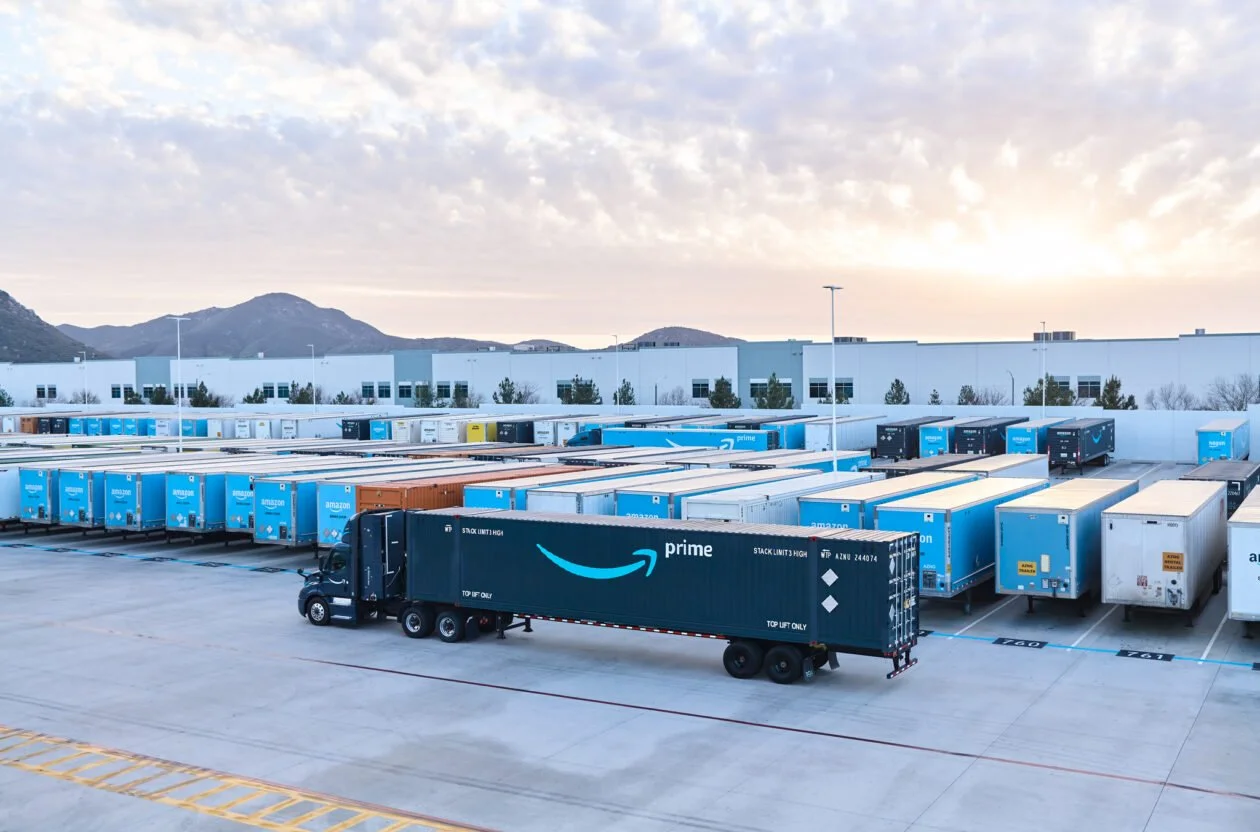
Amazon's Stealth Logistics Empire: The Massive Tailwind Coming for Tesla
How opening its entire supply chain to the world is about to create explosive demand for electric semis, autonomous vans, and humanoid robots.
Amazon has turned its vast internal logistics machine into a full-service platform available to any business. The new offering combines freight across ocean, air, ground, and rail; warehousing and distribution; same-style parcel delivery seven days a week; and AI-driven forecasting built on the largest commercial logistics dataset in existence. This isn't a minor expansion—it's the physical-world equivalent of AWS, launched into a $9 trillion market that's already projected to hit $13 trillion by 2035. For Tesla, the implications are generational: a single customer with global scale suddenly needs far more trucks, vans, robots, and autonomy software than it can source today.
Key Takeaways
Amazon Supply Chain Services bundles freight, fulfillment, parcel delivery, and predictive AI optimization into one plug-and-play system that any company can use—exactly how AWS turned internal infrastructure into a profit engine.
The move immediately pressures traditional carriers; UPS, FedEx, and logistics stocks dropped sharply on the announcement because Amazon already operates at a scale that rivals their combined fleets.
Tesla stands to benefit across four hardware categories: electric semis for long-haul freight, autonomous delivery vans to solve driver shortages, Optimus humanoids for warehouse labor, and the unified Full Self-Driving software stack that powers everything.
Amazon's existing assets—1.56 million employees, 1,200 logistics facilities, 40,000+ owned semis, 390,000+ delivery drivers, 30,000 Rivian vans, over one million robots, and its own air fleet—provide the perfect launchpad for rapid scaling.
At scale, a single humanoid robot could deliver labor at roughly $1.50–$2 per hour versus $25–$35 for a human worker, creating economics that make widespread adoption almost inevitable.
Watch for Amazon to break out Supply Chain Services revenue separately in coming quarters; that moment will trigger the same valuation rerating AWS enjoyed.

Why Tesla's Robotaxi Advantage Is Growing Faster Than Anyone Notices
It's not the current fleet size that matters most—it's the explosive growth in data miles and production scale driving down costs exponentially.
Tesla is pushing unsupervised robotaxis into more Texas cities, while competitors like Waymo operate thousands of vehicles across multiple metros. Yet the numbers reveal one player building an insurmountable lead through sheer data volume and manufacturing muscle. With 10 billion cumulative full self-driving miles already logged and the count growing by a billion monthly, the foundation for cheaper, smarter autonomy is solidifying rapidly.
Key Takeaways
Tesla's cumulative FSD miles stand at around 10 billion—50 times the roughly 200 million driverless miles accumulated by its closest rival across its entire history.
Both double autonomous miles approximately every nine months, but Tesla's vastly larger base means its lead widens dramatically each cycle.
Tesla achieves robotaxi costs near 81 cents per mile today, roughly 60% of competitors' current levels.
Production capacity gives Tesla the ability to manufacture hundreds of thousands of capable vehicles quarterly, dwarfing rivals reliant on third-party supply.
Paid unsupervised robotaxi miles nearly tripled quarter-over-quarter in early 2026, signaling accelerating commercial traction.
At scale, autonomous transportation could drop to 25 cents per mile, slashing annual personal mobility costs from hundreds to thousands of dollars.
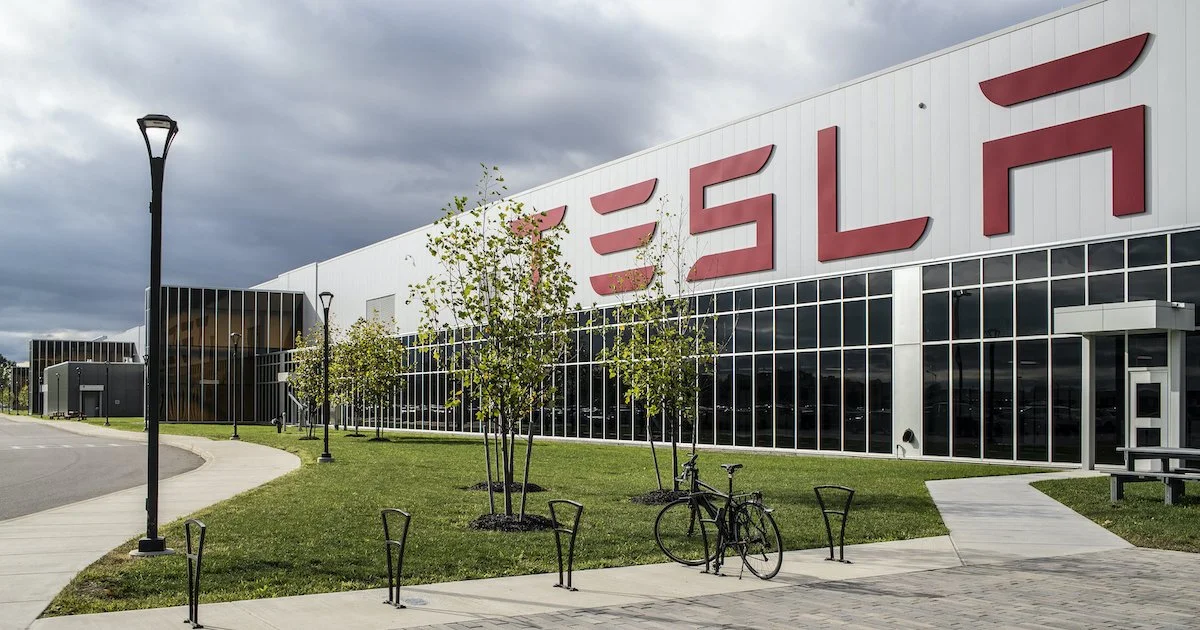
The Operator Who Just Solved Elon Musk’s Biggest Problem
How one quiet executive is enabling the largest reorganization in tech history—and why it frees the world’s most ambitious engineer to move faster than ever.
The Musk companies are no longer operating as separate bets. They are converging into a single, vertically integrated machine built for the AI age. SpaceX and xAI have already combined. Tesla is the final piece. The person positioned to run day-to-day execution across all of them has spent nearly 25 years proving she can deliver at the hardest engineering problems on Earth. This shift lets Elon Musk leave the Tesla CEO chair he has openly disliked for years and return full-time to the work only he can do: first-principles engineering at planetary scale.
Key Takeaways
Elon Musk has repeatedly stated he does not want to remain Tesla CEO and has been searching for years for a successor he trusts to treat the company as a robotics and AI leader rather than a car company.
The February 2026 merger of SpaceX and xAI created a $1.25 trillion vertically integrated entity focused on AI, rockets, satellites, and orbital infrastructure.
Gwynne Shotwell, SpaceX president and COO since 2008, now oversees operations for the combined SpaceX-xAI business and is the clearest candidate to absorb Tesla’s execution responsibilities in the next phase of consolidation.
Her track record includes turning Falcon 9 into the most reliable launch vehicle ever, delivering Crew Dragon for NASA, scaling Starlink to tens of thousands of satellites, and negotiating critical government contracts that kept SpaceX alive in its earliest days.
The resulting structure creates the infrastructure layer of the AI era—orbital data centers, humanoid robots, autonomous vehicles, energy storage, and chip fabrication—all executing under one operational leader while Musk focuses exclusively on engineering breakthroughs.
Investors and technologists should view this not as Elon stepping away but as the company graduating to a new operating model that removes a massive constraint on his time and attention.

AI Leapfrogging: El Salvador's Gamble on Humanoids and Grok to Skip Traditional Development
From cleaning up gang violence to powering education with advanced AI and investing in robotics and geothermal energy, one Central American nation is charting an unconventional path forward. Meanwhile, discussions around AI abundance highlight how human value may increasingly center on irreplaceable in-person experiences and skill-based pursuits.
El Salvador offers a compelling case study in using security reforms as a foundation for rapid technological advancement. By prioritizing AI adoption, humanoid robots, data centers, and renewable energy from its volcanoes, the country aims to bypass decades of incremental progress. This comes as AI systems promise abundance, forcing a reevaluation of human roles—not through replacement, but through new forms of meaning found in live interactions, crafts, and personal mastery aided by intelligent machines.
Key Takeaways
Heavy but non-oppressive police presence has contributed to genuine public happiness and family-friendly public spaces after removing gangs from daily life.
Strategic focus on tech leapfrogging includes humanoids for labor, AI agents, data centers, solar and geothermal power expansion, and Bitcoin mining using volcanic energy.
Public education is transitioning to systems powered by advanced AI like Grok to rapidly build workforce capabilities despite historical under-education challenges.
In an era of AI-driven abundance, premium value accrues to authentic in-person experiences that cannot be easily replicated or spoofed digitally.
AI and robots can serve as highly effective coaches and training partners for sports, crafts, and hobbies, enabling continuous human skill improvement and deeper engagement.
Tesla is progressing on robotaxi deployment with hardware enhancements like improved memory bandwidth for better reasoning in edge cases, alongside Optimus humanoid development as a key long-term driver.
Geopolitical tensions and recent conflicts are accelerating innovation in affordable drone and defense technologies, favoring agile startups over traditional contractors.
Personal branding through content creation serves as a powerful marketing tool for in-person events and services in an AI-saturated media landscape.

AI Superpowers Are Already Here—Here’s How to Claim Yours Before the Transition Leaves You Behind
Adoption and initiative separate those building empires from those watching from the sidelines as AI turns impossible tasks into daily routines.
Artificial intelligence delivers raw leverage at a scale humanity has never seen. Early users report 10x output gains, one-person operations rivaling large teams, and businesses pivoting into entirely new valuations almost overnight. Yet polls show the majority remain deeply concerned—often without ever having used the advanced tools that actually move the needle. The gap between fear and reality is widening fast, and the winners are those who treat AI as foundational infrastructure rather than a novelty.
Key Takeaways
AI agents provide true execution power—turning ideas into completed work—far beyond what basic chat interfaces can achieve.
Most public anxiety stems from people who have never integrated advanced AI into their workflows; actual users see life-changing leverage.
Building AI directly into the foundation of your processes creates compounding advantages in speed, quality, and cost that widen with every model upgrade.
Initiative is non-negotiable: those who adopt early will outpace everyone else as AI becomes the ultimate multiplier of human uniqueness.
Businesses that delay risk total disruption—the classic Innovator’s Dilemma playing out at supersonic speed.
Driving down the cost of chips and electricity is essential for broad access and to prevent extreme wealth concentration.
Nations starting with clean slates and abundant energy resources hold a structural edge in building AI-native systems.
The technology is moving from digital agents to physical robotics and autonomy, unlocking economic mobility and productivity at previously unimaginable scales.
Ethical deployment at the individual and organizational level will determine whether AI creates abundance or chaos.

AI's Silent Takeover: Why Universal Government Checks Are Inevitable
As cognitive jobs disappear at record speed, the math of productivity and taxation is forcing a once-radical idea into mainstream policy.
The economy that powered the last 250 years—people selling their time, companies buying it, and everyone climbing the same ladder—has hit its limit. Artificial intelligence is not merely automating routine tasks. It is absorbing the very skills that once made human labor indispensable: writing, coding, analysis, judgment, and strategy. The result is already visible in hiring data, company headcounts, and government revenue models. The fix on the table is straightforward: direct cash transfers from the federal government, scaled to match the flood of AI-generated output.
Key Takeaways
AI tools have already cut the bottom rung of the career ladder for young software engineers and other cognitive roles, with entry-level hiring down nearly 20 percent in key tech fields even as industry revenue climbs.
Traditional technological shifts always created new human jobs; AI is the first to eliminate the need for human cognition itself, leaving no higher rung to climb.
Roughly 85 percent of federal revenue currently comes from taxes on wages and payroll; when AI displaces those wages, the entire funding model for Social Security, Medicare, defense, and infrastructure collapses unless the tax code shifts to capture AI and robotic production.
Real-world cash-transfer programs—Alaska’s oil-funded dividends since 1982, Stockton’s 2019 pilot, and Kenya’s large-scale randomized trial—show employment either holds steady or rises, poverty falls sharply, and inflation stays in check when production grows faster than the money supply.
The next five years will likely see federal checks issued to every citizen to offset displacement, funded by taxing AI output rather than labor; the only question is whether the system is designed deliberately or patched together during crisis.

The New Luddites: Why Banning AI Data Centers Hands the Future to Rivals
History's lesson is clear—restricting the machines never stops disruption. It only exports the gains.
The push to halt AI infrastructure in the United States echoes a 215-year-old pattern that has played out across cars, nuclear power, and genetically modified crops. While energy demands and job shifts from AI are very real, attempts to pause the physical backbone of the technology have never protected workers or economies. They have simply moved progress to places willing to build faster.
Key Takeaways
The original Luddites were highly skilled English craftsmen who targeted exploitative machines, not technology itself—yet government force crushed their movement while the Industrial Revolution still transformed Britain.
Four major historical cases show the same outcome: Red Flag laws slowed British autos for decades, American farmers eventually embraced cars and tractors, U.S. nuclear construction stalled after Three Mile Island only for data centers to revive it, and EU GMO restrictions left farmers dependent on imports.
A U.S. moratorium on new AI data centers would not pause AI development—it would redirect massive training runs to China, the UAE, Singapore, and other nations racing to host them.
AI exposes far more tasks to automation than past technologies, but the real challenge is accelerating displacement outpacing new job creation since the late 1980s.
Long-term success has always come from policies that distribute gains—worker protections, retraining, and productivity-sharing—rather than banning the infrastructure.
Tech leaders who deploy AI today report massive efficiency gains, suggesting the difference lies in adoption strategy, not the technology alone.
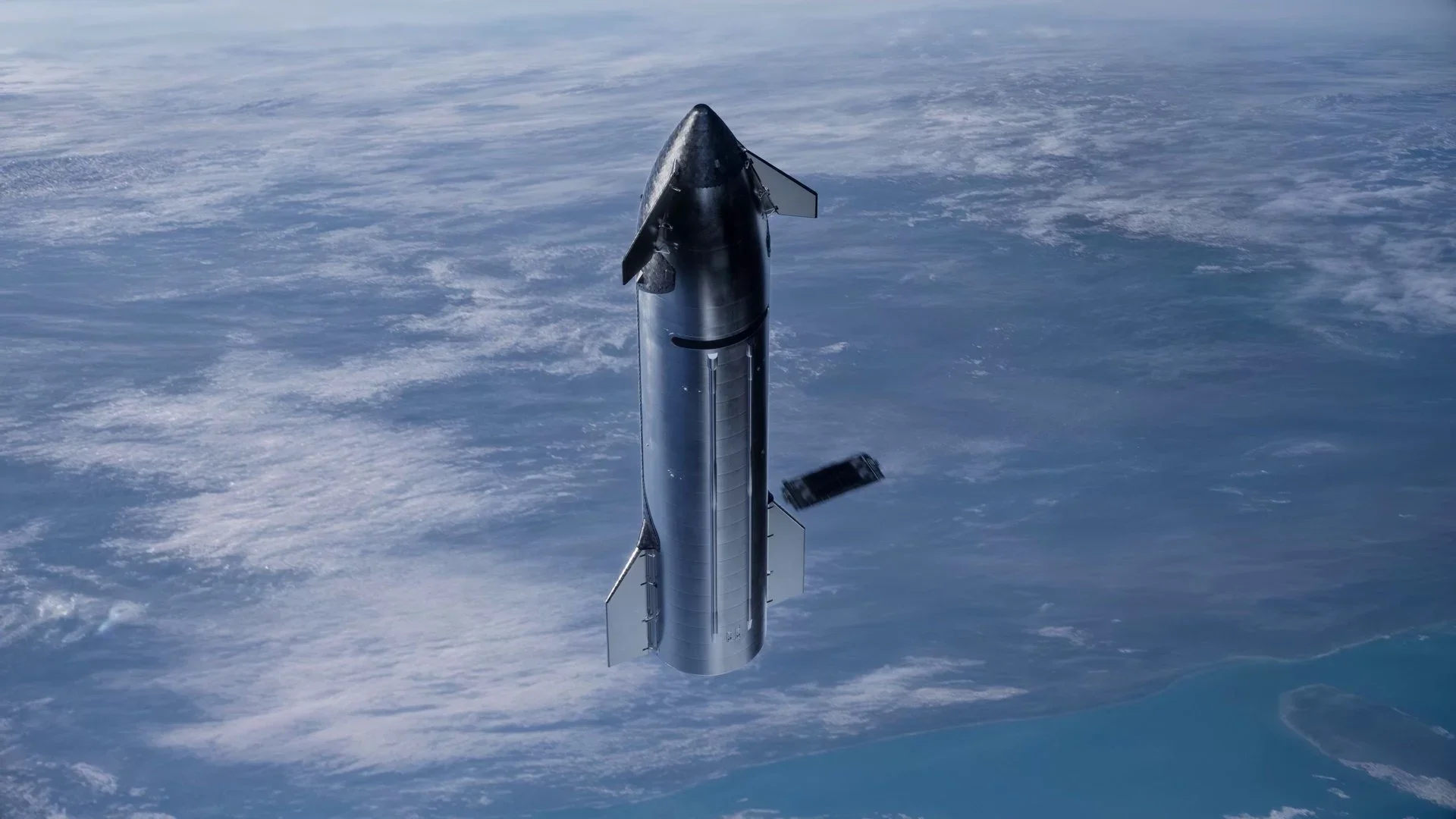
Unlocking the Stars: Starship, Orbital AI, and the Human Purpose Puzzle
Reusable rockets are set to slash space costs by orders of magnitude, opening orbital factories and AI compute clusters while automation quietly rewires human skills and identity—yet geopolitics in the Middle East and Eastern Europe supplies the friction that could accelerate it all.
SpaceX’s push toward full Starship reusability stands to repeat the shipping container breakthrough that cut ocean freight costs by 95 percent and turned global trade into an everyday reality. That single innovation let manufacturing shift to low-cost regions and built the modern supply chains powering everything from consumer electronics to pharmaceuticals. The same dynamic is now poised for orbit: cheap, frequent launches make zero-gravity factories practical for products ruined by Earth’s atmosphere or gravity, while solar-powered data centers in space could host the next leap in AI inference without terrestrial power or cooling limits.
Key Takeaways
Starship reusability could deliver a 100x to 1,000x jump in payload-to-orbit capacity, mirroring how standardized containers enabled globalization and China’s manufacturing dominance.
Orbital manufacturing becomes viable for gravity-sensitive processes such as advanced pharmaceuticals, while space-based AI inference clusters bypass Earth’s energy and heat constraints.
A successful reusable fleet at scale supports multi-trillion-dollar valuations only if it pairs with rapid earnings growth from new markets like orbital compute and global launch services.
Tesla’s near-term profit ramp may outpace SpaceX post-IPO, making the latter a longer-horizon bet dependent on two breakthroughs: full reusability and orbital AI revenue.
AI cognitive offloading already erodes routine skills—phone numbers, map reading, household chores, driving—freeing mental bandwidth for higher-order thinking but raising questions about identity and purpose.
Humans naturally invent new forms of friction through hobbies, creative arts, athletics, and philosophical structures to preserve meaning even in an age of abundance.
Geopolitical tensions, from record Russian casualties in Ukraine to Iran’s internal regime pressures, create short-term chaos that could reshape energy markets and tech supply chains while spurring innovation.

Tesla Just Built the Google of Atoms
The complete physical AI platform no competitor can replicate—and why it will define the next 20 years of technology
The physical world now has its dominant platform. One company has quietly assembled every critical layer—custom silicon, world-class AI models, battery chemistry, factories that scale like nothing else, vast real-estate holdings, and a global logistics network—and wired them together into a single, accelerating flywheel. The result is faster innovation, lower costs, and a data advantage that grows exponentially every day. This is not a car company with side projects. It is the infrastructure layer for the atom economy, and the implications stretch far beyond stock prices.
Key Takeaways
Tesla operates a full physical AI stack: computation, AI models, chemistry, manufacturing, land/real estate, and logistics—all internally controlled and mutually reinforcing.
Manufacturing functions as the CPU, real estate as storage, and logistics as the network in an atoms-based computer model that mirrors digital computing.
Billions of real-world driving miles feed a single neural architecture used for both autonomous vehicles and humanoid robots, creating a data flywheel no rival can match.
In-house battery chemistry, repurposed legacy factories, and continent-spanning energy assets deliver cost and infrastructure advantages that compound across every layer.
Vertical integration turns individual businesses into a cascading advantage: cheaper chips power better AI, better AI improves manufacturing, improved manufacturing lowers battery prices, and so on.
Single-layer competitors face structural economic disadvantages that widen over time, regardless of early leads in narrow domains.
Historical platform cycles suggest massive regulatory scrutiny is coming once dominance becomes obvious.