
SpaceX Asks the FCC to Clear a 100,000-Satellite Starlink Network Built on Starship
The third-generation, non-geostationary system would spread up to 100,000 satellites across two very-low-orbit shells packed with beamforming and optical inter-satellite links to multiply capacity, but the entire plan hinges on regulators clearing spectrum and Starship becoming routine enough to fly

SpaceX Absorbs xAI and Bets Its $1 Trillion Revenue Target on Compute, Not Rockets
Fresh off the largest IPO in history, Elon Musk is claiming SpaceX can multiply revenue 54x by 2030 — a promise that only makes sense because the company quietly became an AI infrastructure play whose addressable market it pegs at $28.5 trillion.

Virginia's Data Center Alley Hits a Political Wall as the AI Buildout Outgrows the Grid
The nation’s densest cluster of compute is now cycling backup generators as primary power and colliding with a new governor’s moratorium, exposing how permitting fights over nuclear and battery storage are throttling the AI boom’s real bottleneck: electricity.

SpaceX Signs $6.3 Billion AI Compute Lease With Reflection AI as Texas Court Clears Starbase Path
A $150-million-per-month lease of NVIDIA GB300 capacity to Reflection AI, a unanimous Texas Supreme Court win over Boca Chica beach closures, and United’s first wide-body Starlink transatlantic flight together reframe SpaceX as a multi-market infrastructure company while Tesla fights to control the
SpaceX Targets $28 Trillion Opportunity with Truth-Seeking AI and Lunar Infrastructure
How control over the full stack—from rocket design to satellite operations and real-time data—creates durable advantages in markets projected to reach trillions.
The core advantage lies in end-to-end control over satellite systems and connectivity infrastructure. This approach compresses development cycles, slashes costs through in-house production, and generates recurring revenue at low marginal expense once the network is deployed. Layered onto that foundation is the ability to feed live global data into advanced AI systems, creating models that stay current rather than relying on frozen datasets. Together these elements form a platform positioned to expand aggressively into the multi-trillion-dollar intersections of orbital infrastructure, worldwide broadband, and intelligent computing.
Key Takeaways
Vertical integration spanning satellite design, manufacturing, launch, and constellation operations delivers superior cost efficiency and deployment speed that competitors struggle to match.
Ownership of the full orbital launch stack creates structural barriers, as replicating global leadership in reliable, high-cadence access to space requires years of accumulated hardware and operational experience.
Real-time data streams from large-scale platforms enhance AI model accuracy and timeliness, supporting truth-seeking systems that reflect current events and user-generated information.
Once core infrastructure exists, adding subscribers or new services incurs near-zero marginal cost, enabling rapid scaling and high operating margins in connectivity.
Integrated control across hardware, networks, data, and AI layers opens participation in multiple expanding markets, including satellite broadband, direct-to-device services, and space-enabled intelligent systems.
A mission-oriented culture combined with deep technical talent sustains the iteration velocity required to maintain leads in capital-intensive, fast-evolving fields.
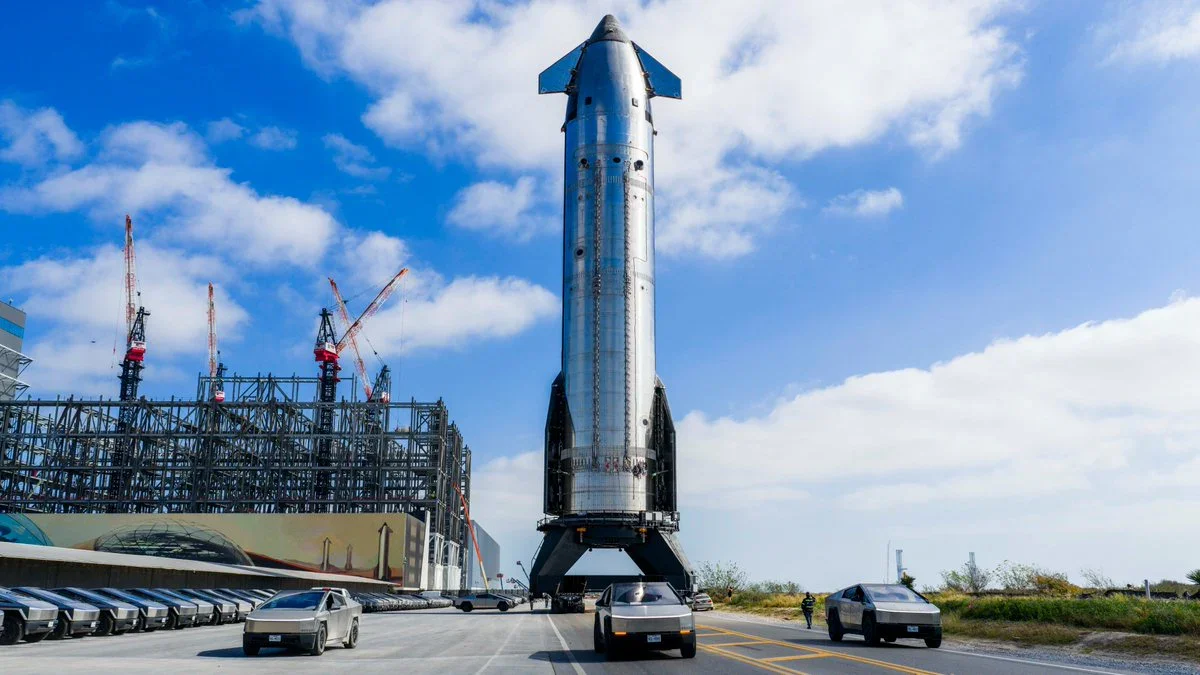
Starship V3: Doubling Saturn V Thrust to Unlock Million-Ton Orbital Capacity and Space AI
How rapid reusability and purpose-built satellites shift compute infrastructure from ground constraints to solar-powered orbital scale
Starship Version 3 produces more than twice the thrust of the Saturn V rocket that powered the Apollo program. Version 4 extends that margin toward three times the historic benchmark. These gains, paired with flight rates exceeding one per hour, move annual mass delivery to orbit from roughly 2,500 tons industry-wide today to the million-ton range within about three years. The same vehicles that enable this throughput also support a new generation of satellites optimized for AI workloads, where solar arrays generate power and radiators reject heat directly into space.
Key Takeaways
Starship V3 thrust exceeds twice the Saturn V level, with Version 4 approaching three times that output, directly multiplying payload mass per flight.
Mature operations target launch cadence above one flight per hour, turning space access into high-volume industrial activity rather than episodic events.
SpaceX currently delivers 85–90 percent of all mass placed into Earth orbit; Starship operations aim to expand total global capacity by orders of magnitude.
Annual mass to orbit could scale from approximately 2,500 tons to over one million tons per year within roughly three years once Starship reaches full cadence.
Recent record payloads represent only a small fraction of what operational V3 vehicles will carry routinely on each flight.
Orbital AI platforms take the form of compact satellites rather than conventional data-center buildings lifted into space, focusing on integrated power generation and thermal rejection.
AI satellites require less hardware complexity than Starlink units, needing primarily solar cells, radiators, and laser links instead of large phased-array antenna systems.
Early AI satellite designs target 150 kilowatts peak power while sustaining about 120 kilowatts of continuous compute, based on actual large-scale AI cluster performance.
Starlink Crosses 10 Million Users as SpaceX Builds Toward Orbital AI Compute
SpaceX’s connectivity arm doubled its subscriber base to 10.3 million in a year while standing up a gigawatt-scale supercomputer and mapping a path to solar-powered AI data centers in space.
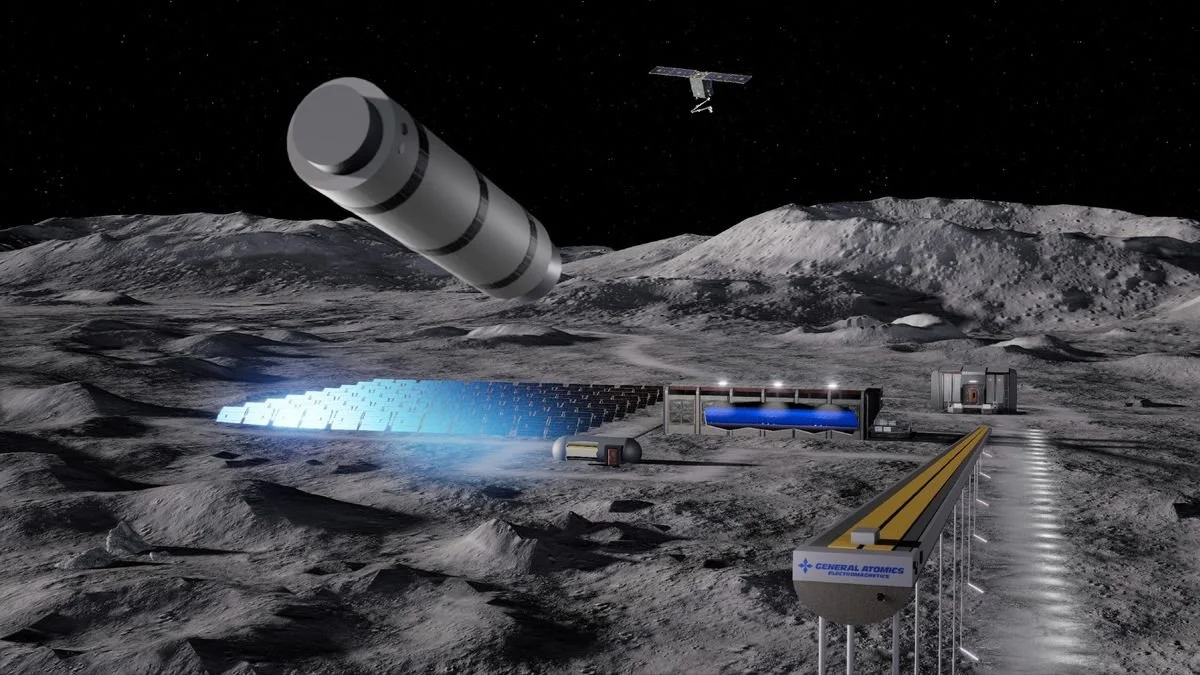
Stop Thinking Small: The Moon as the Gateway to Kardashev-Scale Energy and Compute
Lunar in-situ manufacturing combined with electromagnetic mass drivers creates a practical route to 1,000x energy growth and large-scale deployment of AI satellites in deep space.
Current terrestrial limits on land, materials, and launch costs cap how far energy production and computational infrastructure can scale. Shifting the bulk of manufacturing to the Moon and using its physical properties for efficient electromagnetic launches removes those ceilings. The result is a system capable of producing and deploying the massive solar arrays, radiators, and AI-optimized satellites required to push civilization measurably closer to stellar energy levels.
Key Takeaways
Global energy use sits at roughly 20 terawatts today; even a 1,000x increase remains a small fraction of the output needed for Kardashev Type II status.
The Moon’s one-sixth Earth gravity and total lack of atmosphere allow local production of heavy components like solar panels and thermal radiators with far lower energy input than lifting equivalent mass from Earth.
Electromagnetic mass drivers function as long linear motors that accelerate payloads to lunar escape velocity without onboard propellant, enabling high-volume launches of finished satellites into deep space.
In-situ resource utilization on the Moon means most of the mass for solar power systems and satellite structures comes from lunar regolith rather than Earth shipments.
AI satellites gain continuous solar power and the large radiator surfaces needed for heat rejection in vacuum—both difficult to scale when everything must launch through Earth’s atmosphere and gravity well.
Industrial-scale lunar operations create the logistics backbone that simultaneously makes routine human access to the Moon feasible and affordable.
Reusable heavy-lift rockets handle the initial delivery of specialized equipment and crews, after which lunar production takes over for bulk materials and reduces long-term Earth dependency.
SpaceX’s Massive Scale-Up: From Reusable Rockets to Orbital AI Empires
Unlocking multi-trillion-dollar markets through vertical integration and relentless iteration.
SpaceX is executing a tightly integrated strategy that turns orbital dominance into advantages in global broadband and frontier AI. By driving down launch costs through reusability and scaling production at unprecedented speeds, the company is positioning itself to capture enormous value across space transportation, connectivity, and compute infrastructure. This isn’t incremental progress—it’s a compounding flywheel that accelerates capability while slashing expenses.
Key Takeaways
Starship is poised to deliver roughly 100 metric tons to orbit initially, with Version 4 designs targeting 200 metric tons, while achieving full reusability to drive another order-of-magnitude cost reduction beyond Falcon’s already industry-leading economics.
Starlink’s V3 satellites promise a 20X capacity leap per launch compared to current V2 on Falcon, scaling toward petabyte-scale annual network throughput and closing the digital divide for billions.
The company is building the world’s largest coherent supercomputer clusters and pioneering orbital AI compute using solar power and radiative cooling for near-zero operating costs.
Revenue reached approximately $19 billion in 2025 with nearly $7 billion in positive adjusted EBITDA, while investing heavily in future infrastructure; connectivity alone showed 50% year-over-year growth.
Direct-to-device (Gen 2) 5G-quality service and specialized government constellations like Starshield expand addressable markets dramatically, backed by vertical integration that competitors struggle to match.
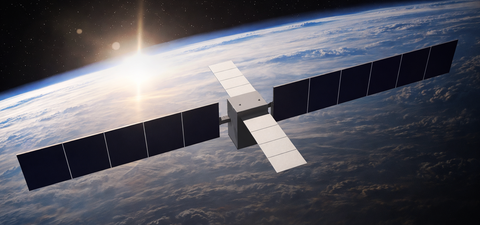
The Orbital AI Revolution: Why a Million Satellites Will Soon Power Every Major AI Model
Earth’s power grids are hitting a hard wall just as AI demand explodes. The solution? Move the data centers to space—where solar energy never stops and cooling is free.
The AI boom is real, but the infrastructure to run it is not. Tech giants have already committed three-quarters of a trillion dollars to data centers for 2026 alone, yet electricity shortages are forcing delays, cancellations, and even regulatory caps in key markets. At the same time, a handful of companies have quietly proven that full AI models can run on actual data-center chips in orbit. The economics, physics, and full-stack control now align to make orbital compute not just possible—but inevitable.
Key Takeaways
Global AI spending hits a record $1 trillion in 2026, but electricity—not money—is the real bottleneck, with major hubs like Northern Virginia maxed out until 2028 and countries like Singapore limiting new builds.
A single NVIDIA H100 chip has already run complete large language models in orbit 325 km above Earth, transmitting results back to the ground in real time.
Orbital solar power delivers roughly five times the efficiency of ground systems thanks to constant sunlight and no atmosphere, while deep-space radiative cooling at near-absolute zero eliminates the billions of gallons of water and massive energy overhead required on Earth.
Launch costs are collapsing: Starship targets under $200 per kilogram (and eventually $20), turning maintenance, redundancy, and refresh cycles from impossible to routine.
One company controls the entire vertical stack—reusable rockets, custom space-optimized chips, ground superclusters, and the world’s largest satellite constellation—positioning it to deploy the first million-satellite orbital data-center network.
Major cloud providers and rocket competitors are accelerating their own orbital plans, creating a high-stakes race that will define the next decade of compute infrastructure.
A pending IPO includes explicit performance milestones tied to 100 terawatts of space-based compute capacity—the power equivalent of 85 billion average U.S. homes.

The AI War Is Over: Only Two Factions Will Dominate by 2030
Compute compounds like nothing in history—turning a handful of leaders into an unassailable advantage while the rest get acquired, commoditized, or left behind.
In the age of AI, the most valuable resource isn’t land, oil, or even raw processing power. It’s the self-reinforcing cycle where superior models draw more users, those users generate higher-quality data, and that data trains even stronger models. This flywheel accelerates with every iteration, widening the gap between frontrunners and everyone else. Eight major factions are battling for control of this cycle. Most coverage calls it competition. The math reveals something far more decisive: by 2030, only two will hold the keys to the intelligence layer that underpins the global economy.
Key Takeaways
AI’s compounding loop—models, users, data, and compute feeding each other—creates exponential separation that no physical resource war has ever matched.
Training costs have already jumped roughly tenfold in three years and could exceed a billion dollars per frontier model by 2027, pricing out all but the deepest-pocketed players.
The real bottleneck isn’t just GPU counts; high-bandwidth memory (HBM) determines how effectively massive clusters work together.
Labs now train on 100 times more data than classic scaling laws recommend, shifting the goal from efficiency to massive user retention and cheap inference at scale.
OpenAI leads in users but bleeds cash on inference and talent; Microsoft locks in enterprises; Meta uses open-source to neutralize monopoly pricing; China pursues cheap, efficient models despite chip limits; Google owns unmatched data, custom chips, and infrastructure; Anthropic bets on safety for enterprise and government; the Musk stack integrates compute, real-world data, and connectivity under one roof; regulators slow Western progress while China accelerates.
Google wins through substrate dominance—proprietary data, power-efficient TPUs, and quiet efficiency gains. The Musk integrated stack wins through vertical control of compute scale, fleet data, and end-to-end ownership.
The other six will likely be absorbed, reduced to distribution layers, or confined to regional/price-sensitive markets.
For individuals: focus on skills AI cannot synthesize on demand; invest in the infrastructure winners; prepare children for an economy where intelligence is abundant and cheap.
SpaceX Just Locked In the AI Infrastructure Crown
The vertical stack that turns rockets, chips, power, and satellites into permanent AI rent.
A single partnership has quietly redrawn the AI landscape. SpaceX is no longer just the leader in reusable rockets — it has assembled the only fully integrated physical stack for frontier AI, from silicon fabs to orbital data centers. By opening its massive Colossus compute cluster to Anthropic’s Claude models, the company proved it can act as the landlord for the entire industry while keeping its own options wide open.
Key Takeaways
SpaceX is supplying Anthropic with over 300 megawatts and 220,000+ NVIDIA GPUs from the Memphis Colossus-1 facility, instantly doubling rate limits and removing throttling for Claude Pro, Max, Code, and API users.
The deal follows SpaceX’s all-stock absorption of xAI, giving the combined entity ownership of the world’s largest concentrated GPU clusters and positioning it as a hyperscaler with launch, chip, power, and network capabilities no one else matches.
Vertical integration now spans Falcon 9/Starship launches, Terafab’s multi-hundred-billion-dollar 2nm chip production, Starlink’s 10,000+ satellite constellation, and gigawatt-scale data centers — six critical layers versus four for even the strongest competitors.
Anthropic gains immediate capacity to deploy its next-generation Mythos model at scale; SpaceX secures high-margin recurring revenue that strengthens its path to a $1.5–2 trillion+ IPO.
The broader shift: models are commoditizing fast. Sustainable advantage now lives in the physical stack below the model — the new oil, pipelines, refineries, and shipping lanes of the AI economy.
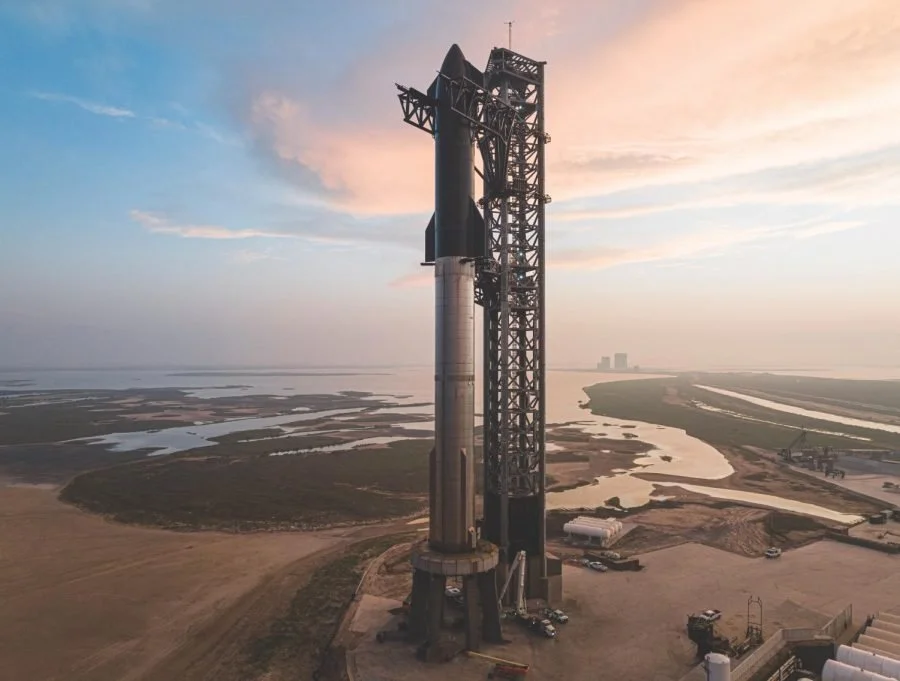
Starship's Rocket Catch Just Unlocked the Most Important Product in Human History
A 5,000x drop in launch costs is turning space into the next global economic engine—cheaper than air travel, with industries emerging that were impossible just a year ago.
The Starship booster catch marks more than an engineering milestone. It proves that access to orbit is about to become dramatically cheaper, unlocking an entirely new economy between Earth and Mars that will dwarf today's satellite sector. This shift will reshape energy, manufacturing, computing, and resource extraction on a scale last seen with container shipping or the internet. The numbers are staggering, and the early players are already raising hundreds of millions while hardware launches into orbit.
Key Takeaways
Launch costs to orbit have fallen from $54,000 per kilogram during the Space Shuttle era to a projected $10–20 per kilogram with Starship, a 5,000x reduction that makes space business models profitable instead of impossible.
Wright's Law is driving relentless cost declines: every doubling of production volume cuts prices by 15–25 percent, the same dynamic that turned solar from $76 per watt in 1977 to 20 cents today.
Orbital manufacturing in microgravity is producing pharmaceutical crystals and semiconductor materials that cannot be made on Earth due to gravity's interference, creating entirely new product categories.
Space-based solar mirrors and orbital AI data centers solve Earth's power, cooling, and land constraints, while robot labor at roughly $2 per hour handles construction and maintenance that humans could never scale.
The second- and third-order effects of this infrastructure will spawn trillion-dollar industries nobody has named yet, exactly as container shipping and cheap bandwidth created globalization and the digital economy.
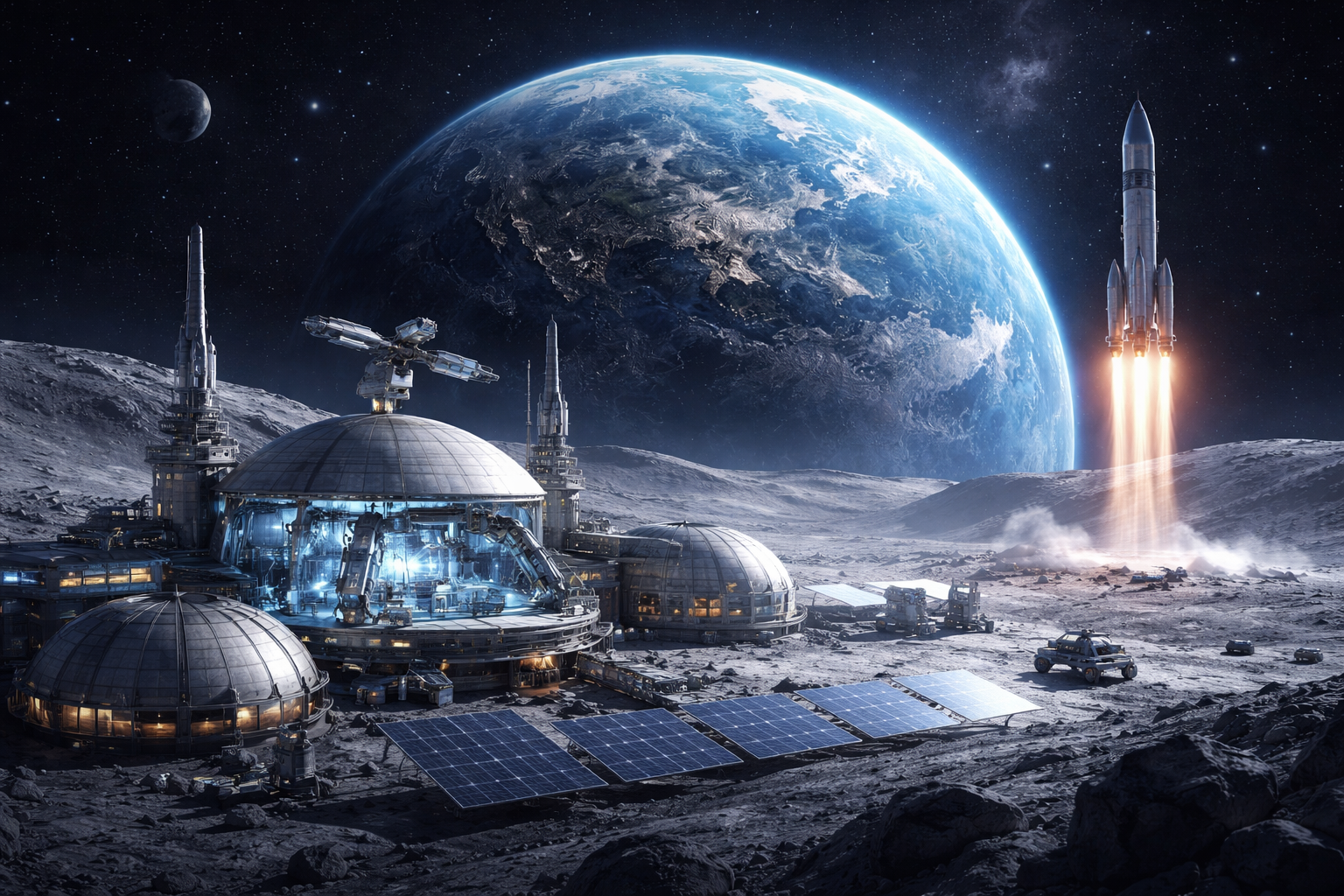
Elon Musk's Moon Gambit: The Trillion-Dollar Pivot Reshaping Space, AI, and Global Power
Why SpaceX's shift from Mars to the Moon accelerates humanity's multi-planetary future while fueling massive AI advancements and outpacing rivals.
SpaceX's recent decision to prioritize a self-sustaining lunar city over immediate Mars colonization marks a strategic turning point. This move slashes development timelines, harnesses unlimited solar energy for AI data centers, and positions the company to dominate emerging space economies amid rising competition from China.
Key Takeaways
SpaceX is delaying Mars missions by five to seven years to focus on the Moon, enabling faster iteration cycles due to shorter travel times and frequent launch windows.
The Moon serves as a testing ground for critical technologies like orbital refueling, habitat systems, and resource utilization, de-risking the longer Mars journey.
Integration with AI through the recent merger unlocks space-based data centers powered by endless solar energy, addressing Earth's power shortages for AI growth.
Competition with China's lunar ambitions drives urgency, with potential trillions in value from lunar resources like water ice for fuel and manufacturing.
This pivot aligns with an upcoming IPO, offering investors tangible milestones in lunar operations, government contracts, and commercial opportunities.
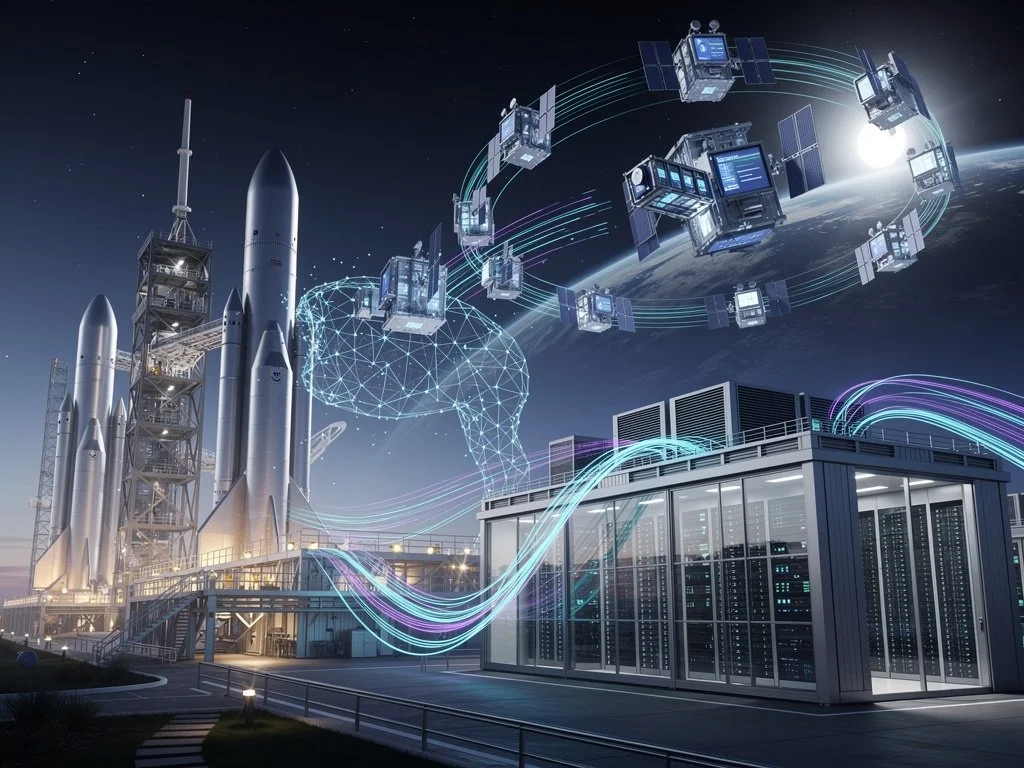
The Musk Megamerger: Building the Ultimate AI Infrastructure Empire
Revolutionizing Compute from Orbit to Earth
A massive merger between SpaceX, Tesla, and xAI could birth a $3 trillion powerhouse that dominates AI by leveraging space for unlimited energy and cooling. This isn't just consolidation—it's a strategic play to own the backbone of the AI era, from rockets to robots.
Key Takeaways
SpaceX, valued at $800 billion, might reverse merge into Tesla's $1.5 trillion structure, potentially including xAI's $230 billion valuation for a combined entity exceeding $3 trillion.
The core driver is overcoming AI's compute bottleneck through space-based data centers, offering constant solar power and passive cooling in orbit.
Synergies include SpaceX's rockets and satellites for deployment, Tesla's manufacturing for hardware scale, and xAI's models for intelligence, creating a vertically integrated AI stack.
Starship enables massive satellite launches, targeting 6,000 compute-enabled units annually, forming a global orbital network.
Risks involve regulatory hurdles, execution challenges in space tech, and geopolitical tensions, but the infrastructure moat could prove unbeatable.