
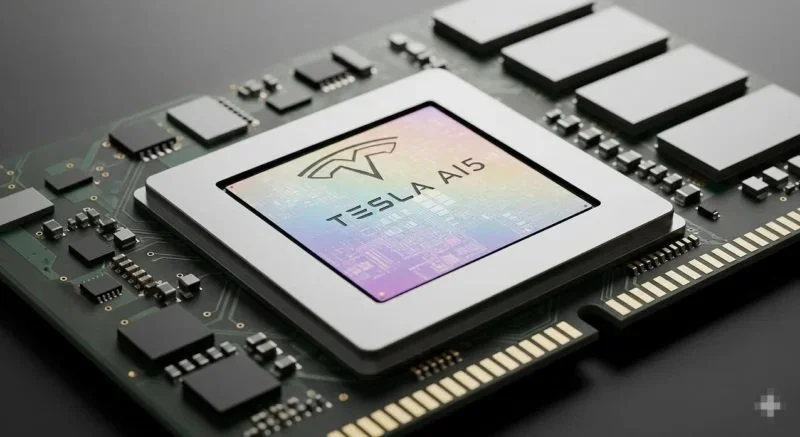
Tesla’s Custom AI Chip Quietly Builds the Foundation for Independence From Nvidia
How a radically simplified inference engine, a $119 billion domestic fab, and orbital data centers powered by constant sunlight could reshape who controls the future of AI infrastructure.
Tesla’s AI5 chip, taped out in April 2026, delivers inference performance in the same range as Nvidia’s H100 for the specific workloads that matter most to large-scale robotics and autonomy systems. Two of the chips together reach territory previously occupied by Nvidia’s Blackwell B200. The difference lies in what the design deliberately left out and where it will actually run first.
Key Takeaways
The AI5 chip matches high-end Nvidia inference throughput for Tesla’s targeted tasks while consuming dramatically less power and costing a fraction as much, because it is built as a narrow-purpose ASIC rather than a general-purpose GPU.
Radical simplification — removing the image processor and other unused blocks — allows the chip to focus exclusively on the low-precision math that runs real-time perception and control in vehicles and humanoid robots.
First deployments target Optimus humanoid robots and internal AI supercomputers rather than next-generation vehicles, since existing hardware already exceeds typical human driving performance in most scenarios.
Tesla continues purchasing hundreds of thousands of Nvidia GPUs for training its largest models, treating custom inference silicon and general-purpose training hardware as complementary tools rather than substitutes.
A rapid internal roadmap calls for AI6 production in 2027 on Samsung’s process with roughly double the performance, followed by AI6.5 on TSMC’s Arizona fab, targeting a new generation every nine to twelve months.
The dedicated Terafab facility carries phase-one costs of $55 billion and total project costs approaching $119 billion — larger than the entire US CHIPS Act — and will be split across Tesla and SpaceX balance sheets ahead of SpaceX’s planned public listing.
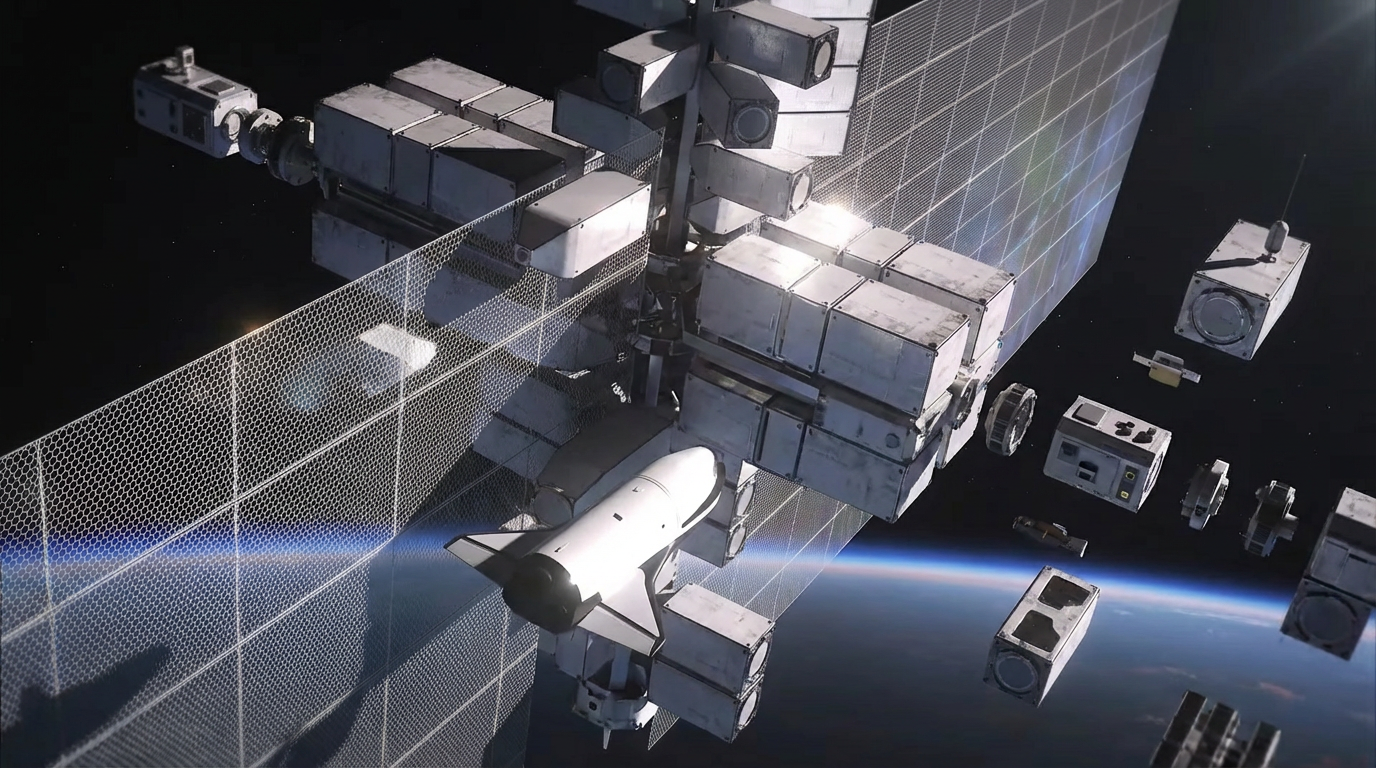
SpaceX regulatory filings seek approval for up to one million satellites configured as orbital data centers that run on uninterrupted solar power, with internal projections placing the total addressable market for space-based AI infrastructure at $26 trillion.
The long-term objective is vertical ownership of every critical layer — chip design, domestic fabrication, low-cost launch, and space-based power — so that AI deployment at planetary scale does not depend on any single external supplier for the foundational compute element.
AI Heads to Orbit: Building Data Centers Beyond Earth's Limits
Why space could become the new home for AI's insatiable hunger for power and cooling, unlocking exponential growth in inference and beyond.
Space-based computing is emerging as a game-changer for AI's expansion. With earthly data centers hitting walls on energy availability and water for cooling, shifting operations to orbit taps into unlimited solar power and natural vacuum cooling. This approach not only sidesteps terrestrial bottlenecks but also paves the way for massive scaling in AI inference, where demand is skyrocketing as models become everyday tools.
Key Takeaways
Space offers unlimited, low-cost solar energy without the need for batteries or land permits, producing eight times more power per solar panel than on Earth.
Cooling in space relies on radiating heat into the void, eliminating the massive water consumption that plagues ground-based data centers.
Initial focus will be on AI inference tasks, like generating images or running chatbots, which can operate on isolated nodes rather than massive interconnected clusters needed for training.
Over the next decade, inference compute could dominate AI energy use, potentially doubling every six to twelve months, far outpacing training demands.
Challenges like radiation hardening and deployable radiators are being solved through innovative engineering, making space viable for high-power chips.
Launch costs are plummeting with reusable rockets, enabling terawatts of orbital compute capacity without the constraints of Earth's grid or politics.
By 2035, space might host a small but growing share of new data centers, with full-scale adoption potentially reaching meaningful levels by 2050.