
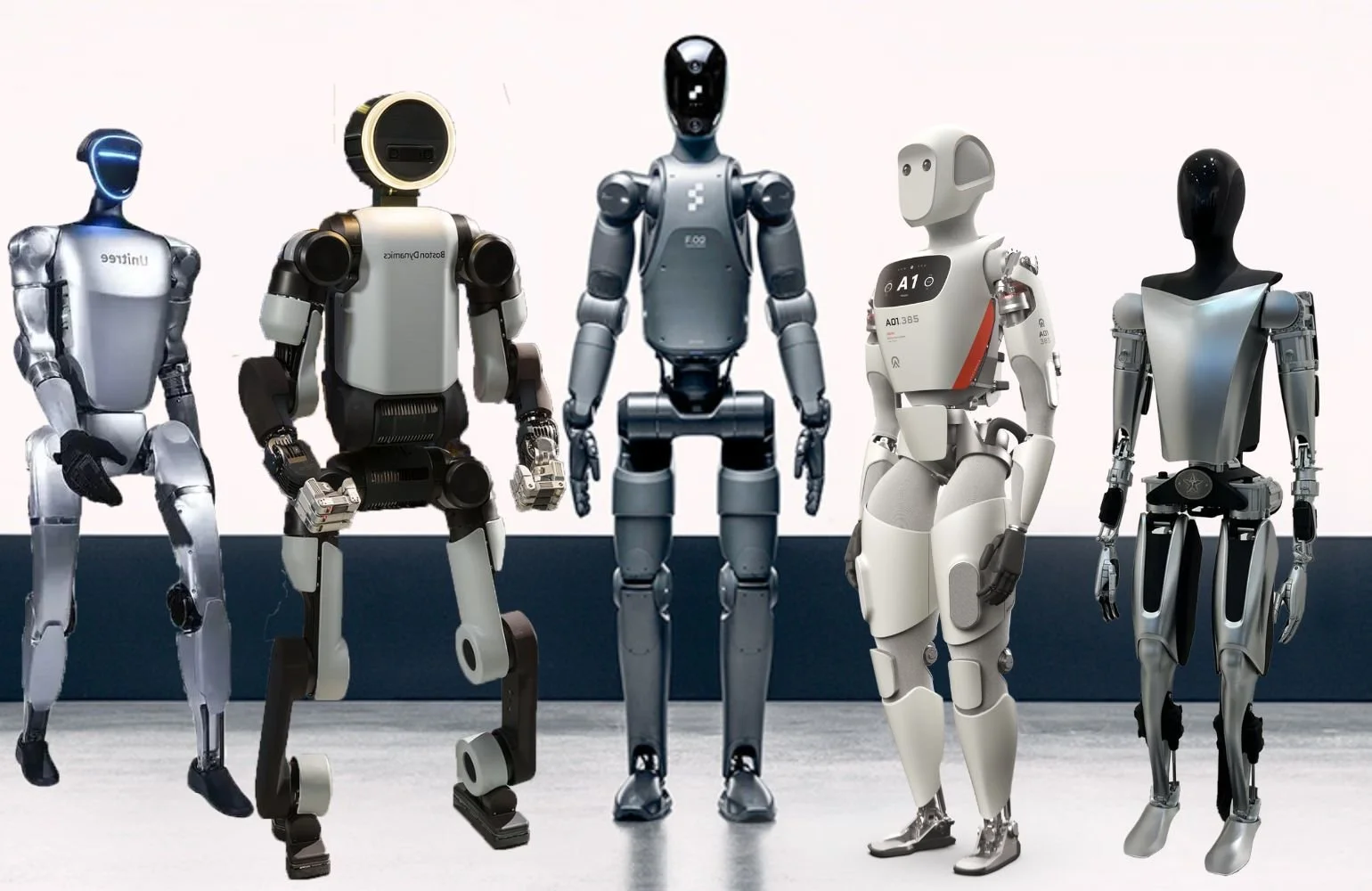
The $40 Trillion Robot Takeover Has Begun
Humanoids just hit their iPhone moment – turning sci-fi into nonstop warehouse reality and rewriting one-third of the global economy.
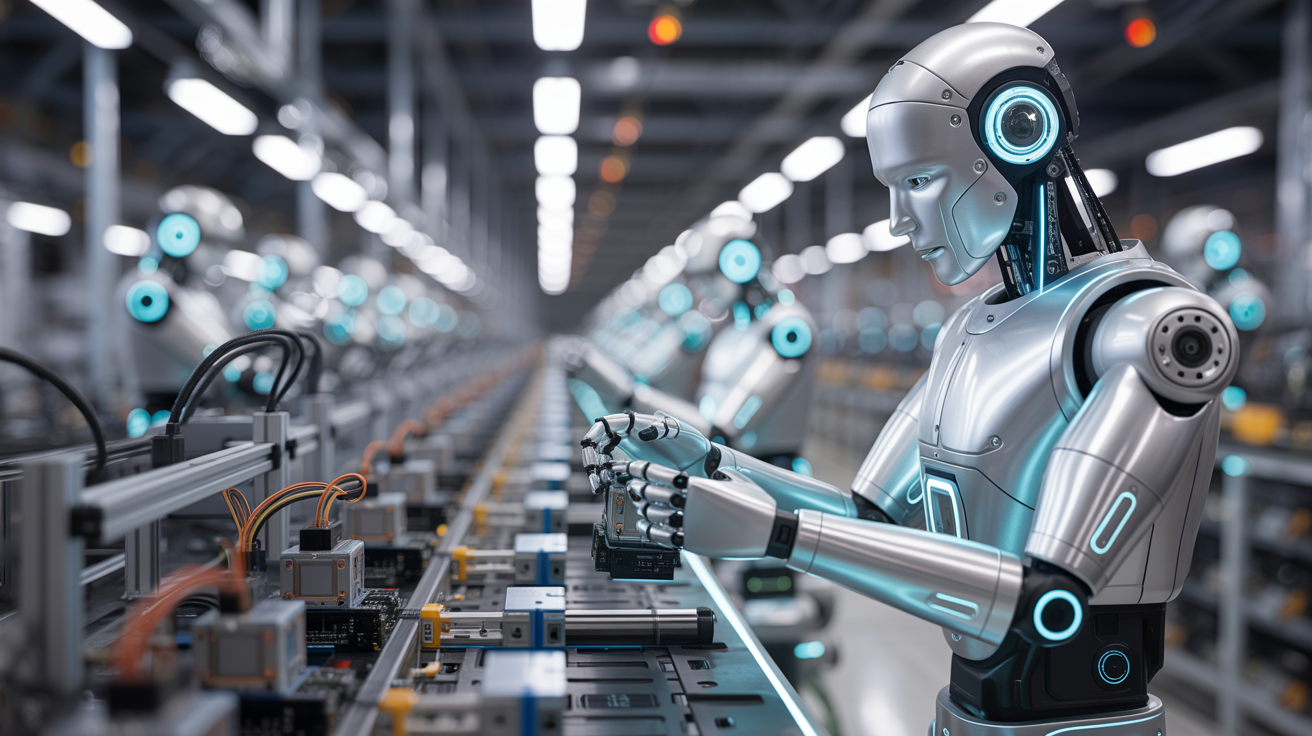
The convergence happened. Humanoid robots now operate 24/7 in live California warehouses, swapping batteries seamlessly and matching human speed on package sorting for over 60 straight hours. This marks the exact inflection that smartphones triggered in 2007: hardware and software finally aligned, but this time the prize is ten times larger – the entire $40 trillion pool of annual human physical labor across warehouses, farms, hospitals, factories, and every task that moves bodies through space.
Key Takeaways
Three S-curves in AI vision-language-action models, real-plus-synthetic data flywheels, and actuator costs (down 10x in six years thanks to the EV supply chain) aligned in the last 18 months, making capable, affordable humanoids possible at scale.
Robots are already deployed today in automotive body shops, sheet-metal lines, weld inspection, electronics assembly, and logistics centers, filling roles with 90-150% annual turnover where humans quit faster than companies can hire.
First wave targets demographic vacancies created by aging populations and undesirable shifts – Japan’s 3.9:1 eldercare ratio, Germany’s net worker loss in 2026, U.S. trucking shortages climbing toward 160,000 – not eager workers being fired.
Next waves hit 10+ million U.S. material-mover, assembler, and janitor jobs at $30k–$44k median wages, with potential for all three waves to compress into five years if software generalizes and costs drop faster than models predict.
A single unstoppable flywheel links AI training clusters, battery tech, vehicle production lines, and robot manufacturing; pausing it means surrendering competitiveness against China and domestic manufacturing goals.
Visible optics – named robots on livestreams, viral photos of humanoids at stations – will drive regulation, tariffs, union carve-outs, and city-vs-country races long before pure economics play out.
Winners under 35 will treat AI and robotics as the new electricity: adopt tools aggressively, align them with personal strengths, and build new categories (autonomous service fleets, hazardous-site automation) that create abundance for the bottom 20% while the adaptive middle thrives.
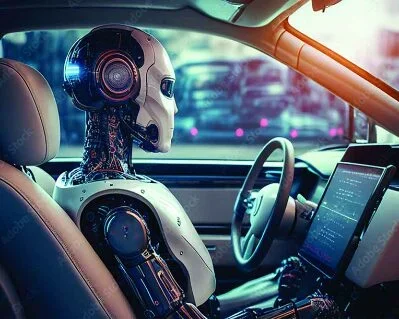
Sentient Cars, Robot Armies, and Restored Senses: The AI Stack That Could Deliver Abundance at Planetary Scale
How vision-native neural networks, fully reusable heavy lift, and direct brain interfaces are moving from prototypes to infrastructure that multiplies human capability.
The most consequential progress right now is not in any single headline demo but in three tightly linked layers of AI: vehicles that see and reason like humans, general-purpose humanoid machines that can multiply labor, and neural interfaces that read and write directly to the nervous system. These layers are advancing on parallel tracks that reinforce each other. Camera-only autonomy is already running unsupervised in real cities. Humanoid platforms are shifting from research videos to factory deployment. Brain implants have moved from restoring basic communication to targeting limb control and artificial vision. Together they sketch a path where the majority of road distance becomes AI-driven within a decade, robot populations exceed human ones, and previously irreversible losses of mobility or sight become addressable. The common thread is a deliberate focus on scalable, biology-mimetic systems that improve through software and fleet data rather than exotic new hardware at every step.
Key Takeaways
Camera-and-neural-net autonomy, built to match human visual processing, is already operating without safety drivers or remote monitors in multiple Texas cities and is projected for broad U.S. availability before the end of the year.
The same vision-first architecture is expected to reach at least ten times human-level safety, turning self-driving from a narrow feature into the default mode for most distance traveled within roughly ten years.
Humanoid robots are forecast to outnumber people and expand total economic output by a factor of ten to one hundred, shifting the baseline from universal basic income to universal high income supported by extreme productivity gains.
Full rapid reusability on the latest heavy-lift rocket architecture, targeted for this year, removes the core economic barrier to routine transport of large payloads and is viewed as the decisive step toward self-sustaining settlements beyond Earth.
Brain-computer interfaces have already restored speech and digital control for people with complete motor disconnection; next milestones include bridging spinal injuries to reanimate limbs and delivering artificial vision, including to individuals blind from birth, with potential for superhuman precision over time.
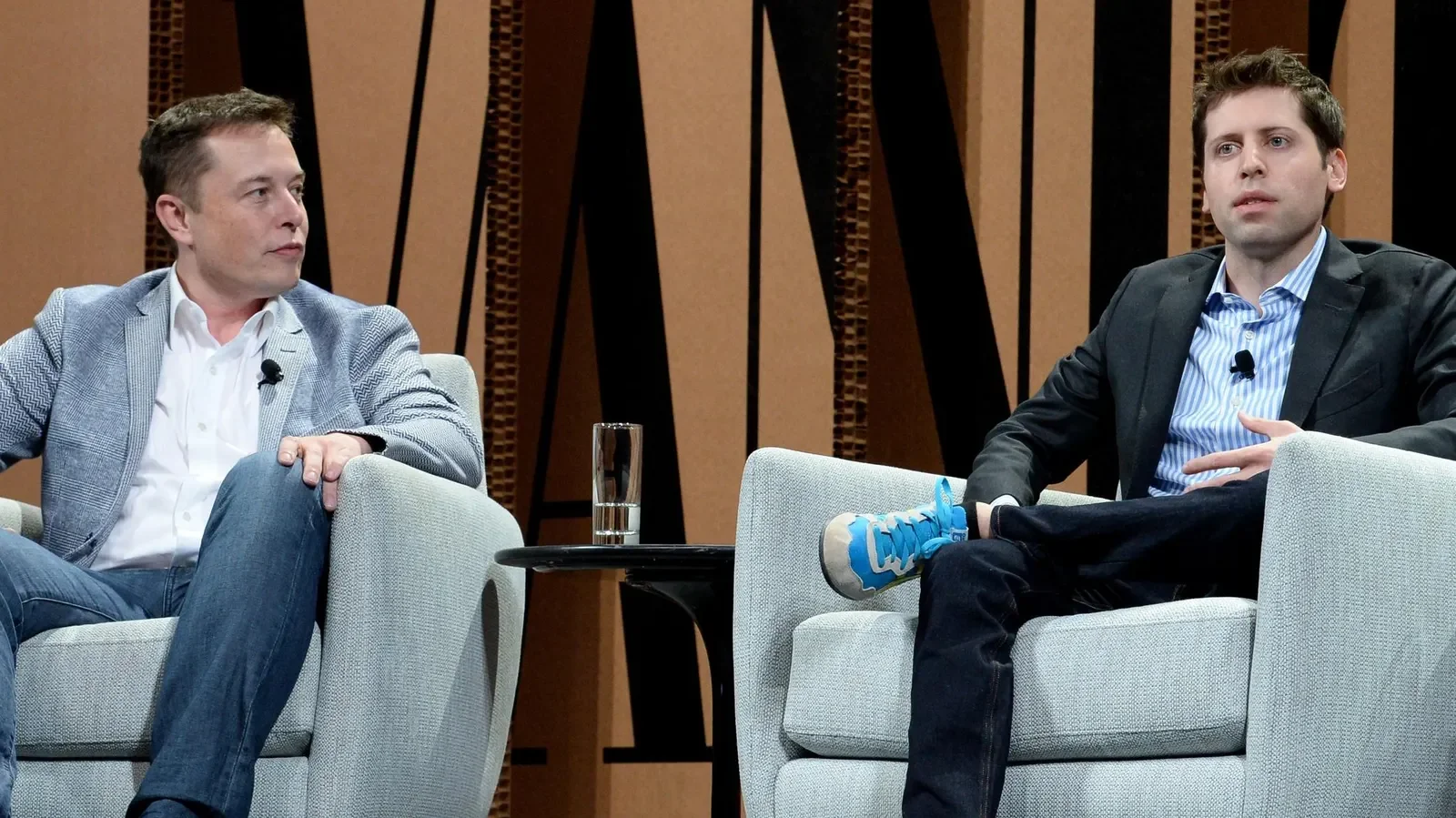
The $130 Billion Lawsuit That Could Rewrite Nonprofit Law for the Next Century
One courtroom decision now testing whether a tax-advantaged charity can convert into a for-profit powerhouse—handing billions in equity to insiders while reshaping the rules for every hospital, university, and research lab in America.
This trial, which opened on April 27, 2026, in the U.S. District Court for the Northern District of California, is far larger than any AI chatbot rivalry. At its core sits a single question with trillion-dollar consequences: Can a 501(c)(3) public charity, built on tax-deductible donations and a charter promising public benefit, legally transform itself into a for-profit entity where employees, executives, and outside investors capture enormous equity stakes? The assets in play total roughly $130 billion. The precedent set here will echo through America’s entire charitable sector for generations.
Key Takeaways
OpenAI launched in 2015 as a 501(c)(3) nonprofit with an explicit charter to advance AI for humanity’s benefit through open research, collaboration, and resistance to corporate concentration of power.
By 2025 the organization had completed a full conversion to a Delaware public benefit corporation, removing earlier profit caps; the original nonprofit foundation retained an approximately 26% ownership stake valued at around $130 billion at the time of conversion.
The lawsuit claims breach of charitable trust and unjust enrichment, arguing that assets originally held in public trust were effectively transferred to private hands without meeting historical standards for nonprofit-to-for-profit restructurings.
Regulators including the IRS, California Attorney General, and Delaware Attorney General reviewed the changes, yet the case tests whether paper approvals satisfied the spirit and letter of century-old nonprofit law.
A ruling in either direction will directly affect the $1 trillion-plus annual U.S. charitable sector—hospitals, university endowments, research foundations, conservation groups, religious institutions, and more—by clarifying (or loosening) the rules for converting mission-driven assets into commercial equity.
Three plausible outcomes range from a full green light for future conversions, a hard reset enforcing traditional public-trust protections, or a hybrid ruling that adds stricter procedural safeguards going forward.
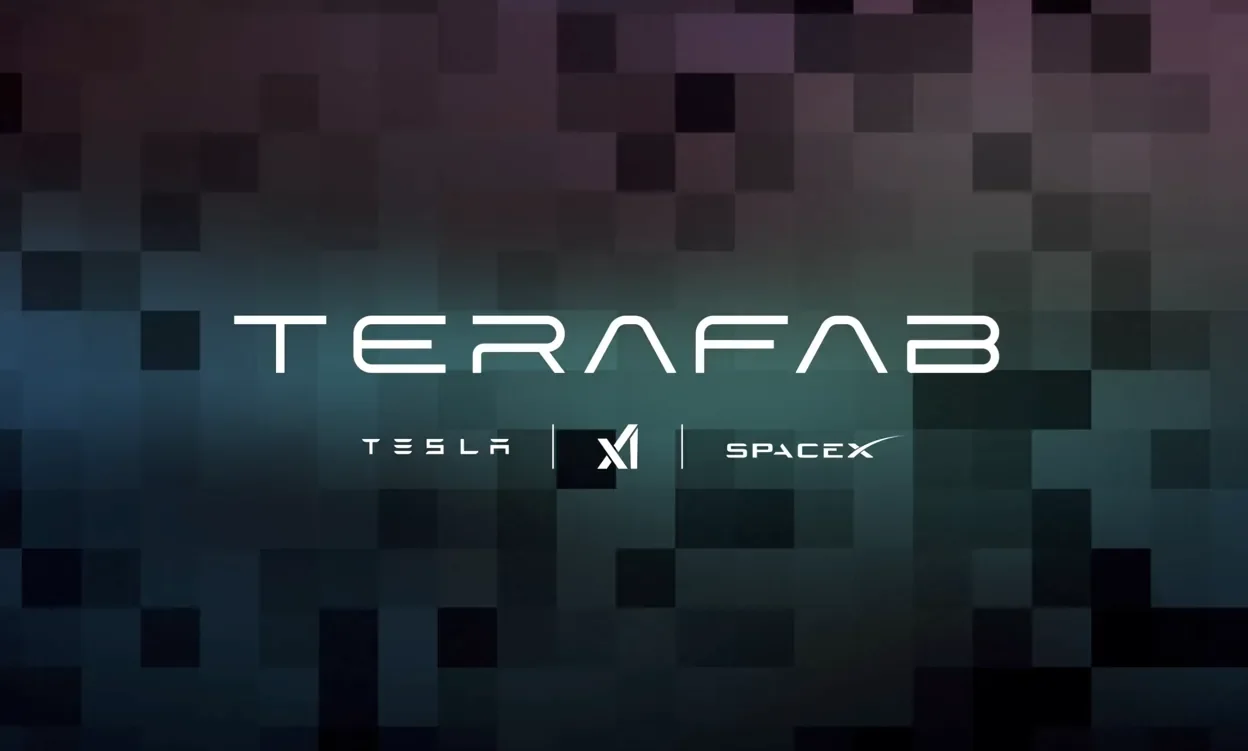
The Tera Fab Breakthrough: Building Terawatts of AI Compute to Power a Galactic Civilization
Why one facility, paired with orbital infrastructure and robotics, could unlock energy abundance at a scale that dwarfs everything on Earth today.
The most valuable insight here is simple: humanity’s entire current AI chip production barely scratches the surface of what’s required to reach meaningful cosmic scale. A new integrated chip fabrication project called Tera Fab changes that equation by delivering terawatts of annual compute output—orders of magnitude beyond today’s global total—while making space-based AI not just viable but dramatically cheaper than anything possible on the ground. The result is a clear path to multi-planetary expansion, humanoid robots in the billions, and an economy powered by the Sun itself.
Key Takeaways
Current worldwide AI chip output sits at roughly 20 gigawatts per year; all existing fabs combined supply only about 2 percent of the terawatt-scale capacity now planned.
Tera Fab integrates logic, memory, packaging, testing, and mask-making in a single building, creating an ultra-fast design iteration loop measured in days instead of months.
Two specialized chip families emerge: high-volume, efficient designs for edge inference in humanoid robots and vehicles, plus radiation-hardened, high-power versions optimized for the harsh space environment.
Space-based solar delivers five times more consistent energy than ground installations, with no atmosphere, no night cycle, and no weather—driving AI compute costs below terrestrial levels within two to three years.
Starship upgrades will enable 10 million tons of payload to orbit annually, supporting orbital solar arrays and compute clusters at terawatt scale.
A lunar electromagnetic mass driver built with robotic labor will later push compute into the petawatt range, opening the door to million-fold economic growth and post-scarcity abundance.

Elon Musk's Bombshell: Mass and Energy as the New Global Currency
The Shift That Redefines Wealth in an AI-Driven World
Rapid advances in AI, robotics, and solar power are converging to make intelligence, labor, and energy nearly free, positioning mass and energy as the core drivers of future economies. This transformation echoes historical currency shifts and points to a deflationary era where energy production becomes the ultimate measure of value.
Key Takeaways
AI training and inference costs have plummeted, with benchmarks dropping from thousands of dollars to pennies, making cognitive tasks approach zero cost.
Robotic labor could reach 20 cents per hour by 2032, disrupting a $40 trillion global market in physical work.
Solar energy costs have fallen 99.6% since 1976, outpacing other sources and enabling exponential growth in power generation.
Historical currency systems—from gold to petrodollars—evolved with dominant economic inputs; energy now emerges as the next anchor.
Orbital solar data centers could multiply Earth's energy output by millions, turning space into the ultimate power source.
In this framework, companies controlling energy, AI, and robotics stacks stand to dominate, while traditional fiat currencies face unprecedented pressure.

The Hidden Convergence: How Elon's Empire is Building a $3 Trillion Future
Unlocking Abundance Through Integrated Tech Ecosystems
A massive shift is underway in technology, where separate companies are merging their strengths to create something far larger than any single entity. At the core is a vision of robots handling all human tasks, AI anticipating needs before they're voiced, and unlimited energy powering it all. This isn't distant sci-fi—key pieces are already connecting in ways that could reshape industries and economies.
Key Takeaways
Four major companies—Tesla, SpaceX, xAI, and Neuralink—are pooling resources to form an interconnected system worth over $3 trillion in combined value.
AI from xAI is designed to power Tesla's humanoid robots, creating self-sufficient machines that outperform humans in physical and cognitive tasks.
Satellite integration from SpaceX into Tesla vehicles ensures constant global connectivity, enabling real-time data sharing for autonomous driving.
Underground tunnels from The Boring Company serve as ideal testing grounds for self-driving tech, generating valuable data to refine AI models.
Neuralink's brain interfaces aim to blend human and machine intelligence, opening doors to telepathic control of robots and devices.
Despite missed timelines, rapid progress in robot deployment, energy storage, and AI supercomputing shows convergence happening now.
This ecosystem creates unbeatable advantages, like network effects in data and hardware, that competitors can't easily match.
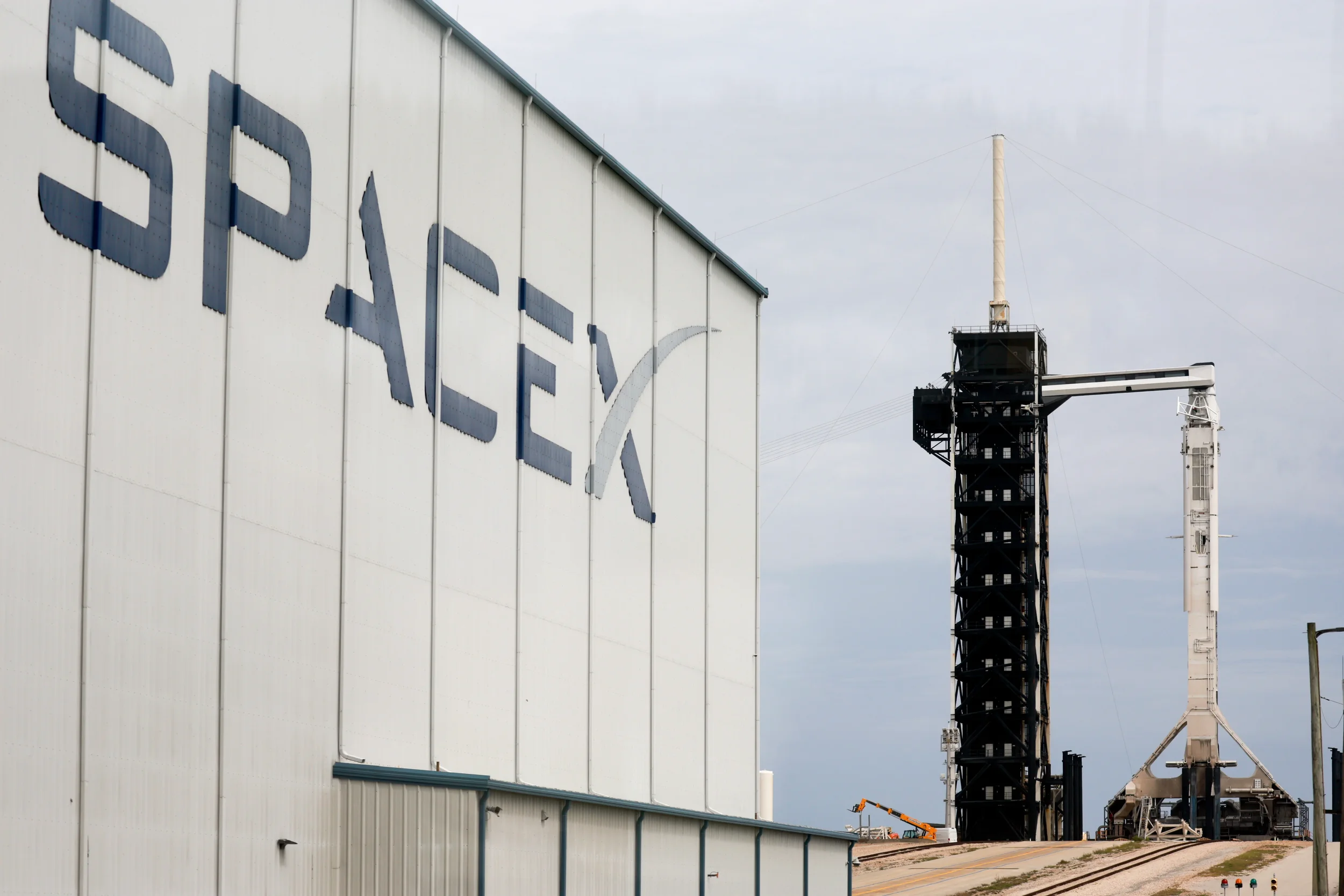
SpaceX Swallows xAI: The Dawn of Orbital AI Powerhouses
Revolutionizing Compute from the Stars – Why This Merger Changes Everything
The fusion of SpaceX and xAI unlocks a new era where AI training escapes Earth's limits, powered by endless solar energy in orbit. This deal catapults innovation by sidestepping power shortages and regulatory hurdles, paving the way for breakthroughs in physics, tech, and human expansion beyond our planet.
Key Takeaways
SpaceX's acquisition of xAI creates a $1.25 trillion entity, the world's most valuable private company, focused on integrating AI with space tech.
AI compute moves to space-based satellites, harnessing constant solar power and natural cooling to scale far beyond Earth's energy constraints.
This solves immediate bottlenecks like electricity demand and environmental concerns, enabling 10-100 times more AI capacity annually.
Starship rockets will launch millions of tons into orbit yearly, funding moon bases, Mars cities, and vast AI constellations.
The merger opens AI training services to other companies, accelerating global tech advances while fueling multi-planetary goals.
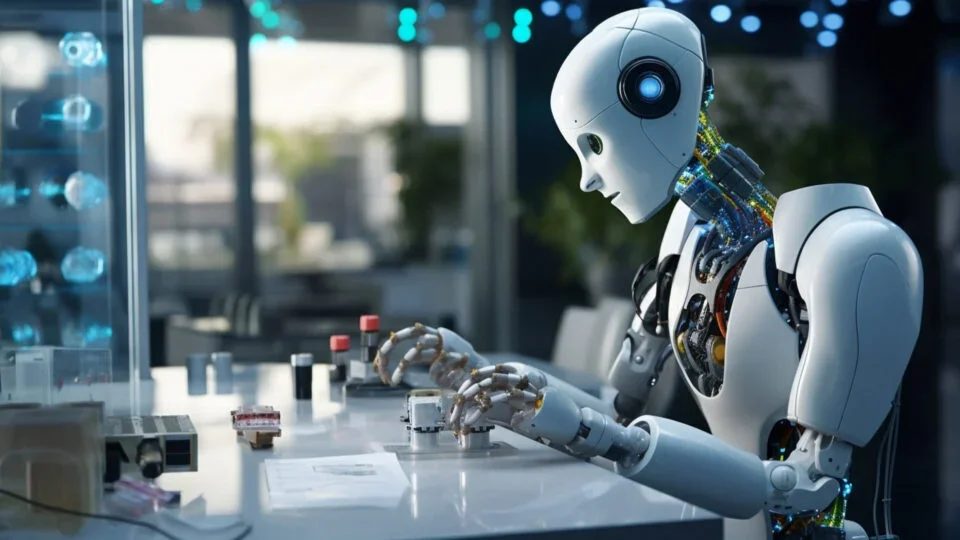
Elon Musk's Davos Vision: Abundance Through AI, Robots, and Space Power
The path to a future where robots outnumber humans, energy becomes limitless, and consciousness survives beyond Earth.
Key Takeaways
Electrical power has emerged as the primary bottleneck for scaling AI, with chip production outpacing grid additions in most regions except China.
Humanoid robots will drive unprecedented economic abundance, eventually outnumbering people and saturating needs like elder care, childcare, and household tasks.
Tesla plans to deploy Optimus robots for complex factory tasks by the end of 2026 and sell them to the public by the end of 2027, once safety and functionality reach high reliability.
Full rocket reusability with Starship could slash space access costs by 100x, enabling cheap satellite deployment and space-based solar for AI data centers.
Space-based solar offers 5x more effective power collection than ground-based systems, with no weather, night cycles, or atmospheric losses—making orbit the lowest-cost location for AI compute within a few years.
AI could surpass individual human intelligence by the end of 2026 or early 2027, and exceed all of humanity combined by around 2030-2031.
Large-scale solar arrays (roughly 100x100 miles) could power entire nations like the US or Europe, but deployment faces barriers like high tariffs on imported panels.
Consciousness is viewed as rare and fragile, making multiplanetary life essential to protect it from Earth-bound disasters.
Optimism about technological progress outweighs risks, as abundance from AI and robotics can broadly benefit society if energy constraints are solved.
NVIDIA's Alpha Mayo: Ushering in the Era of Reasoning Autonomous Vehicles
Revolutionizing Mobility with AI That Thinks and Adapts
The rapid evolution of AI is transforming how vehicles operate, making self-driving cars not just possible but intelligent enough to handle unpredictable scenarios through reasoning. This shift promises safer roads, widespread adoption of autonomous tech, and a foundation for broader robotics applications that could reshape industries from transportation to manufacturing.
Key Takeaways
Advanced AI models like Alpha Mayo enable end-to-end training for autonomous vehicles, processing camera inputs directly to control steering, brakes, and acceleration while explaining decisions in real-time.
Synthetic data generation tools create trillions of simulated driving miles, overcoming the limitations of real-world data collection for rare scenarios.
Dual software stacks in vehicles provide redundancy: one for advanced AI driving and another for traceable, safety-certified fallback operations.
Open-sourcing AI models accelerates ecosystem growth, allowing partners to build on full stacks for everything from personal cars to robo-taxis.
The same AI techniques apply beyond vehicles to various robots, from humanoid forms to industrial manipulators, trained in virtual simulators.
Integration of AI physics into design tools revolutionizes industries like electronics and systems design, speeding up simulations and innovations.
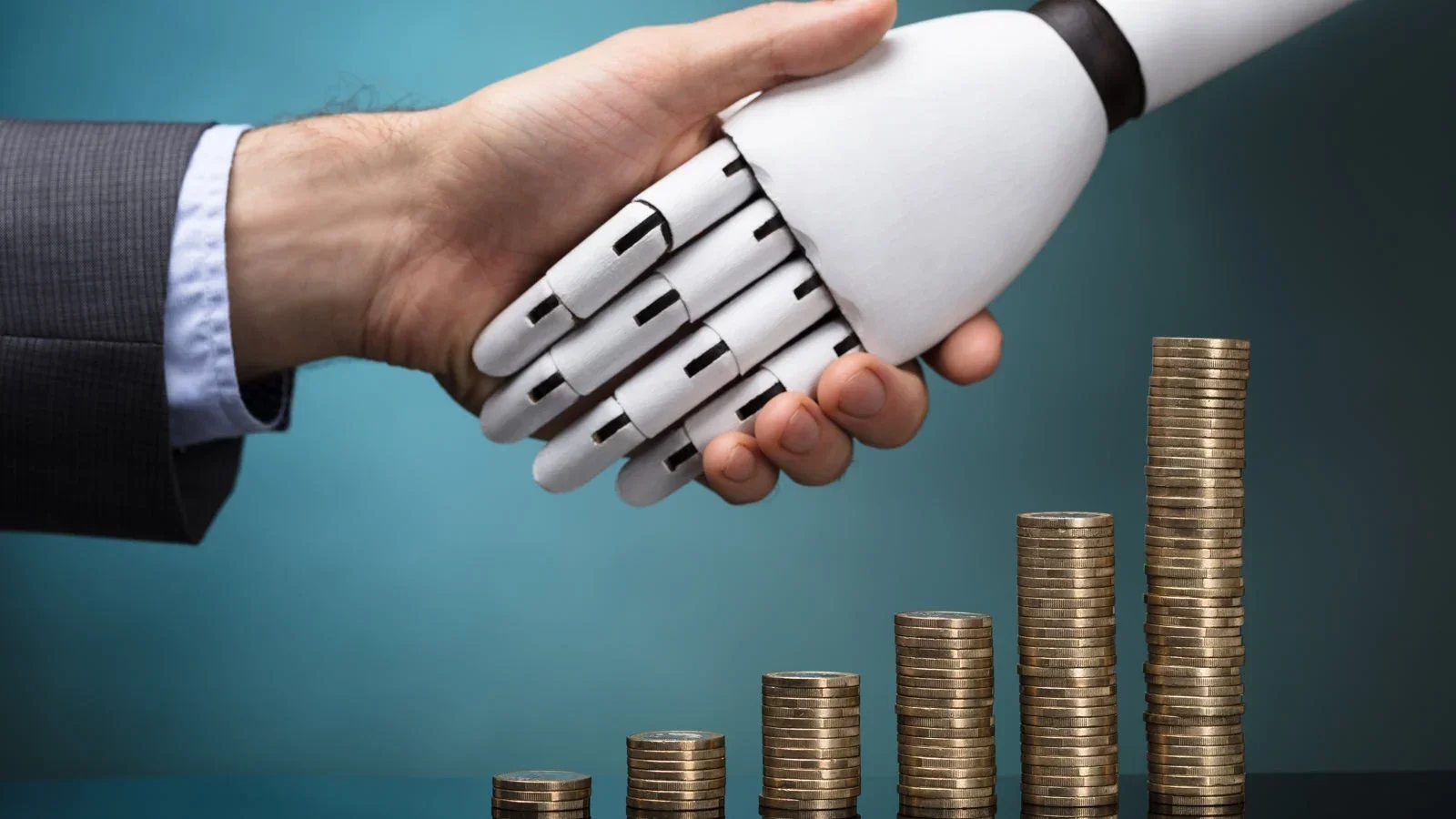
The Malibu Paradox: Why Abundance Won't Erase Scarcity
Rethinking Wealth in an AI-Driven Future
Imagine a world where robots and AI eliminate poverty entirely, making high-income access universal. Yet, even in this era of limitless resources, battles over prime locations like beachfront property could redefine competition and ownership.
Key Takeaways
Universal high income emerges when labor, energy, and materials cost nothing, thanks to AI, robots, solar power, and asteroid mining.
Physical goods become infinite, but locations tied to geography, history, and authenticity remain scarce.
Instant transportation via tunnels, electric aircraft, and high-speed transit could decentralize value, making remote living as convenient as urban hubs.
Without money, allocation of rare assets might shift to reputation, contributions, or even robot armies, potentially locking in current inequalities.
The transition risks unemployment, asset bubbles, and political fights over land rights and robot control.
Human nature's drive for status and exclusivity may persist, turning competition toward new forms like bot legions or social credits.
The Dawn of Optional Work: AI, Robots, and Humanity's Next Leap
Redefining Existence in a World of Infinite Possibility
The rapid evolution of AI and robotics is set to transform society, making traditional jobs optional while pushing humanity toward multi-planetary sustainability. At the core lies a vision where technology ensures abundance, but challenges like population decline threaten long-term progress.
Key Takeaways
AI and robotics advancements could make working optional within 10-20 years, turning jobs into hobbies much like gardening today.
Becoming a multi-planetary species ranks among the top evolutionary milestones, ensuring redundancy against planetary catastrophes.
Future economies may shift to universal high income, where competition focuses on relative status rather than survival needs.
Population decline poses a risk to expanding human consciousness, as more people increase the chances of unlocking universal truths.
Leadership in tech involves building trusted teams that act as extensions of visionary minds, enabling massive scale in projects like rockets and robots.
Early Mars settlements will be harsh and dangerous, akin to historical frontiers, requiring mission-driven pioneers.
Neuralink's Leap: From Sci-Fi to Everyday Reality
Unlocking Human Potential Through Brain-Machine Fusion
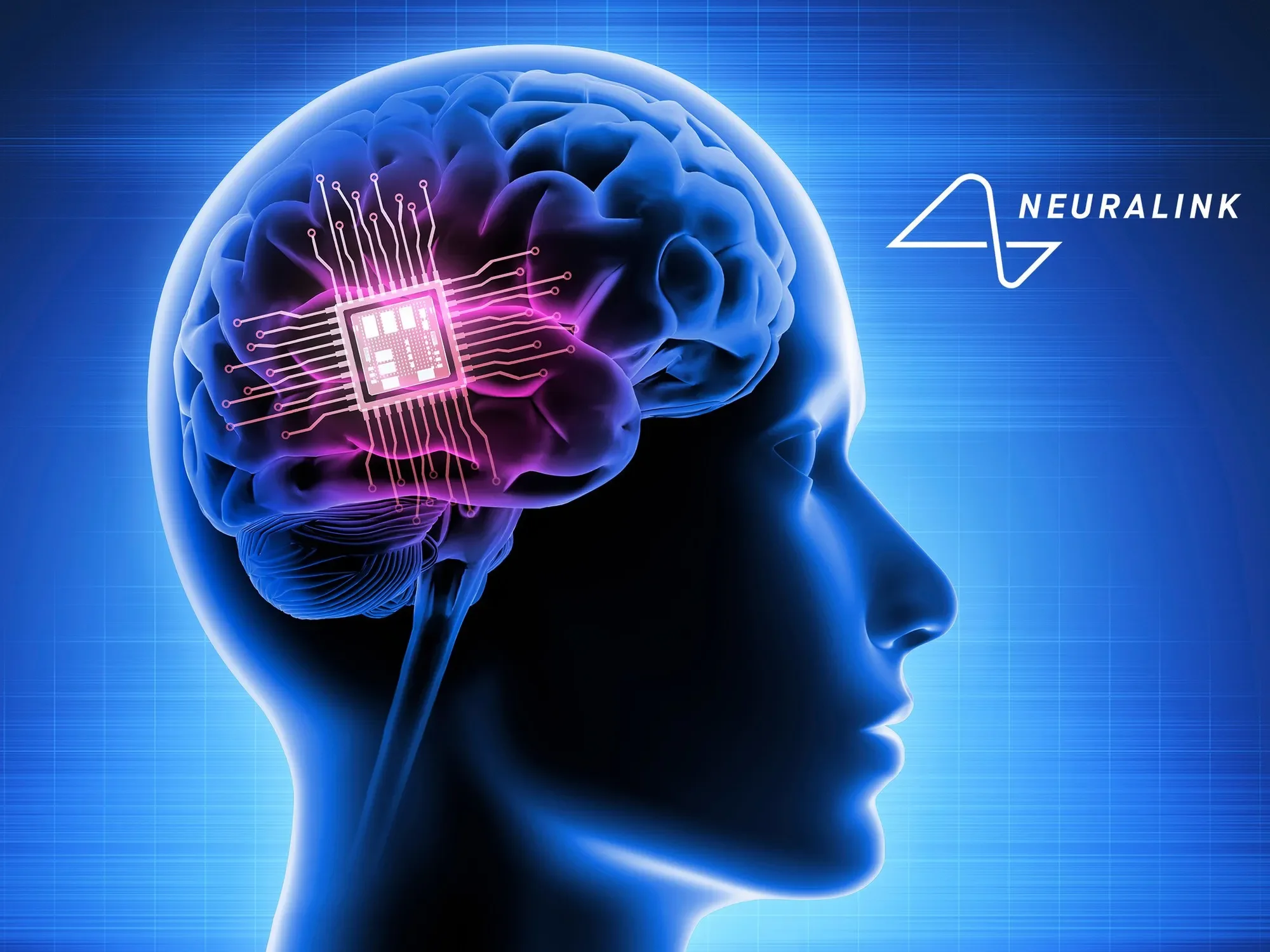
Neuralink is pushing boundaries in brain-computer interfaces, turning paralysis into possibility and aiming for full brain connectivity. With rapid advancements in implants, robotics, and decoding, the tech promises to restore lost functions and enhance cognition, all while scaling to help thousands.
Key Takeaways
Neuralink's first product enables quadriplegic users to control devices like computers and phones purely through thought, with average daily usage reaching eight hours.
The company has implanted devices in 13 people as of late 2024, focusing initially on spinal cord injuries and ALS, with plans to expand to restoring sensation, speech, and vision.
Surgical robots insert ultra-thin threads into the brain, avoiding blood vessels, with future versions targeting faster, more reliable procedures under one hour.
Implants feature 1,000 channels for neural recording, wireless charging, and data compression to transmit signals via Bluetooth, but scaling to higher channel counts demands innovations in power, packaging, and compression.
Decoding algorithms convert brain spikes into actions like cursor movement in 15-20 minutes of calibration, though ongoing drift requires robust, self-adapting ML models.
Long-term vision includes whole-brain interfaces for treating psychiatric disorders, augmenting abilities, and exploring the brain's inner workings, backed by vertical integration from chip design to manufacturing.

Tesla's Drone Revolution: Partnering with SpaceX to Dominate the Skies
Why This Could Be the Next Big Leap in Autonomous Tech and National Security
Tesla stands on the brink of transforming the commercial drone market by leveraging its battery expertise and teaming up with SpaceX for advanced materials and aerodynamics. This move could challenge China's dominance, boost U.S. security, and pave the way for flying vehicles.
Key Takeaways
Tesla's low-cost, high-density batteries give drones longer flight times and better efficiency than competitors.
SpaceX's lightweight materials and aerodynamic designs from rockets can create stronger, lighter drone frames and propellers.
Tesla's electric motor production scales easily to drones, enabling high-torque, reliable performance at lower costs.
Integrating Tesla's full self-driving AI allows for fully autonomous drones that navigate complex environments without human input.
Entering the drone market addresses China's control over commercial drones, reducing national security risks for U.S. businesses and governments.
Drones serve as a low-risk testing ground for electric vertical takeoff and landing vehicles, accelerating urban air mobility.
Robotaxis Set to Ignite Economic Revival in Forgotten Neighborhoods
Revolutionizing Mobility for the Underserved: A Path to Broader Prosperity
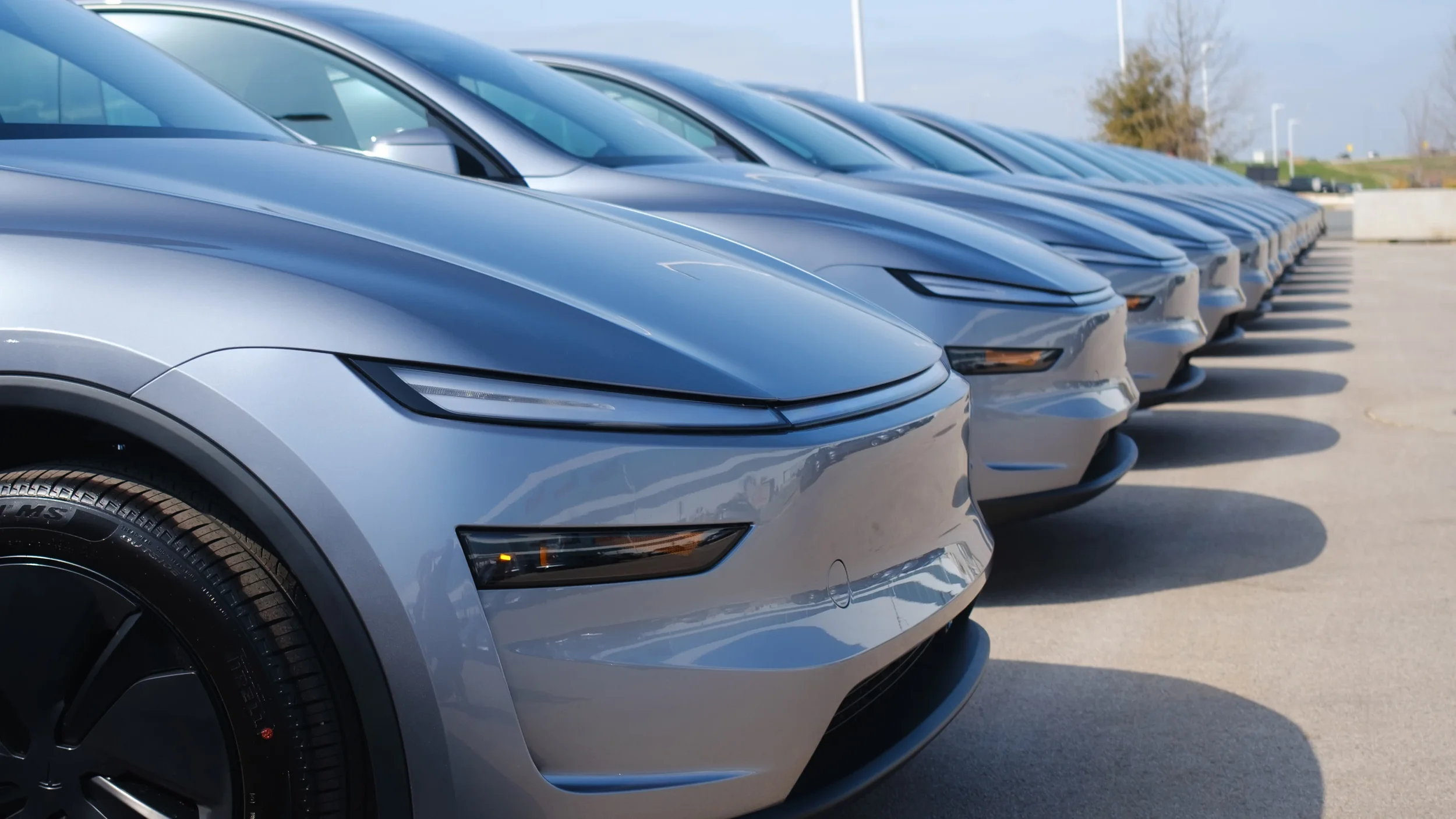
Robotaxis promise to cut transportation costs dramatically, opening doors to jobs, healthcare, and community growth in low-income areas long hampered by isolation.
Key Takeaways
Transportation acts as a major barrier in economically disadvantaged neighborhoods, limiting access to opportunities and contributing to stagnation.
At scale, robotaxis could reduce per-mile costs to around 30 cents, making rides up to 90% cheaper than current options like rideshares.
Lower costs would enable more travel for work, medical visits, and social activities, boosting local economies through increased foot traffic and investment.
Communities in food deserts or with poor public transit stand to gain the most, with affordable rides transforming daily errands into feasible routines.
While job displacement for drivers remains a challenge, competition among providers could drive even better pricing and services.
Overall, this shift expands mental horizons, fostering optimism and long-term societal benefits like reduced segregation and enhanced freedom.