
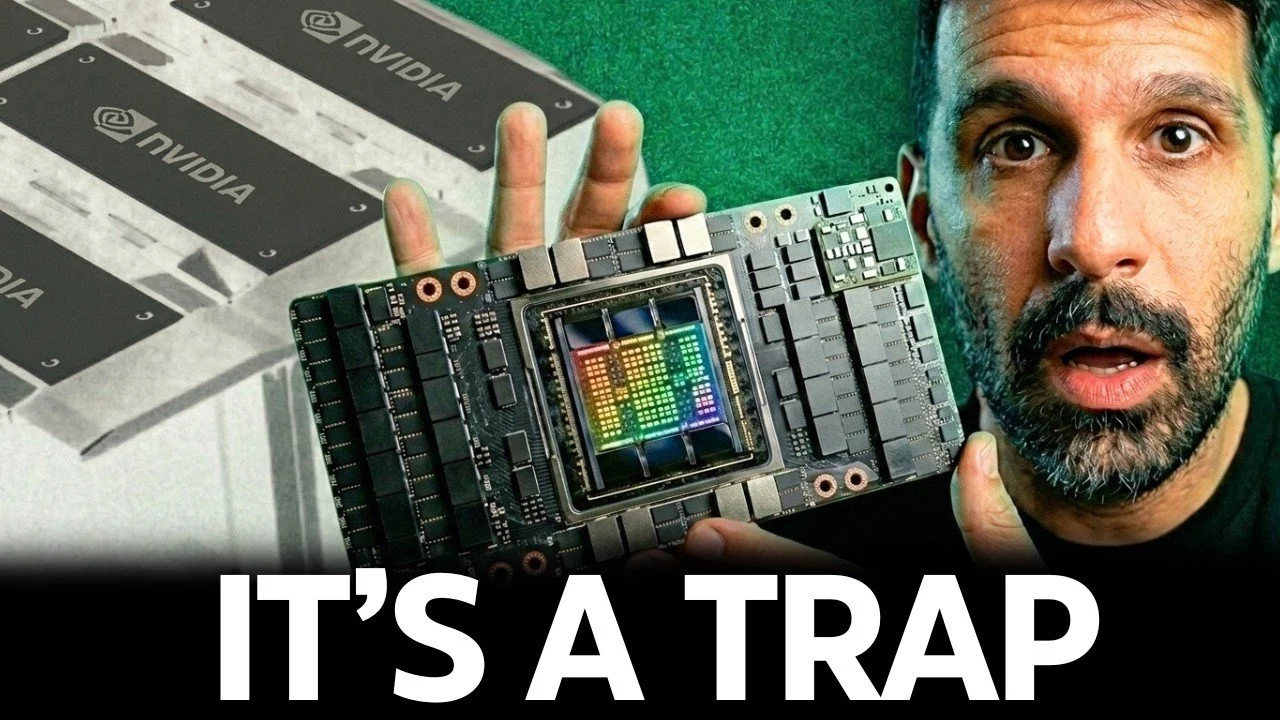
NVIDIA Absorbs Groq in a $20 Billion Move as the Chip War Shifts From Training to Inference
With inference already running two-thirds of the world’s AI compute, NVIDIA’s Christmas Eve licensing deal for Groq’s patents, software, and top engineers quietly removed its fastest challenger while AMD, Cerebras, and Tesla scatter across entirely different mountains.
Nvidia Pays $20 Billion for Groq's Team as the AI Chip War Shifts to Inference
By licensing Groq’s entire patent portfolio and hiring founder Jonathan Ross plus roughly 80% of its staff on Christmas Eve, the $5 trillion chip king is fortifying the one battlefield - inference - where in-house silicon from Google, Amazon, and Microsoft most threatens its 75% margins.
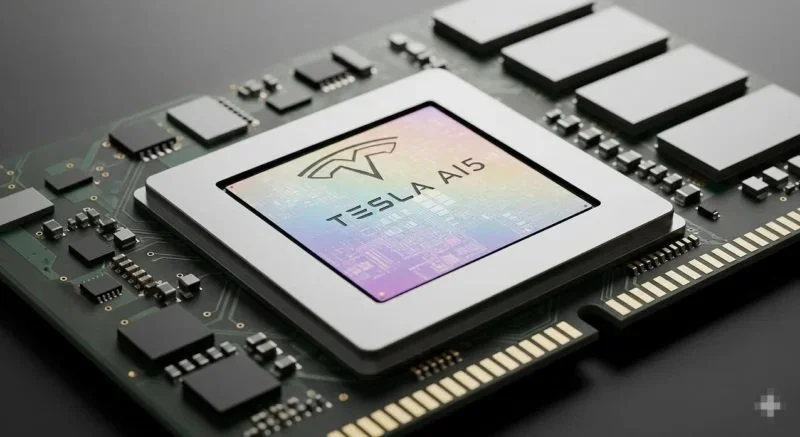
Tesla’s Custom AI Chip Quietly Builds the Foundation for Independence From Nvidia
How a radically simplified inference engine, a $119 billion domestic fab, and orbital data centers powered by constant sunlight could reshape who controls the future of AI infrastructure.
Tesla’s AI5 chip, taped out in April 2026, delivers inference performance in the same range as Nvidia’s H100 for the specific workloads that matter most to large-scale robotics and autonomy systems. Two of the chips together reach territory previously occupied by Nvidia’s Blackwell B200. The difference lies in what the design deliberately left out and where it will actually run first.
Key Takeaways
The AI5 chip matches high-end Nvidia inference throughput for Tesla’s targeted tasks while consuming dramatically less power and costing a fraction as much, because it is built as a narrow-purpose ASIC rather than a general-purpose GPU.
Radical simplification — removing the image processor and other unused blocks — allows the chip to focus exclusively on the low-precision math that runs real-time perception and control in vehicles and humanoid robots.
First deployments target Optimus humanoid robots and internal AI supercomputers rather than next-generation vehicles, since existing hardware already exceeds typical human driving performance in most scenarios.
Tesla continues purchasing hundreds of thousands of Nvidia GPUs for training its largest models, treating custom inference silicon and general-purpose training hardware as complementary tools rather than substitutes.
A rapid internal roadmap calls for AI6 production in 2027 on Samsung’s process with roughly double the performance, followed by AI6.5 on TSMC’s Arizona fab, targeting a new generation every nine to twelve months.
The dedicated Terafab facility carries phase-one costs of $55 billion and total project costs approaching $119 billion — larger than the entire US CHIPS Act — and will be split across Tesla and SpaceX balance sheets ahead of SpaceX’s planned public listing.
SpaceX regulatory filings seek approval for up to one million satellites configured as orbital data centers that run on uninterrupted solar power, with internal projections placing the total addressable market for space-based AI infrastructure at $26 trillion.
The long-term objective is vertical ownership of every critical layer — chip design, domestic fabrication, low-cost launch, and space-based power — so that AI deployment at planetary scale does not depend on any single external supplier for the foundational compute element.
Elon Musk Just Made the Bet of the Century on Chips
Securing the entire AI supply chain with triple redundancy as Taiwan tensions escalate
The global chip industry faces its most precarious moment in decades. Advanced semiconductor manufacturing is concentrated in the hands of just three companies, one of which sits on an island 100 miles from mainland China. At the same time, demand for AI accelerators, robot brains, autonomous vehicle processors, and space-based compute is exploding faster than factories can keep up. Against this backdrop, Tesla, SpaceX, and xAI have executed an unprecedented series of moves that lock in capacity across every major foundry while building a fully vertical, US-based mega-factory capable of producing everything from raw silicon to finished AI chips under one roof.
Key Takeaways
Only three companies on Earth can manufacture the most advanced semiconductor chips below seven nanometers: TSMC in Taiwan (roughly 90% of global leading-edge output), Samsung in South Korea, and Intel in the United States.
Tesla, SpaceX, and xAI have secured dedicated production lines with all three foundries, creating triple redundancy for AI chips powering Full Self-Driving, Optimus robots, Grok training, and next-generation satellite constellations.
Terra Fab, a $25 billion vertically integrated facility on Tesla’s Austin campus, will handle the entire chip-making process—design, logic fabrication, high-bandwidth memory, advanced packaging, and testing—at massive scale, targeting 100,000 wafer starts per month initially and eventually scaling to one million.
An eight-year, $16 billion agreement with Samsung guarantees long-term capacity for the next-generation AI6 chip on the bleeding-edge two-nanometer process at Samsung’s new Taylor, Texas fab, just miles from Tesla’s Gigafactory.
US government backing through the CHIPS Act gives Intel roughly 10% public ownership, aligning national security interests with the success of the domestic foundry now partnering on Terra Fab.
AI chip demand currently runs three times higher than available supply, while high-bandwidth memory prices are projected to surge 130% through 2027, making secured capacity a decisive competitive edge.
This strategy delivers strategic insurance against potential disruption of Taiwan’s chip output, which military analysts project could trigger a $10 trillion global economic hit—worse than the 2008 financial crisis and COVID-19 combined.
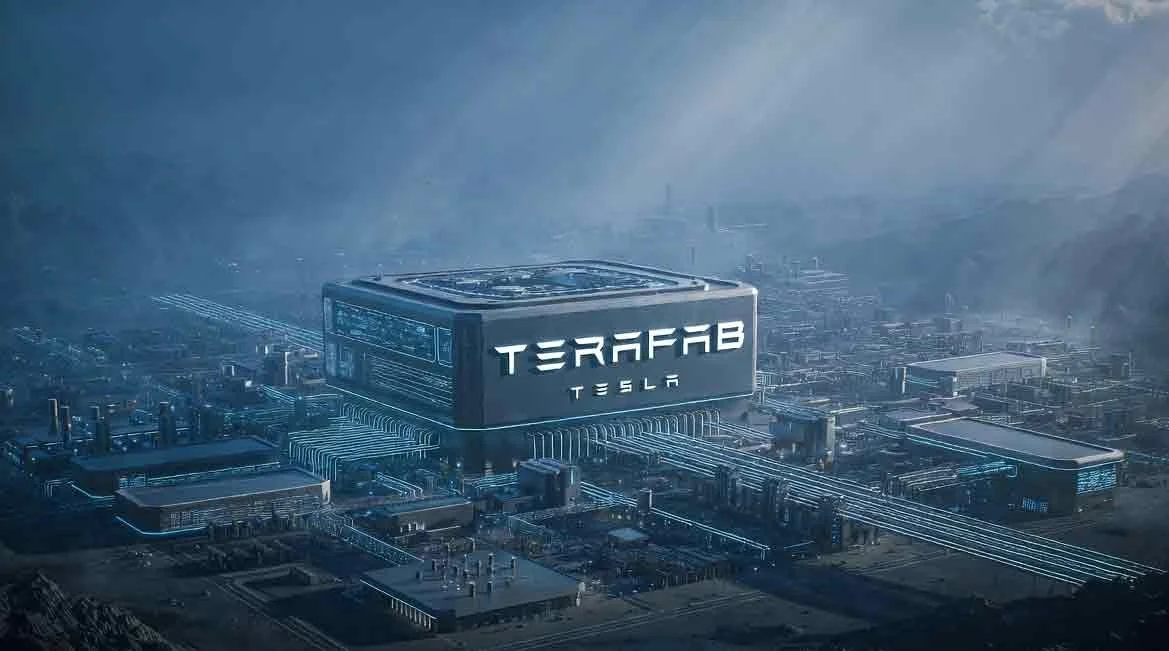
Elon Musk’s $25 Billion Chip Factory Is the Biggest Industrial Bet Ever Made
One Texas plant could crank out enough custom AI silicon to power a terawatt of compute—most of it headed to space—while rewriting the rules on design speed and efficiency.
A single factory under construction in Texas is preparing to manufacture custom AI chips at a scale that would consume more advanced semiconductor capacity than most nations currently possess. The project aims for 200 billion chips per year and one terawatt of annual compute power, with roughly 80 percent destined for orbital AI satellites launched by SpaceX. The real game-changer lies in how the factory compresses chip design cycles from months to weeks and uses advanced packaging techniques to stretch limited high-end lithography resources far beyond what traditional foundries achieve. This approach turns a seemingly impossible supply-chain bottleneck into a structural advantage for autonomous vehicles, humanoid robots, and space-based AI systems.
Key Takeaways
The factory starts at 100,000 wafer starts per month and scales to 1 million—roughly 70 percent of TSMC’s current worldwide output from all its plants combined.
Every two-nanometer chip relies on extreme ultraviolet lithography machines produced by a single company in a Dutch town of 45,000 people; global production sits at only 50 to 60 units per year, with every machine already spoken for years ahead.
In-house mask-making and rapid wafer runs shrink chip iteration cycles from three-to-four months down to one-to-two weeks, delivering five-to-ten times faster design progress than standard foundry loops.
Chiplet architecture limits expensive EUV usage to only the compute cores while sourcing memory and input/output dies on older, readily available nodes—boosting yields from 30-40 percent on monolithic dies to around 80 percent.
Custom inference silicon optimized specifically for Tesla workloads removes idle transistors, delivering major gains in power efficiency, latency, and cost—critical for extending robot runtime and lowering per-unit economics to $2 per hour of labor.
The strategy outsources heavy EUV volume work to existing foundries while owning the design-to-packaging loop, creating a compounding moat that widens each year as competitors remain locked into general-purpose chips.
Geopolitical risks around Taiwan and China’s slower EUV progress make localized, rapid-iteration capacity a strategic hedge for Western AI leadership.

Why Musk’s TeraFab Chip Factory Is Actually Insane
The lithography wall standing between today’s AI boom and tomorrow’s terawatt-scale future—and the clever paths that could smash through it.
Tesla’s TeraFab project isn’t just another factory announcement. It’s a direct assault on the single hardest problem in modern computing: turning raw silicon into the chips that will power millions of humanoid robots, autonomous vehicles, orbital AI constellations, and data-center-scale training clusters. The vision is breathtaking—terawatt-scale compute—but the physics and supply-chain math reveal why this might be the most ambitious manufacturing bet in tech history.
Key Takeaways
Cutting-edge EUV lithography machines are produced at a rate of only 50–60 per year worldwide, with plans to reach 100 by 2030—orders of magnitude short of what terawatt ambitions require.
Roughly 3.5 EUV machines are needed to sustain one gigawatt of advanced-chip output; scaling to terawatts implies a need for thousands of these machines cumulatively.
For inference-heavy workloads (robots, self-driving, satellites), mature 7 nm and larger DUV processes can be ramped far faster and with multiple suppliers, offering a practical near-term bridge.
Maskless alternatives such as multi-beam helium particle lithography promise finer features, dramatically faster design iteration, and long-term scalability beyond today’s photon-based limits.
Success hinges on a phased playbook: deep supplier partnerships for knowledge transfer, rapid internal R&D fabs, aggressive supply-chain acceleration, and AI-augmented engineering to compress decade-long timelines into years.
Taiwan's $10 Trillion Chip Crisis: Why Elon Musk Is Racing to Build His Own Semiconductor Empire
Global AI depends on one vulnerable island. Musk's Terra Fab could be the ultimate hedge—and a game-changer for Tesla and beyond.
The world's most advanced chips all come from one place: Taiwan. With China positioning forces for a potential takeover by 2027, the global economy faces a catastrophic risk estimated at $10 trillion in GDP losses in the first year alone. Yet amid this fragility, one leader is taking decisive action by investing tens of billions into domestic chip manufacturing independence. This move isn't just about one company—it's a signal of how tech giants are rethinking supply chains in an era of rising geopolitical tensions.
Key Takeaways
TSMC in Taiwan produces around 90% of the world's most advanced sub-7 nanometer chips, powering everything from AI systems to smartphones and defense tech.
China has directed its military to prepare for an invasion or blockade of Taiwan by 2027, with ongoing drills, incursions, and naval expansions increasing the pressure.
A disruption could wipe out $10 trillion from global GDP in year one—far exceeding the combined impacts of COVID-19 and the 2008 financial crisis—due to chip shortages crippling industries worldwide.
Tesla's new Terra Fab project aims for 2-nanometer process technology at massive scale, targeting production of hundreds of billions of custom AI and memory chips annually to support Tesla's autonomous vehicles, robots, and AI training.
This vertical integration strategy builds resilience against Taiwan risks while creating optimized, efficient silicon tailored to specific workloads in driving, robotics, and AI.
A broader "Sovereign AI" movement is underway, with countries and companies investing heavily in domestic chip and data center capacity to secure technological independence.
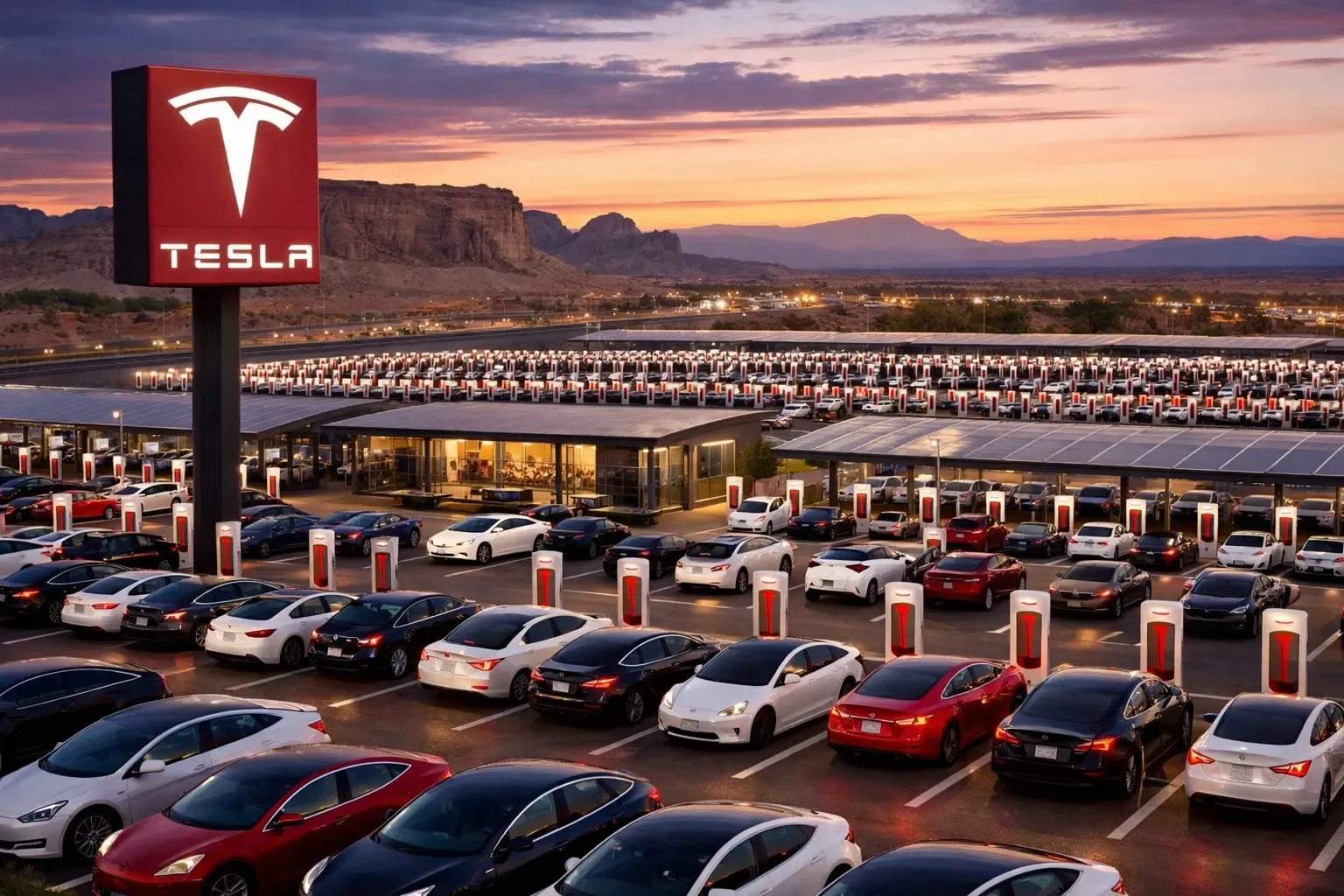
Tesla's Quiet Infrastructure Revolution: Off-Grid Chargers, Business Charging, and the AI Chip Moonshot
How Tesla is quietly building the backbone for massive energy + compute scale while the world debates geopolitics and AI backlash.
The most valuable signals right now aren't in the headlines. They're in the unglamorous but hyper-scalable infrastructure moves: massive off-grid Supercharger sites that double as potential compute nodes, a new program letting businesses host and price their own chargers, and the imminent kickoff of a gigantic in-house AI chip fabrication project. These pieces form the foundation for Tesla's energy storage dominance, fleet-wide inference, and independence from fragile global supply chains.
Key Takeaways
Tesla launched Supercharger for Business in mid-March 2026, allowing property owners to install and set pricing on Superchargers while Tesla handles hardware, software, maintenance, and network integration.
The massive Lost Hills "Project Oasis" station in California—164 stalls, 11 MW solar farm, 39 MWh battery storage—operates primarily off-grid and demonstrates a replicable model for high-utilization solar + battery sites that could host AI inference during low-EV demand periods.
Tesla's Terafab project launches March 21, 2026: a multi-billion-dollar effort to build a 2nm-class semiconductor fab targeting 100–200 billion custom AI chips annually for Dojo, vehicles, and distributed compute.
Geopolitical risks around Taiwan and advanced chip supply remain acute, but Tesla's vertical integration push reduces long-term exposure.
AI graphics breakthroughs like NVIDIA's DLSS 5 show photoreal neural rendering becoming mainstream, yet face cultural resistance that may be amplified by competing interests slowing U.S. AI progress.
Agentic AI tools (Claude Code, OpenRouter, local models) are already automating paperwork, development, and operations—shifting from scarcity to abundance mindsets in creative and professional fields.
Tesla's Bold Leap into Custom AI Silicon
Unlocking the future of autonomous vehicles, humanoid robots, and massive-scale AI training through a game-changing partnership.
Tesla has just sealed a massive partnership that could reshape the AI hardware landscape, positioning the company to control its destiny in chip production while boosting U.S. manufacturing. This move addresses supply chain vulnerabilities, cuts costs, and accelerates innovation in everything from self-driving tech to robotics.
Key Takeaways
Tesla's new AI6 chip aims to handle both AI training and inference on a single architecture, optimizing for vehicles, robots, and data centers.
A $16.5 billion deal with Samsung taps into a Texas-based fab for production, enhancing efficiency and reducing reliance on overseas suppliers.
This strategy mirrors past vertical integration successes, like battery production, to secure supply for ambitious AI goals.
Broader implications include strengthening U.S. chip manufacturing amid global tensions and fostering competition that drives industry-wide advancements.
The partnership leverages expertise from key engineers to create specialized hardware tailored to real-world AI demands.