
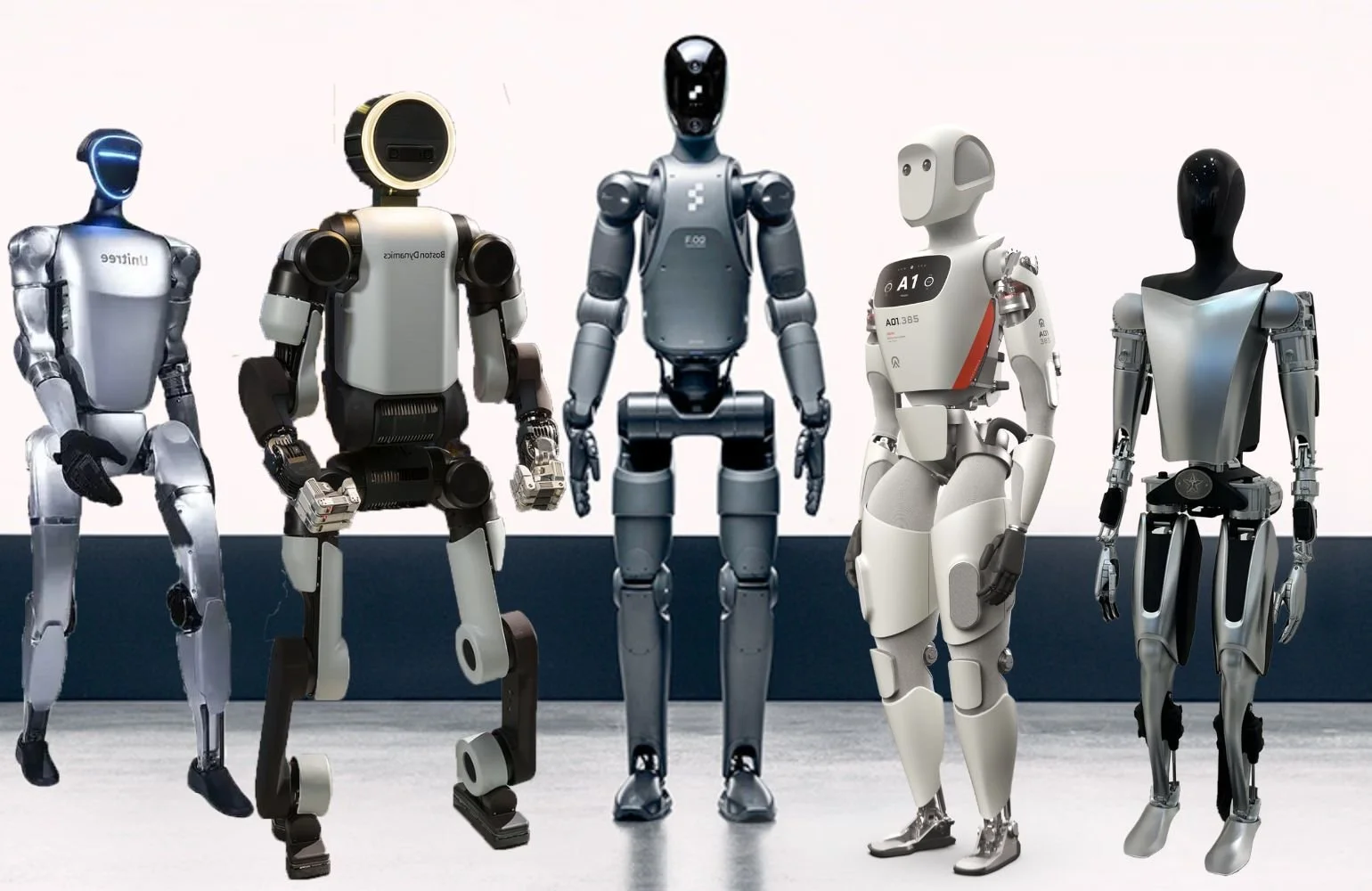
The $40 Trillion Robot Takeover Has Begun
Humanoids just hit their iPhone moment – turning sci-fi into nonstop warehouse reality and rewriting one-third of the global economy.
The convergence happened. Humanoid robots now operate 24/7 in live California warehouses, swapping batteries seamlessly and matching human speed on package sorting for over 60 straight hours. This marks the exact inflection that smartphones triggered in 2007: hardware and software finally aligned, but this time the prize is ten times larger – the entire $40 trillion pool of annual human physical labor across warehouses, farms, hospitals, factories, and every task that moves bodies through space.
Key Takeaways
Three S-curves in AI vision-language-action models, real-plus-synthetic data flywheels, and actuator costs (down 10x in six years thanks to the EV supply chain) aligned in the last 18 months, making capable, affordable humanoids possible at scale.
Robots are already deployed today in automotive body shops, sheet-metal lines, weld inspection, electronics assembly, and logistics centers, filling roles with 90-150% annual turnover where humans quit faster than companies can hire.
First wave targets demographic vacancies created by aging populations and undesirable shifts – Japan’s 3.9:1 eldercare ratio, Germany’s net worker loss in 2026, U.S. trucking shortages climbing toward 160,000 – not eager workers being fired.
Next waves hit 10+ million U.S. material-mover, assembler, and janitor jobs at $30k–$44k median wages, with potential for all three waves to compress into five years if software generalizes and costs drop faster than models predict.
A single unstoppable flywheel links AI training clusters, battery tech, vehicle production lines, and robot manufacturing; pausing it means surrendering competitiveness against China and domestic manufacturing goals.
Visible optics – named robots on livestreams, viral photos of humanoids at stations – will drive regulation, tariffs, union carve-outs, and city-vs-country races long before pure economics play out.
Winners under 35 will treat AI and robotics as the new electricity: adopt tools aggressively, align them with personal strengths, and build new categories (autonomous service fleets, hazardous-site automation) that create abundance for the bottom 20% while the adaptive middle thrives.
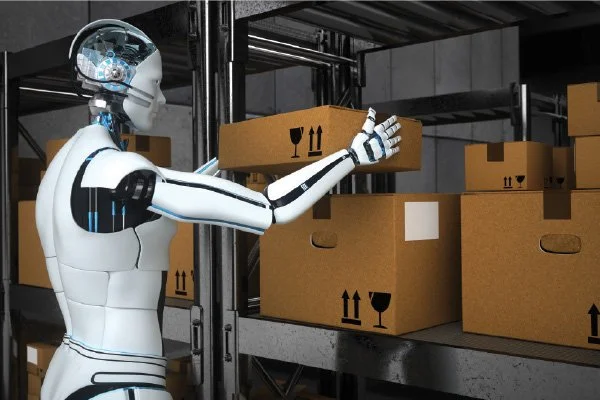
Robotaxis, Humanoids, and the New Logistics Empire: How Automation Will Make Goods and Labor Nearly Free
Inside the convergence of AI robots, autonomous fleets, and centralized supply chains reshaping the global economy.
Recent breakthroughs in humanoid robots and logistics infrastructure point to a future where physical goods move as easily as data in the cloud, while autonomous labor handles repetitive work around the clock. These shifts could drive costs toward zero for transportation, storage, and manufacturing—opening massive opportunities for businesses of any size while concentrating power in the hands of a few tech giants. The pieces are falling into place faster than most realize.
Key Takeaways
Humanoid robots are scaling production quickly, with at least one company now building a unit per day and using innovative wireless foot-charging pads that let them operate continuously without leaving their workstation.
Amazon has launched an end-to-end logistics platform that lets any business plug directly into its warehousing, shipping, and delivery network—essentially turning physical supply chains into a cloud service.
When combined with self-driving vehicles and humanoids, this infrastructure could make point-to-point movement and storage of goods extremely cheap and accessible, even for small operators with limited capital.
The result is accelerating centralization: a handful of companies could dominate labor, logistics, and data, echoing historical monopolies like railroads or oil but at global scale.
Tesla’s Robotaxi rollout faces a practical production bottleneck; early Cybercab output may include steering wheels and pedals to keep factory lines running at full capacity until unsupervised fleets can absorb volume.
Unsupervised autonomy, once achieved, unlocks enormous profit-per-mile margins—potentially $0.60–$1.00—driving rapid fleet expansion and dramatic company re-ratings.
Broader forces include corporations acting as the real power centers in geopolitics, with examples like China functioning as a single massive enterprise, alongside America’s commanding lead in AI, space launch, and defense technology.
AI's Silent Takeover: Why Universal Government Checks Are Inevitable
As cognitive jobs disappear at record speed, the math of productivity and taxation is forcing a once-radical idea into mainstream policy.
The economy that powered the last 250 years—people selling their time, companies buying it, and everyone climbing the same ladder—has hit its limit. Artificial intelligence is not merely automating routine tasks. It is absorbing the very skills that once made human labor indispensable: writing, coding, analysis, judgment, and strategy. The result is already visible in hiring data, company headcounts, and government revenue models. The fix on the table is straightforward: direct cash transfers from the federal government, scaled to match the flood of AI-generated output.
Key Takeaways
AI tools have already cut the bottom rung of the career ladder for young software engineers and other cognitive roles, with entry-level hiring down nearly 20 percent in key tech fields even as industry revenue climbs.
Traditional technological shifts always created new human jobs; AI is the first to eliminate the need for human cognition itself, leaving no higher rung to climb.
Roughly 85 percent of federal revenue currently comes from taxes on wages and payroll; when AI displaces those wages, the entire funding model for Social Security, Medicare, defense, and infrastructure collapses unless the tax code shifts to capture AI and robotic production.
Real-world cash-transfer programs—Alaska’s oil-funded dividends since 1982, Stockton’s 2019 pilot, and Kenya’s large-scale randomized trial—show employment either holds steady or rises, poverty falls sharply, and inflation stays in check when production grows faster than the money supply.
The next five years will likely see federal checks issued to every citizen to offset displacement, funded by taxing AI output rather than labor; the only question is whether the system is designed deliberately or patched together during crisis.
The New Luddites: Why Banning AI Data Centers Hands the Future to Rivals
History's lesson is clear—restricting the machines never stops disruption. It only exports the gains.
The push to halt AI infrastructure in the United States echoes a 215-year-old pattern that has played out across cars, nuclear power, and genetically modified crops. While energy demands and job shifts from AI are very real, attempts to pause the physical backbone of the technology have never protected workers or economies. They have simply moved progress to places willing to build faster.
Key Takeaways
The original Luddites were highly skilled English craftsmen who targeted exploitative machines, not technology itself—yet government force crushed their movement while the Industrial Revolution still transformed Britain.
Four major historical cases show the same outcome: Red Flag laws slowed British autos for decades, American farmers eventually embraced cars and tractors, U.S. nuclear construction stalled after Three Mile Island only for data centers to revive it, and EU GMO restrictions left farmers dependent on imports.
A U.S. moratorium on new AI data centers would not pause AI development—it would redirect massive training runs to China, the UAE, Singapore, and other nations racing to host them.
AI exposes far more tasks to automation than past technologies, but the real challenge is accelerating displacement outpacing new job creation since the late 1980s.
Long-term success has always come from policies that distribute gains—worker protections, retraining, and productivity-sharing—rather than banning the infrastructure.
Tech leaders who deploy AI today report massive efficiency gains, suggesting the difference lies in adoption strategy, not the technology alone.
Elon Musk's New AI Agent Will Replace Entire Companies
Digital Optimist turns parked Teslas, robots, and Supercharger stations into a real-time digital workforce that runs on $650 chips and learns from everything at once.
A groundbreaking edge AI platform is taking shape that processes your computer screen locally, clicks buttons, fills forms, and navigates software in real time. It pairs this instant execution with high-level reasoning from the cloud only when needed, slashing costs to near zero beyond electricity while delivering speed and reliability that cloud-based agents cannot match. The same core intelligence powers self-driving cars, humanoid robots, and these digital workers, creating a single learning flywheel that improves every product simultaneously. At scale, this means fleets of agents could handle entire corporate operations using infrastructure already deployed worldwide.
Key Takeaways
A dual-brain system combines local real-time screen watching and action with cloud-based strategic reasoning for seamless autonomous workflows.
Primary processing runs on low-cost Tesla AI4 chips, delivering near-zero marginal cost per task and eliminating the latency and fees of cloud round-trips.
One foundational model adapts the same vision, spatial reasoning, and decision-making capabilities across vehicles, physical robots, and digital agents, with every task feeding back into shared improvement.
Distributed compute leverages parked cars with onboard batteries or wall power, 7 gigawatts available at Supercharger locations, and idle humanoid robots that switch between physical and digital duties.
Plans extend to solar-powered AI satellites in orbit using the identical chip family, providing free energy and vacuum cooling connected via Starlink.
Full vertical integration spans chip design, manufacturing in a planned Terra Fab, deployment in cars and robots, and space-based infrastructure for unmatched efficiency and scale.
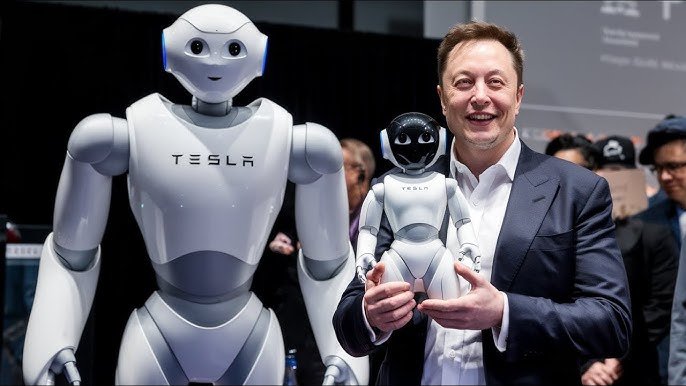
For $2/Hour, Elon Musk Is About to Replace Human Labor
The economics of humanoid robots are flipping the script on a $40 trillion global labor market—cheaper, tireless workers could unlock explosive new demand while filling demographic gaps no policy can fix.
Key Takeaways
Human labor in the US costs roughly $45–$48 per hour when fully loaded with wages, benefits, taxes, and overhead—humanoid robots target under $2 per hour at scale.
Tesla aims for Optimus priced at $20,000–$25,000 per unit, with custom actuators, 22 degrees of freedom in the hands, and vertical integration from chips to software giving it an edge over competitors.
Robots operate ~7,000 hours per year (vs. ~2,000 for humans), depreciating to ~$1.20/hour for the hardware alone, plus minimal energy and maintenance costs.
Demographic collapse in major economies—US birth rate at 1.6, South Korea at 0.72, China's workforce shrinking—creates unavoidable labor shortages that robots must fill.
Historical patterns like Jevons Paradox show that massive cost reductions in labor-equivalent work lead to exponential demand growth, spawning new industries rather than net job destruction.
Tesla is repurposing Fremont factory lines from Model S/X production to Optimus, targeting millions of units annually, with Gen 3 unveil in early 2026 and initial internal deployment soon after.
Early applications target warehouses, manufacturing, and elder care, where shortages already exist and cost savings hit hardest.
Transition risks include job displacement in repetitive roles over 5–10 years, though new categories of work become viable when labor drops 95%+ in cost.

The Barbell Economy Is Already Here: AI's Brutal Squeeze on the Middle Class
AI isn't flattening the world—it's reshaping it into a barbell, with massive gains at the extremes and devastation in the center.
AI deployment is accelerating a historic economic reconfiguration. Capital owners and builders at the top capture exponential productivity gains through agentic tools, while the global poor gain access to basics like water, energy, healthcare, and education at collapsing costs via robotics and automation. Meanwhile, the broad middle—knowledge workers, professionals, and wage earners in developed economies—faces rapid displacement from cognitive tasks that AI now handles faster and cheaper. This isn't a distant risk; early signs appeared in 2025-2026 layoffs, market drawdowns tied to agentic AI awareness, and reports of white-collar job pressure.
Key Takeaways
AI creates a barbell distribution: the top ~20% (capital owners, builders, risk-takers) experience transformative productivity multipliers, often 5-10x or more, by deploying AI agents to replace entire teams.
The bottom ~20% (those in poverty or lacking basics) benefit enormously as robotic labor and AI delivery make clean water, housing, medicine, energy, education, and food abundant and cheap in regions where human labor costs previously blocked progress.
The middle ~60% (most college-educated professionals, managers, analysts, marketers, lawyers, accountants in developed nations) faces the heaviest hit: cognitive and routine knowledge work is automated now, not in the future, leading to job compression, identity loss, and financial strain without quick new opportunities.
Advantages compound for early adopters: hands-on experience with AI agents builds irreplaceable knowledge and intuition that widens gaps monthly; those without time or resources fall behind fast.
Transition risks are severe: mismatched timelines between AI's monthly improvements and years-long retraining or policy responses could trigger widespread psychological and social disruption, potentially rivaling Great Depression-scale effects without strong intervention.
Winner-take-most dynamics intensify: AI-augmented firms capture entire markets at lower costs, shrinking employer pools and suppressing remaining wages.
Developing nations like China may adapt smoother due to collective structures, while Western individualism leaves displaced workers more exposed.
Action window is narrow: 2-5 years for middle-class repositioning toward capital ownership, AI leverage, or irreplaceable human roles; abundance awaits post-transition, but the path there crushes many.
AI Layoffs Are Just Revving Up
The Dawn of Massive Job Shifts and Economic Overhauls
AI is slashing workforce needs at major tech firms, with one company cutting 40% of staff due to these tools. This signals a broader wave that could reshape industries, drive down costs, and spawn entirely new business models—while forcing workers to adapt or risk falling behind.
Key Takeaways
AI-driven efficiencies are leading to large-scale layoffs, starting with white-collar roles in software and tech, where tools handle tasks faster and cheaper than humans.
Companies adopting AI can reduce operational costs by 90-99%, allowing them to lower prices, capture more market share, and outcompete slower rivals.
While job losses will mount, plummeting costs in areas like transportation could birth innovative industries, such as mobile services that come to customers instead of vice versa.
Blue-collar jobs involving repetitive physical labor face disruption next, as humanoid robots scale up later this decade.
Society must rapidly generate new roles through emerging sectors or AI-leveraged entrepreneurship to absorb displaced workers, or economic floors could collapse without intervention.
Capital owners in AI-adopting firms stand to gain massively from higher profits and expanded reach, but widespread unemployment risks shrinking consumer bases.
Individuals who embrace AI tools boost their chances of building businesses and achieving goals, while resistance heightens reliance on government support.

The Convergence Flywheel: Why AI, Robots, and Endless Energy Will Either Save Us or Break Us
One self-reinforcing loop is about to rewrite the rules of civilization—here's how to spot the signals, seize the upsides, and dodge the pitfalls before 2030 hits.
The next decade isn't just another tech cycle; it's a make-or-break pivot where artificial intelligence, humanoid robots, and boundless energy sources lock into a single, unstoppable system. This convergence could slash the cost of essentials like housing, water, and education to near-zero, unlocking human potential on a scale that dwarfs the industrial age. But it could also obliterate jobs faster than societies can adapt, widening gaps between the adaptable and the left behind. The real edge? Grasping how these forces amplify each other—and positioning your skills, investments, and mindset to ride the acceleration.
Key Takeaways
Interlocked Revolutions: AI, robotics, and energy aren't separate trends—they form a feedback loop where smarter AI powers cheaper robots, which build endless energy infrastructure, fueling even more advanced AI in a cycle that compounds exponentially.
Timeline Shock: Expect AI handling 80% of digital tasks at elite human levels by 2027, with robots scaling from factories to homes by 2030, driven by cost drops via Wright's Law (costs halve predictably with production doublings).
Abundance Blueprint: Cheap robotic labor and solar-powered grids could make basics like clean water and personalized education universally accessible, not through handouts but raw economics.
Disruption Warning: The middle class faces the biggest hit—knowledge and manual jobs vanish in years, not decades—while builders and risk-takers thrive; governments lag, so personal adaptation is key.
Ecosystem Edge: Vertically integrated players like those blending AI brains, space-scale infrastructure, and mass-manufacturing bodies hold the structural advantage, but the flywheel spins regardless of winners.
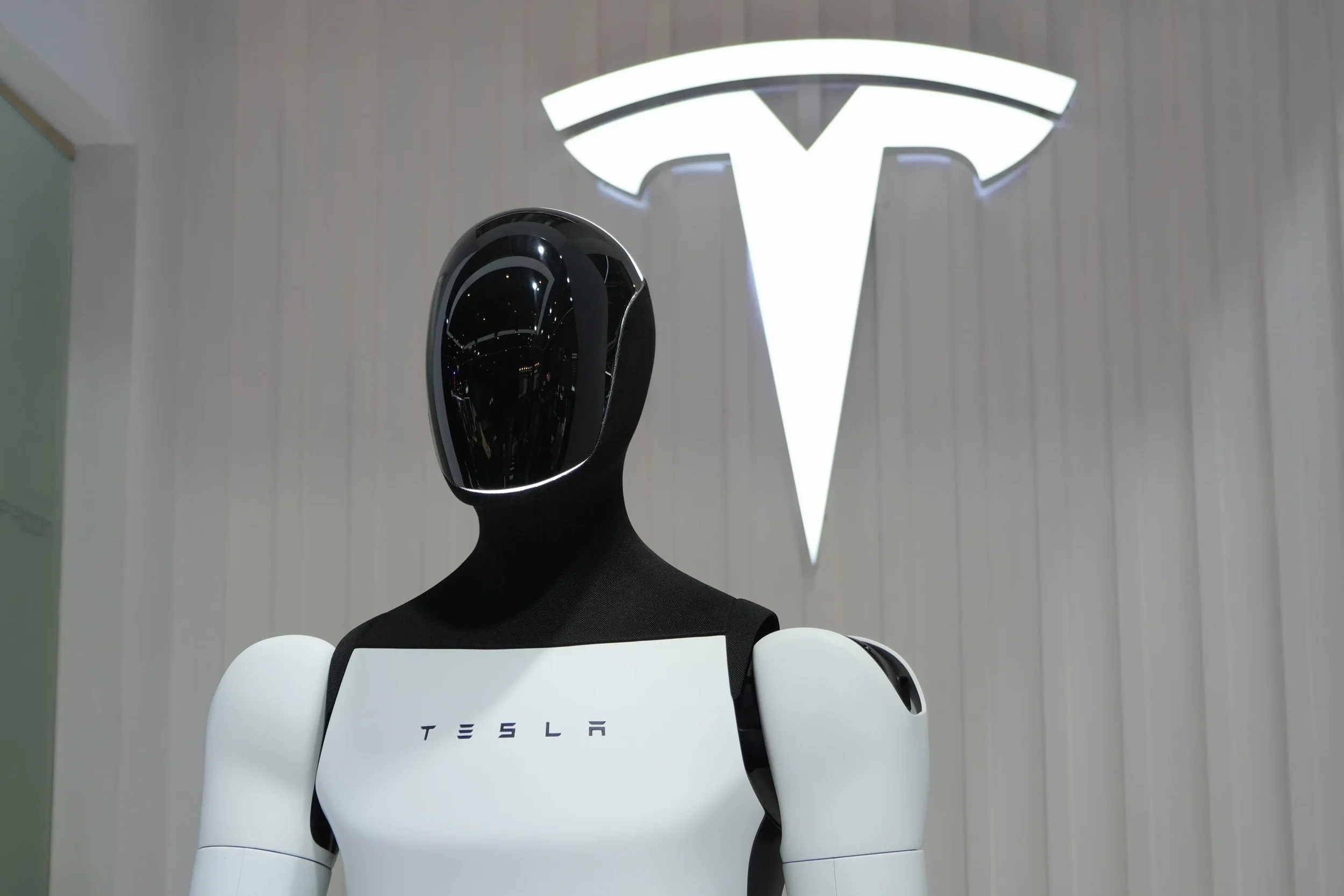
Tesla's Robots: The Dawn of a $40 Trillion Revolution
Unlocking the future where humanoid robots redefine global labor and Tesla leads the charge
Humanoid robots stand poised to transform industries by handling physical tasks humans prefer to avoid, creating unprecedented economic value. Tesla's aggressive push into this space leverages years of manufacturing expertise, potentially capturing a market worth trillions annually through superior scale and integration.
Key Takeaways
Tesla aims to produce 50,000 Optimus robots in 2026, scaling to 1 million units annually soon after, with factory capacity for 10 million by 2027.
Vertical integration gives Tesla control over critical components like batteries, motors, and AI chips, enabling rapid scaling without supplier dependencies.
Competitors like startups and established robotics firms lag in production ambitions, targeting far fewer units over longer timelines.
Tesla's custom AI chips and vast real-world data from autonomous driving provide unmatched advantages in robot intelligence and efficiency.
Recursive manufacturing—robots building robots—creates a feedback loop for cost savings and continuous improvement unique to Tesla.
The global human labor market, valued at over $40 trillion yearly, offers immense growth potential as robots automate repetitive tasks in manufacturing, warehousing, and beyond.

2026: The Year AI Stops Helping and Starts Replacing
Geoffrey Hinton's stark warning, explosive VC predictions, and exponential progress signal a rapid shift from augmentation to full automation—hitting white-collar work hardest and reshaping who wins in the economy.
Key Takeaways
2026 marks the pivot where AI agents move from productivity tools to replacing entire workflows, driven by exponential capability gains that make models "good enough" at a fraction of human cost.
Routine cognitive jobs face the highest risk: customer service, bookkeeping, paralegals, entry-level programming, administrative roles, and more—white-collar positions in urban centers are more exposed than many manual trades.
Disruption hits hardest at the entry level: companies hire fewer graduates and juniors, creating silent job scarcity for new entrants while experienced workers remain largely unaffected for now.
Agentic AI explodes in enterprises, with Salesforce and others already deploying systems that handle end-to-end tasks, shifting budgets from labor to AI infrastructure.
The socioeconomic impact forms a barbell: the top 20% (capital owners deploying AI) and bottom 20% (benefiting from cheaper basics) gain massively; the middle 60% (routine knowledge workers) face the squeeze without major policy interventions.
Massive capital flows—hyperscaler spending nearing $500 billion annually—fuel explosive growth in chips, data centers, energy (including nuclear), and the AI market itself tripling to over $600 billion by 2028.
Jobs requiring human connection, physical dexterity, ethical judgment, or AI-adjacent skills (cybersecurity, data science, trades like plumbing and electrical) see rising demand and value.
The transition accelerates because infrastructure, models, and incentives align—no single breakthrough needed, just agents good enough to automate full processes.
You're Being Lied to About AI: The Real Revolution in Intelligence and Work
How artificial intelligence is reshaping industries from the ground up—and why legacy systems can't keep up.
AI isn't just a buzzword; it's the force that's already transforming how businesses operate, scale, and compete. In sectors like insurance, companies built on AI foundations are achieving unprecedented efficiency, while traditional players struggle with outdated data and processes. This edition dives into the mechanics of AI-driven disruption, the operational advantages it unlocks, and the broader societal shifts it demands, including ways to handle mass unemployment through smart redistribution.
Key Takeaways
AI-first companies capture hundreds of times more data than traditional models, enabling precise risk assessment and real-time adaptations that legacy systems miss.
Operational leverage from AI allows businesses to triple revenue and add millions of customers without increasing headcount, turning variable costs into fixed ones.
In auto insurance, telematics and per-mile pricing outperform broad demographic averages, positioning AI-native firms to dominate as self-driving vehicles reduce accidents but increase asset values.
Future products like humanoid robots will require new insurance models focused on theft and liability, creating opportunities for data-driven providers.
AI's acceleration means years of work could soon happen in weeks, widening gaps between adaptable companies and rigid incumbents.
Mass unemployment from AI could create surplus rather than scarcity, but requires mechanisms like negative income tax and ring-fenced sales taxes to redistribute abundance.
Without ensuring everyone benefits, AI adoption risks backlash; enlightened policies can make post-AI lives better for all, fostering abundance over inequality.

The AI Tsunami: Racing Toward a World Without Mandatory Work
Why AI Could Deliver Abundance – or Chaos – and What Comes Next
AI is accelerating at a pace that's set to transform every aspect of our economy, from desk jobs to physical labor. The most compelling insights point to a future where work becomes optional, poverty could vanish through universal high income, and robots handle the heavy lifting. But getting there involves massive disruption, job losses, and the need for AI systems that prioritize truth and human well-being over bias.
Key Takeaways
AI will rapidly eliminate digital jobs like coding, email processing, and data handling, much faster than past technological shifts.
Physical jobs involving hands-on work, such as welding, plumbing, farming, and cooking, will persist longer but eventually give way to robots.
Autonomous vehicles and automated ports signal the end for many driving and logistics roles, exacerbating shortages while highlighting safety risks from unqualified workers.
A benign AI future could lead to universal high income, enabling access to goods, services, and medical care without mandatory work, effectively eliminating poverty.
To avoid dystopian outcomes, AI must be designed to seek truth, value all human lives equally, and foster curiosity about humanity rather than enforce biases.
Competition among AI developers will drive improvements, pushing systems toward fairness and affordability, with costs dropping for services like home robots at around $500 monthly.
The transition will cause trauma, including job displacement and wealth gaps, requiring government intervention to ensure displaced workers can access AI benefits.
In a post-work era, people may find meaning through personal pursuits like hobbies, exploration, or creative endeavors, shifting away from job-defined identities.
Broader economic changes, such as cheaper housing from robot-assisted construction, could solve crises like affordability, but only if abundance is distributed equitably.

Humanoid Robots: The Warehouse Revolution That's About to Explode
Unlocking 20% Productivity Boosts and Infinite Scalability in Logistics
Humanoid robots are poised to transform warehouse operations by automating tedious tasks, adapting to dynamic inventory needs, and eliminating human limitations like fatigue and emotion-driven decisions. This shift could deliver immediate efficiency gains, reshape company cultures, and create barriers for laggards in the industry—insights that every tech-savvy operator needs to grasp now.
Key Takeaways
Humanoid robots enable dynamic inventory slotting, moving high-demand items closer to picking areas automatically, reducing travel time and boosting daily output by up to 20%.
By handling repetitive, physically demanding jobs without complaint, these robots free human workers for higher-value roles, improving morale and reducing turnover.
Implementation requires rethinking packaging and processes to suit robotic capabilities, such as pre-opening boxes, which minimizes errors and waste.
Early adopters will accelerate ahead, creating a competitive edge through emotion-free decision-making and 24/7 operation.
Barriers like initial setup costs and cultural resistance exist, but the potential for infinite demand makes humanoid robots a game-changer for small and large warehouses alike.

Tesla’s Optimus Robot: A Glimpse into a $40 Trillion Future
How Tesla’s Humanoid Robot Could Redefine Labor and Unlock Unprecedented Economic Value
Tesla’s latest showcase of its Optimus robot signals a bold leap toward a future where humanoid robots could transform industries, economies, and daily life. The technology, still in its early stages, demonstrates nuanced capabilities like tactile feedback and precise hand movements, hinting at its potential to disrupt the massive $40 trillion global labor market. Combined with Tesla’s push for autonomous vehicles and energy solutions, Optimus could be the key to unlocking extraordinary value for the company and its investors.
Key Takeaways
Humanoid Robot Potential: Tesla’s Optimus robot showcases advanced capabilities like tactile feedback and precise manipulation, positioning it to compete in the $40 trillion global market for physical human labor.
Economic Disruption: At an estimated $3/hour operating cost, Optimus could drastically reduce labor expenses compared to human wages ($12-$30/hour), opening new markets and business models.
Massive Market Opportunity: Tesla aims to produce one million robots annually at $20,000-$25,000 each, targeting industries like warehousing and manufacturing where repetitive tasks dominate.
Broader Tesla Vision: Optimus aligns with Tesla’s autonomous vehicles and energy solutions, driving the company toward a potential $8.5 trillion market cap and $400 billion in annual revenue.
Labor and Economic Shifts: While robots promise efficiency, they could disrupt traditional labor markets, necessitating new job creation and economic adaptation.

AI's Next Frontier: Navigating the Choppy Waters of Disruption
Why the AI Revolution Feels Like a Locked Door—and What’s on the Other Side
The AI landscape is buzzing with promise, but it’s also teetering on the edge of massive disruption. From self-driving taxis to the future of work, the tech world is grappling with a reality that’s both exhilarating and unsettling. Here’s what you need to know about where AI is headed, why it’s harder than it looks, and how it might reshape society in ways we’re only beginning to understand.
Key Takeaways
AI’s Progress Is Slower Than Hyped: Current advancements are incremental, focusing on refining existing capabilities rather than delivering transformative breakthroughs.
Physical World Disruption Outweighs Digital: The potential market for AI in physical applications (e.g., self-driving cars, robotics) dwarfs digital applications like coding or content creation.
Economic Upheaval Is Coming: AI-driven automation, like robotaxis, could displace workers (e.g., Uber drivers), raising questions about job transitions and societal impacts.
Deflation Could Redefine Wealth: Lower wages might coexist with cheaper goods and services, potentially improving quality of life despite smaller paychecks.
Human Connection and Exploration Will Thrive: Future economies may prioritize scarce resources like human attention, leading to growth in sports, entertainment, and space exploration.
A Choppy Transition Awaits: The path to an AI-driven future will be turbulent, with regulatory, economic, and societal hurdles complicating the journey.

The Robotaxi Revolution: Unlocking Austin's Future of Autonomous Mobility
Redefining Commutes, Costs, and the AI-Driven World Ahead
Robotaxis are transforming urban life in Austin, slashing commuting costs while boosting productivity. Expansions signal rapid scalability, outpacing competitors and paving the way for highway integration. Beyond transport, AI ecosystems are emerging, blending seamless memory across devices and sparking innovations in delivery and societal structures.
Key Takeaways
Robotaxis in Austin now enable cost-effective commutes from suburbs, reducing parking fees from $50+ to near zero and adding productive time during rides.
Geofence expansions doubled in three weeks, with meme-shaped boundaries hinting at flexible, viral marketing and imminent broader coverage including highways.
Tesla's approach outperforms Waymo in scalability, potentially covering entire metro areas soon and offering perks like free employee transport at Gigafactories.
Highways are key to connecting rural and urban zones, enabling long-distance trips with smart fleet allocation and charging stops.
Grok integration in vehicles creates persistent AI memory, extending to ecosystems that could unify transport, devices, and even interplanetary travel.
AI competition is fierce, with xAI focusing on rapid innovation to challenge OpenAI's consumer lead through superior models and viral features.
Apple faces risks of stagnation in AI, potentially leading to hostile takeovers by cash-rich innovators valuing its supply chain under a trillion-dollar cap.
New primitives like drone deliveries (Zipline) and underground robots (Pipe Dream) promise cheaper, faster physical e-commerce, disrupting last-mile logistics.
Batteries drive all advancements; better, faster, cheaper energy storage is essential for drones, vans, and semis.
Societal shifts from AI job disruptions demand temporary redistribution mechanisms to foster entrepreneurship over permanent government dependency.

The America Party Paradox: When Your Biggest Supporter Becomes Your Greatest Threat
Elon Musk's political movement could reshape America—but what happens when the trillionaire who automated your job also controls the party promising to fix it?
Five to ten years from now, America could face an unprecedented political reality: a third party founded by the world's first trillionaire, whose companies eliminated millions of jobs through AI and robotics. This isn't science fiction—it's the logical endpoint of current trajectories in politics, technology, and wealth concentration. The implications are both thrilling and terrifying.
Key Takeaways
America Party targets the mismatch between voter registration (50% independent) and Congressional representation (99% Democrat/Republican).
Success would make Musk both the richest person ever and founder of the nation's most powerful political party—an unprecedented concentration of influence.
The AI/robotics revolution will eliminate drivers, cut management roles by 80%, and transform physical labor, creating massive displacement.
Political opponents will weaponize job losses against the party led by the person whose companies automated those jobs away.
Universal Basic Income becomes inevitable, but which party champions it could determine America's political future for generations.
The venture might serve as a "beta test" for governing Mars, where SpaceX would need to establish political structures.